

The power of the argument: truth is born in dialogue, not a megaphone
Why real argument is a shared search for truth rather than a fight to win, and why we forgot how to argue just when arguing became easiest.
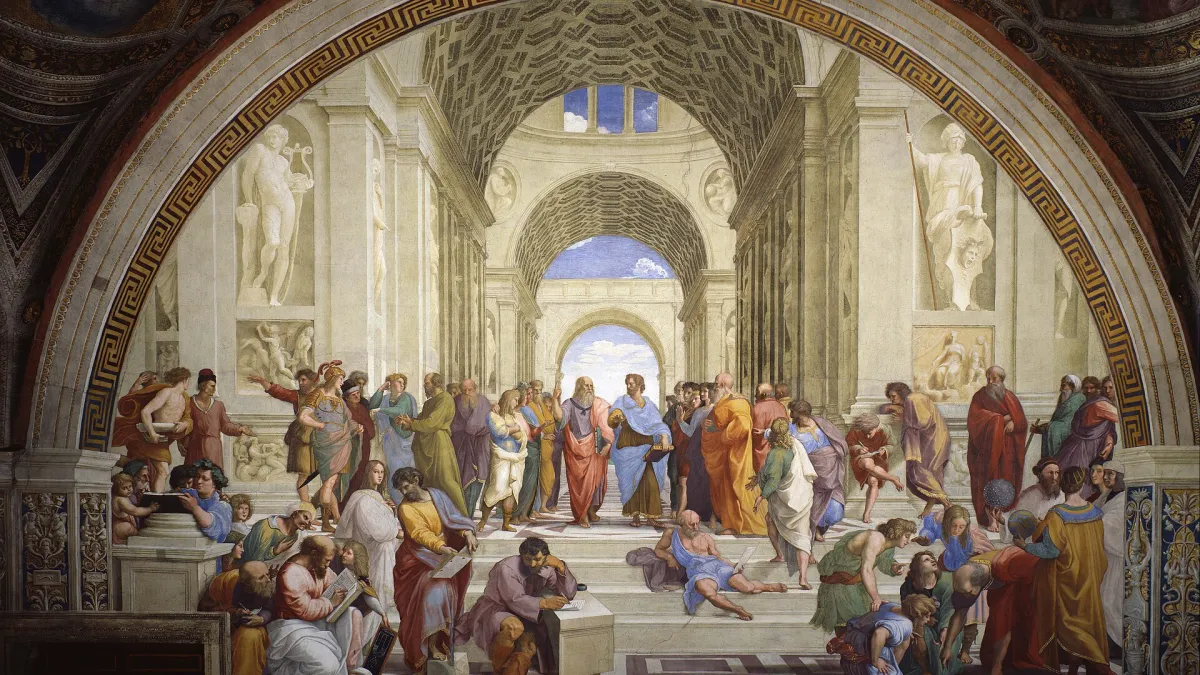
In Raphael’s fresco, philosophers who disagreed on much in life are gathered under one roof. At the center, Plato and Aristotle argue with gestures: one points to the sky, the other to the earth. This is the very image of healthy thought: different truths standing side by side, not annihilating one another.
Arguing to find is not the same as arguing to win
There are two entirely different activities we call by one word, “argument.” The first is a joint attempt to draw nearer to truth, where an opponent helps you see your blind spot. The second is a battle of egos, where the point is not to understand but to win. The first makes both wiser; the second, both dumber and angrier. The ancient Greeks called the art of the first “dialectic” and considered it the summit of the mind. We more often practice the second and call it “standing our ground.”
Doubt is not weakness but a tool of thought
We are used to admiring the person who is “always certain.” But certainty can be bought cheaply, at the price of foolishness: the less you know, the less you doubt. A real thinker is not afraid to say “I may be wrong” — not because he is weak, but because he seeks truth, not applause. The ability to doubt your own rightness is not a crack in your convictions but a window through which light enters them.
“The unexamined life is not worth living.”
— Socrates
My opinion: in a world where argument has become shouting-over and disagreement a reason for hatred, the ability to argue calmly and on the merits has become an almost lost art. Yet it is precisely this that separates a society that thinks from a crowd that simply shouts louder. Learn to argue in a way that lets you shake hands afterward. For the goal of a conversation is not to silence the other, but to see together a little more than each saw alone.
Cover: Raphael, “The School of Athens” (1511).
Comments (0)
Log in to leave a comment →
No comments yet. Be the first.