

The pipeline became the front line: why infrastructure is struck instead of armies
In one week: a desalination plant in Kuwait, a grain ship off Odesa, and tankers loading Kazakh oil at Novorossiysk. One method used by four different belligerents — and what it means for a country at war with nobody.
This week the same thing, in substance, happened in four different places in the world.
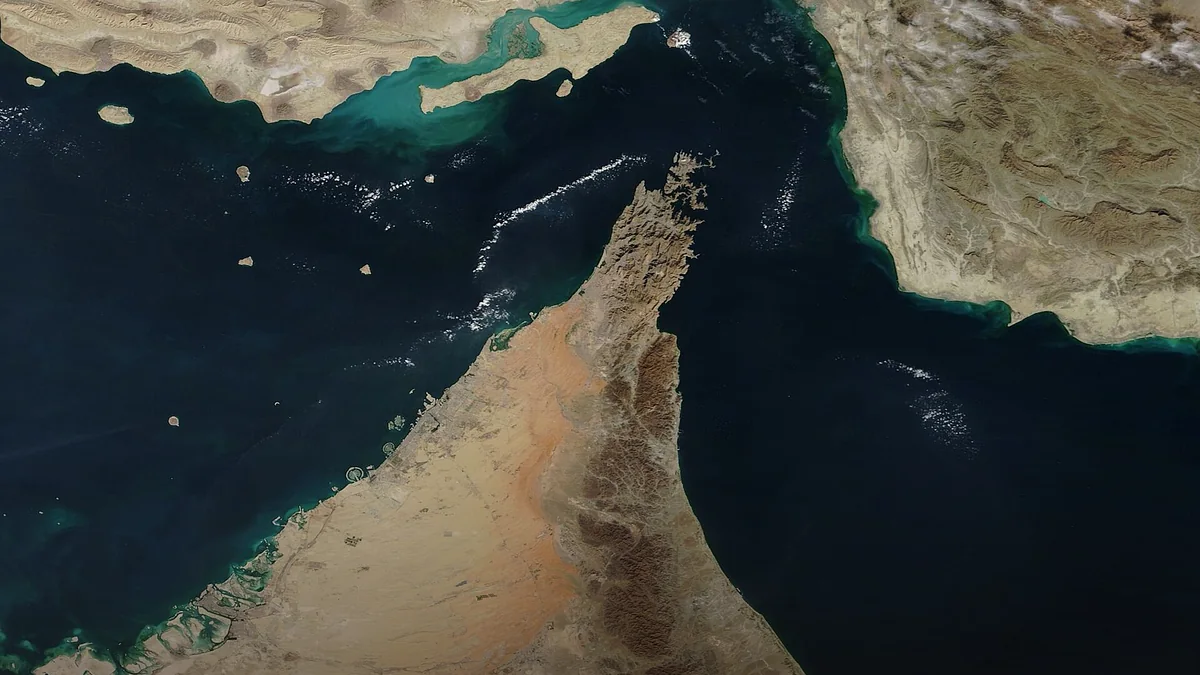
On 17 July Iran attacked a power station and desalination plant in Kuwait. Crude transit through the Strait of Hormuz fell 62%, to 4.1 million barrels a day. On 19 July Russia launched the largest ballistic attack of the war on Kyiv — 41 missiles and 125 drones; the next day a missile hit a ship carrying corn near Odesa. On 17, 19 and 20 July drones struck tankers at the marine terminal of the Caspian Pipeline Consortium at Novorossiysk — the terminal through which roughly 80% of Kazakhstan’s oil exports pass.
Four different belligerents. One method: strike the infrastructure, not the army.
Why this is a new norm, not a coincidence
Infrastructure has been destroyed in every war. What is new is something else: it has become the primary target rather than a secondary one — and the objects struck belong to formally neutral parties.
A desalination plant in Kuwait is drinking water in a desert monarchy that is not party to the conflict. The grain ship off Odesa was carrying food to third countries. The tankers at Novorossiysk were loading the oil of Kazakhstan, a state at war with nobody.
The logic here is cold and, unfortunately, effective. Attacking infrastructure is cheap: a drone costs incomparably less than the damage it causes. It is hard to attribute: the terminal is damaged, but who exactly and on whose orders is a question that can be disputed for months. And it strikes third parties, who then press the belligerents — turning neutral countries into an instrument of leverage.
Kazakhstan as the pure case
Of the four examples the Kazakh one is the most telling, because it contains nothing that could be called participation.
The country supplies no weapons, belongs to no bloc, fights nobody. And yet its main export artery — a 1,510-kilometre pipeline from Tengiz to Novorossiysk — runs into a port that has become a battlefield. Loading was suspended twice in four days. Throughput at the terminal fell over the half-year from 36.0 to 33.4 million tonnes. The attacks are not new: November 2025, January 2026, now July. Losses from the January strikes alone were put at $1.5 billion.
On 19 July Kazakhstan’s Foreign Ministry issued a statement. In form it is firm: it “strongly condemns,” demands an immediate halt, security for export infrastructure and full compensation under international law.
And it names no party at all. It speaks of “UAV attacks” — with no subject.
What the silence is about
I do not read this as cowardice, and it matters to me to explain why.
A country whose oil leaves through one neighbour’s territory, whose main market is another neighbour, and whose producing fields are operated by Western companies has an extremely narrow range of things it can say. To name the attacker is to choose a side in a war in which Kazakhstan has neither an interest nor any means. To say nothing is to concede that its property can be struck with impunity.
A statement without an addressee is an attempt to pass between the two. It records the damage and the demand for compensation without creating a new enemy.
But that position has a price, and it should be said out loud. A demand addressed to nobody is fulfilled by nobody. Compensation under international law cannot be recovered from an unnamed party. In practice the statement is addressed not to the attacker but to the country’s own population and partners: look, we responded.
It is also telling that Kazakhstan almost simultaneously asked the United States and Europe to help secure its oil transport. That is no longer rhetoric but an admission: the country has no instruments of its own and is looking for them abroad.
Why there is no alternative route
The natural question: why not send the oil around?
Because there is nothing to send it around by. The Middle Corridor across the Caspian moved roughly 4.5–4.7 million tonnes in 2025 — against some 70 million tonnes of Kazakh oil exports. That is not an alternative; it is one and a half per cent of the problem.
Worse, the corridor has a physical limit that is rarely discussed. The Caspian is falling by about 30 centimetres a year. Ferry traffic on the Baku–Kuryk route has already contracted 22%, wagon transport 10%. Carnegie’s analysts write plainly of “hard bottlenecks and likely a limited shelf life.”
The pipeline to China does not save the situation either: Atasu–Alashankou has run far below capacity for years, around 1.2 million tonnes in 2024. In December 2025, after the strike on the CPC, Kashagan crude was sent that way for the first time — fifty thousand tonnes. A symbolic quantity.
What follows
First. Transit dependence is neither logistics nor economics. It is the limit of sovereignty. A country with one route for 80% of its exports conducts foreign policy independently exactly to the degree permitted by whoever owns that route and whoever is able to strike it.
Second. Route diversification has stopped being a subject for sectoral meetings and become a national security question. And it needed solving ten years ago: infrastructure is built more slowly than the situation changes.
Third, and more general. If striking someone else’s infrastructure works — and it does, because it is cheap, poorly attributable and applies pressure through third parties — the method will be repeated. Not only in these wars and not only by these participants.
My view
A world in which people fight with pipelines, ports and desalination plants is worse-built than a world in which they fight with armies. In a war of armies there is a front, and it runs somewhere. In a war of infrastructures there is no front: it is wherever a pipe is laid, a plant stands, or a grain ship sails.
For Kazakhstan this yields a conclusion that is unpleasant to formulate and important to understand. Neutrality protects you from taking part in a war. It does not protect you from its consequences. You can be nobody’s enemy and still lose money every week, because your oil is loaded in a port over which drones are flying.
The only answer to that is not statements but routes. And routes take years to build.
Comments (0)
Log in to leave a comment →
No comments yet. Be the first.