

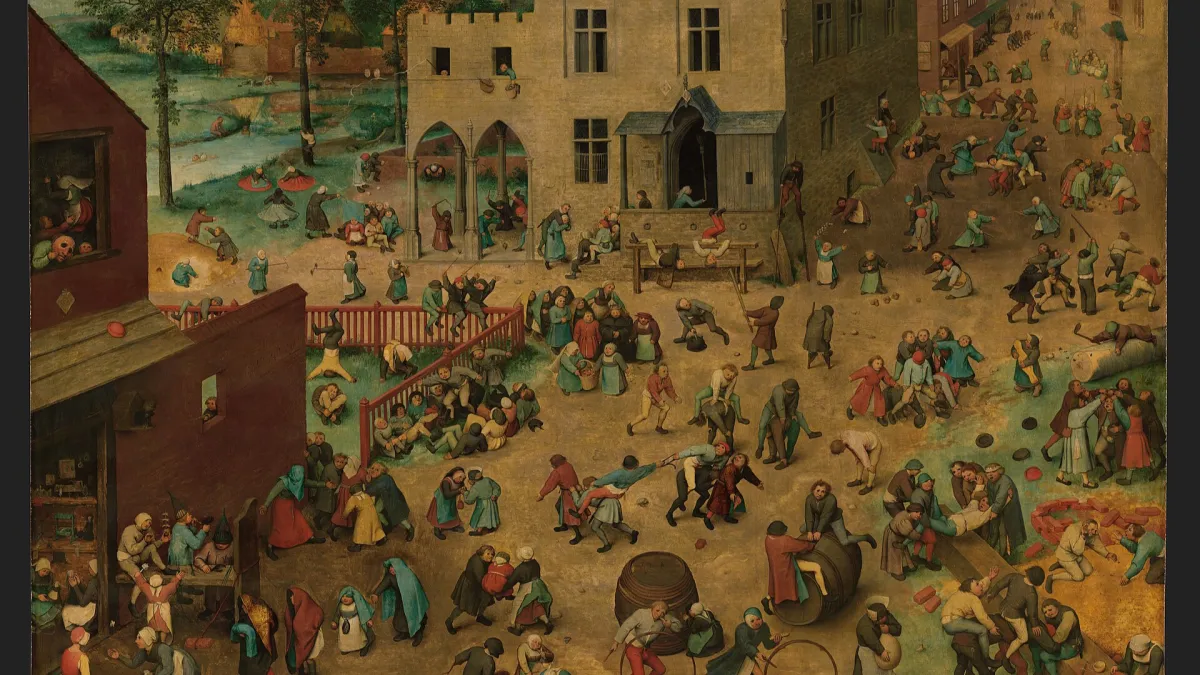
Why we play: from Bruegel's games to video games
Why play is not an escape from life but its oldest rehearsal, and why video games are a new form of a very old human need.
In a painting more than four hundred years old, dozens of children are absorbed in games — and not one of them looks dated. The toys change, but not play itself. The video game your child plays and the hoop on an old canvas are the same human instinct, merely in different costumes.
Play is not a rest from life but its rough draft
We are used to treating play as a waste of time, the opposite of “serious business.” But nature makes nothing superfluous: the young of all intelligent animals play, because play is a safe way to learn dangerous things. A child playing “war” or “shop” is in fact rehearsing adult life: rules, risk, loss, role. Play is the only school where a mistake costs nothing and the lesson stays forever.
Video games are a new chapter, not a new disease
Every generation fears its children’s games: chess, novels, and film were all once thought dangerous. Today it is video games’ turn. Yes, they can be made into a trap — as can a book, or a television. But at heart a good game does what play has always done: it sets a person a task, lets them fail and try again. The question is not whether children play, but what they play, and instead of what. Banning play is pointless — what matters is to return to it the thing Bruegel’s children had: a living companion beside them.
“Man plays only when he is in the full sense of the word a human being, and he is only wholly human when he is playing.”
— Friedrich Schiller
My opinion: do not fear that a person plays — fear the day they stop. Play is the sign of a living, curious mind that has not yet given up. The ability to play — in childhood, in work, in thought — is the ability to see in the world not only an obligation but a possibility. And perhaps whole nations should be judged not only by how they work, but by whether they can truly, wholeheartedly play.
Cover: Pieter Bruegel the Elder, “Children’s Games” (1560).
Comments (0)
Log in to leave a comment →
No comments yet. Be the first.