

Three draws in Geneva. How Gukesh and Sindarov reached 1½–1½
The first three games of the world title match produced the same result in strikingly different ways. Game two lasted just 20 moves. In game three, Sindarov had eight seconds left to make move 40.
India’s world champion Gukesh Dommaraju and Uzbek challenger Javokhir Sindarov reached the first rest day level at the Fondation Martin Bodmer in Cologny, near Geneva. Between 24 and 26 November they tested the Berlin Defence twice and the London System once. Each game earned each player half a point. The decisions those points required, and the time they cost, tell a different story each day.
24 November. The king steps towards the attack
Playing White in the opener, Sindarov manoeuvred a knight towards the kingside in a Berlin Ruy Lopez, then pushed his pawns to open lines against the black king. On move 27 Gukesh found a surprising answer. He stepped forward with the king itself, to f6. Sindarov later acknowledged that he had underestimated the move. With the original attack running out of steam, the challenger regrouped and secured a draw by repetition on move 38.
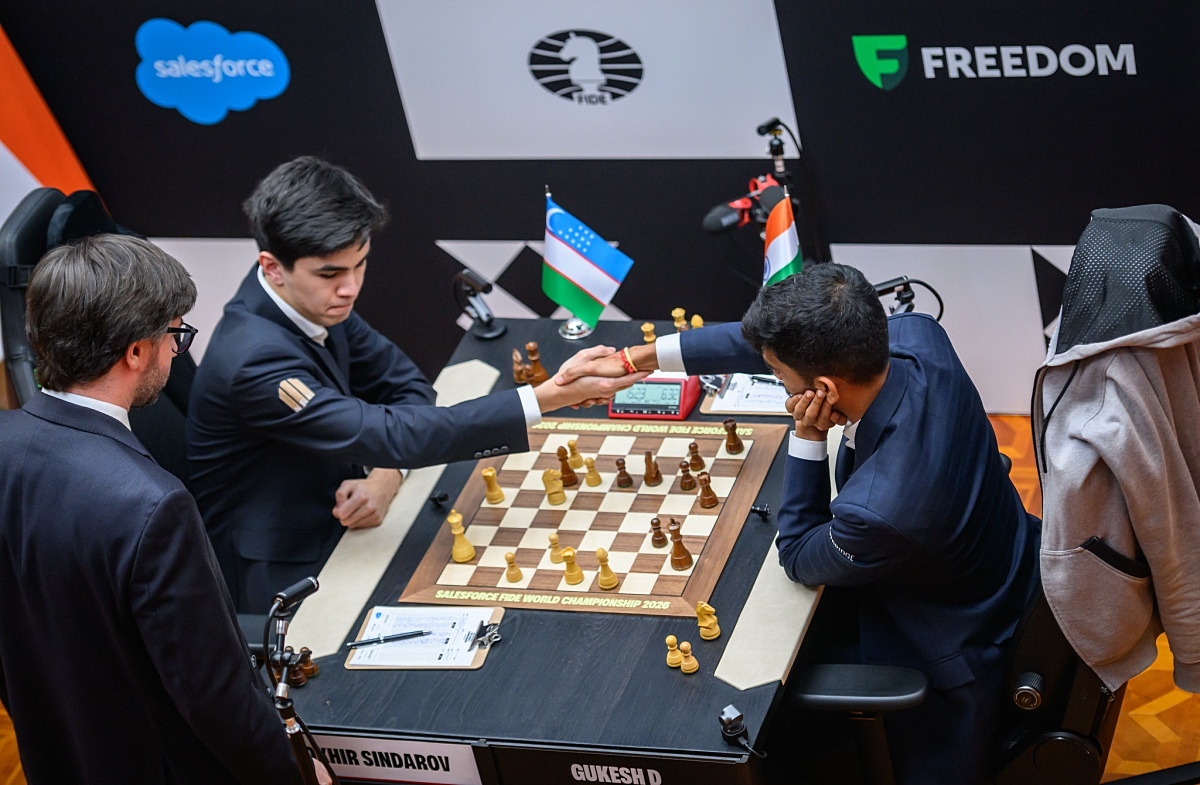
Javokhir Sindarov and Gukesh shake hands in game one on 24 November. PHOTO: fide.com / Michał Walusza.
25 November. Two opening moves
Erzhan Kazykhan, Kazakhstan’s permanent representative to the UN Office in Geneva, made the ceremonial move with the e-pawn. When play began, Gukesh put it back and chose 1.d4. White adopted the London System. After 15…f5, Gukesh had to decide whether to open the centre with c4 or leave it closed. A break would give Black active piece play. The champion saw too little reward for taking that risk, and the players agreed a draw on move 20 after two hours.
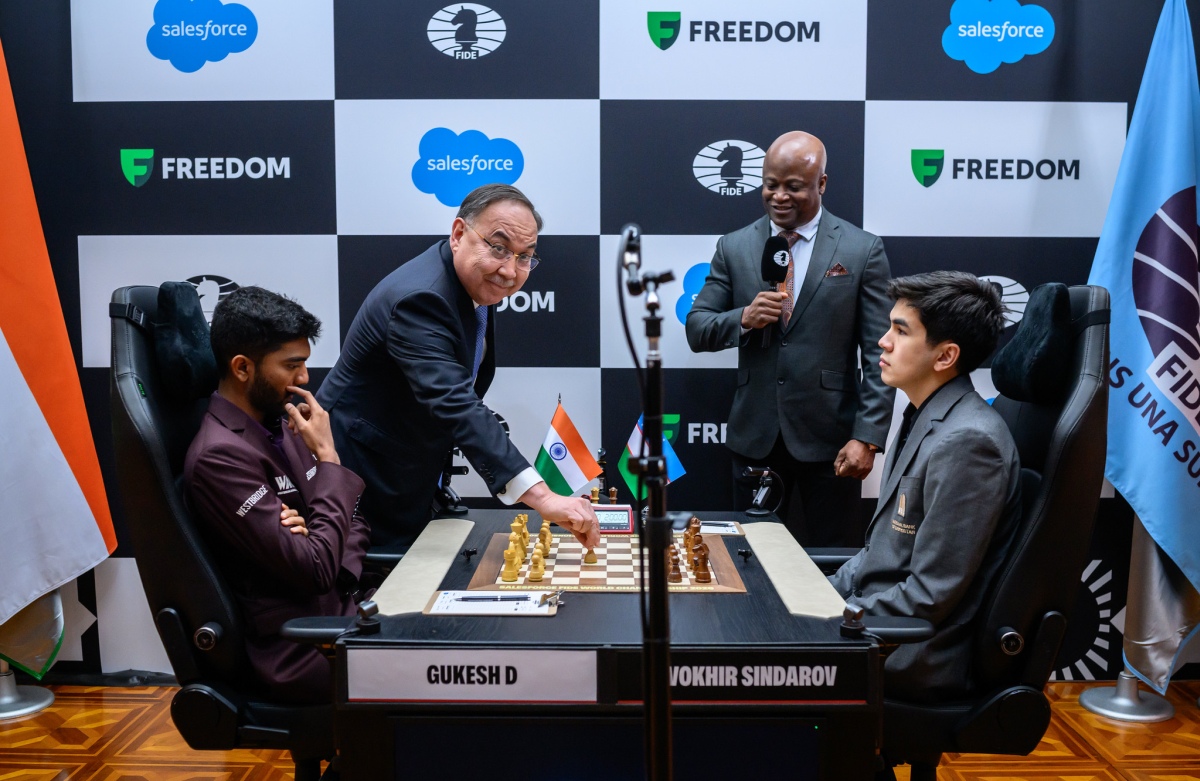
Erzhan Kazykhan makes the ceremonial move before game two, with Gukesh on the left and Sindarov on the right. PHOTO: fide.com / Michał Walusza.
26 November. Eight seconds for move 40
Sindarov again began with 1.e4. This time Gukesh chose the rare 5…Be7 in the Berlin. After 22.Nc5+ the game reached an ending with opposite-coloured bishops. They often make defence easier, but all four rooks were still on the board. That explains the force of 29.f4, a pawn break that could open lines for the heavy pieces. Gukesh said he had overlooked it. Looking back, Sindarov would have preferred to prepare it with h3 first.
Sindarov and Gukesh at the board during game three on 26 November. PHOTO: fide.com / Y.E. Nisenbaum.
Calculating the variations left Sindarov just eight seconds for move 40. Under the match rules, the 30-second increment begins only on move 41. He made the time control and defended accurately until the draw on move 60. The question for the next stretch is who can first give the opponent difficult decisions on the board with too little time to solve them. Gukesh has White on Saturday, 28 November. Game four starts at 15:00 in Geneva, 19:00 in Kazakhstan.
If you have found a mistake or a typo in this article, tell us about it
Comments (0)
Log in to leave a comment →
No comments yet. Be the first.