

Blind Spots: What Neither Kazakhstan's Admirers Nor Its Critics Can See
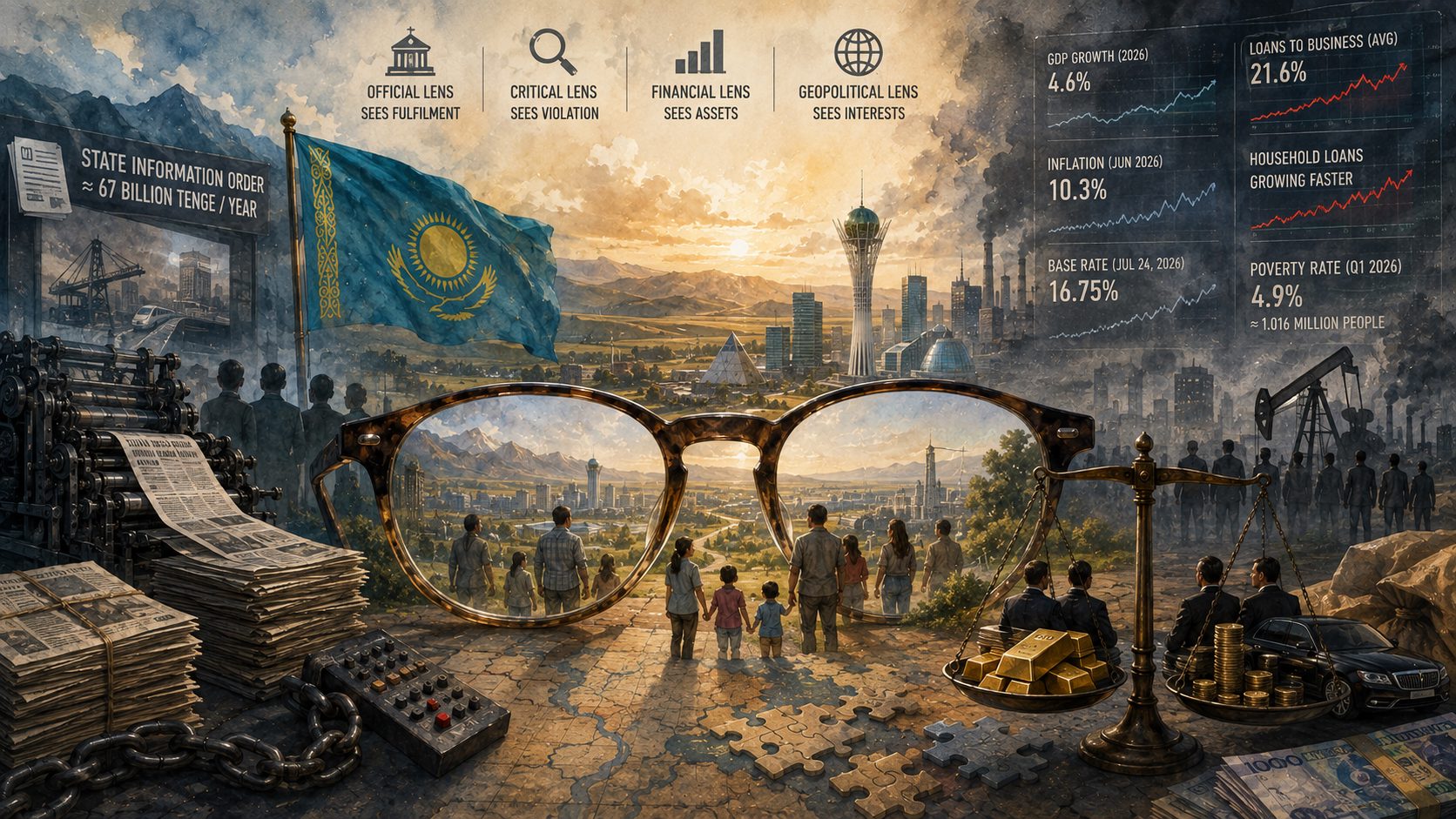
Four lenses write about Kazakhstan — the official, the critical, the business and the geopolitical — and each is built not to notice something. We gather the figures without a lens and examine what none of them sees: the country measures its summit, while the strength of an economy is decided at its floor, not its peak.
Why the coming decade will be won not by the country with the most rich people but by the one with no poor ones — and what its leadership underestimates about the artificial intelligence it already uses with confidence.
Let me say this up front: this is an opinion, not a verdict. Every checkable claim carries a source at the end. Everything else is my assessment, and arguing with it is not merely allowed but necessary.
Four lenses, four blind spots
No country is reported on “as it is” — only through a lens. Kazakhstan has four, and what matters is less what each one shows than what each is built not to notice.
The official lens sees fulfilment. Here the news is a report: launched, commissioned, signed, ranked. It does not lie about facts; it stays silent about the denominator. A school was built — how many were needed? We entered the top 25 for e-government — which index did we not enter? We have already examined the mechanism: when a newsroom’s income depends not on its readers but on whoever controls the budget, circulation stops measuring interest and starts measuring the compliance of accounting departments. The state information order came to roughly 63 billion tenge in 2024, with about 67 billion budgeted annually for 2025–2027.
The critical lens sees violation. Here the news is a failure: detained, refused, concealed. It is more often right on the facts, but it has the mirror-image problem — a permanent minus sign also stops being information. If everything is always bad, a reader cannot tell an ordinary day from a dangerous one, and the warning stops working precisely when it is needed most.
The financial lens — Reuters, Bloomberg, investment notes — sees deals, output, the exchange rate, the policy rate. It is the most honest of the four: it is paid for accuracy, because money is staked on its numbers. But it looks at a country as an asset, and an asset has no schools and does not get tired. People appear in this lens only as “labour force” and “consumer demand”.
The geopolitical lens — Russian, Chinese, Western — sees Kazakhstan as an appendix to somebody else’s plot: transit routes, multi-vector policy, “will he stay or go”. We have shown how that plot distorts even direct speech. The internal life of a country of twenty million simply does not fit into it: it is interesting exactly insofar as it affects a pipeline, a border, or a UN vote.
None of the four is built to lie. Each is built to look at what it is paid to look at. Add them together and you get almost everything — except one thing: nobody measures how the person in the middle and at the bottom of the distribution actually lives. And that is where the next decade will be decided.
The numbers without a lens
Let us gather what can be checked.
In July 2026 the IMF raised its forecast for Kazakhstan’s growth to 4.6% for 2026 and 4.4% for 2027. The actual figures for January–April are more modest: 3.6%. Inflation fell from 12.9% in September 2025 to 10.4% in May 2026 — slower, but still double-digit. Transfers from the National Fund have been cut to 2.77 trillion tenge against 5.25 trillion a year earlier — almost by half. Oil output is projected at 95 million tonnes against 99.4 million in 2025.
The share of the population with incomes below the subsistence minimum in the first quarter of 2026 was 4.9%, about 1.016 million people in 173,000 families. Over the quarter the figure rose by 0.1 percentage points.
Now read these numbers together rather than separately. There is growth — respectable by world standards. Inflation is double-digit. The National Fund’s support has been halved. Output is falling. Poverty is rising, if only by a tenth of a percent.
This is the growth nobody felt. Not because the statistics lie, but because growth and the sensation of growth are different quantities, and nobody publishes the second. We have already shown that inflation hits those who have less: at 10% a year, a person earning 200,000 tenge loses what they spent on food, while a person earning two million loses what they were saving. The same percentage, two different lives.
Blind spot one: poverty is measured with the wrong instrument
4.9% is a figure you could be proud of on any international panel. And it is honest: the methodology is standard and the Bureau of National Statistics counts in good faith.
The problem is not the counting but what is counted. The “below the subsistence minimum” threshold answers the question “how many people have already fallen”. It says nothing about how many are standing one breakdown away from falling — one broken car, one dismissal, one illness, one jump in a loan rate.
Here are the questions none of the four lenses answers, because none of them profits from asking:
- What share of families could not survive an unexpected expense of 300,000 tenge without borrowing?
- What share of the employed work without a written contract — and therefore, at the first crisis, vanish from the statistics entirely rather than showing up as “rising unemployment”?
- How many households service a loan whose payment exceeds a third of their income?
That is the real map of resilience. A country with 5% poor and 40% one step from poverty is more fragile than a country with 8% poor and a stable middle. The first looks better in a report and falls apart at the first shock. The second looks worse and takes the hit.
We have written that corruption behaves like a tax nobody ever voted for — never put to a vote, yet paid by everyone, in a markup on the price and a queue at the hospital. The fragility of the middle works exactly the same way: it appears in no report, but it is settled at every crisis — and settled by those who have less.
Blind spot two: what is misunderstood about AI
Credit where it is due. Kazakhstan’s leadership grasped the significance of artificial intelligence earlier and more deeply than most countries in the region, and is acting in earnest: 2026 has been declared the Year of Digitalisation and AI, a dedicated ministry has been created, the Law “On Artificial Intelligence” — the first in the region — came into force on 18 January 2026, a 2 EFlops supercomputer has been launched, the Alem.AI centre is being built, the country climbed 16 places in the Government AI Readiness Index (60th), and a target has been set: 5 billion dollars of AI exports by 2029.
It is a strong, considered programme. And it contains one error that will devalue a substantial part of the investment.
The bet is placed on compute, laws and exports — that is, on the peak. But AI does not devalue the bottom or the top. It devalues the middle.
Look at what the technology actually does. It does not take work from a loader, and it does not take work from the person who makes decisions. It takes work from the intermediary: whoever moved information from one place to another, filed it, reconciled it, drafted a standard document, translated, wrote a routine report. That layer — the entire middle office, the lower bureaucracy, a large share of lawyers, accountants, translators and analysts — is precisely the middle whose strength determines a country’s resilience.
Hence the consequence the programme does not contain: the winner is not whoever has more FLOPS, but whoever has more people able to use them. Two exaflops in a country where a hundred thousand people can use AI yield less than half an exaflop where five million can. Compute is bought with money and goes obsolete in three years. The ability to apply it is bought over a decade and does not go obsolete.
We have examined why open models are the chance for small countries and what Kimi K3 actually opened: the frontier became available to those without billions to train their own model. That is an enormous gift precisely to a country like ours — and it can only be realised through mass capability, not through a centre of excellence. Digital literacy has stopped being a social programme and become a question of economic security.
And one more thing almost everyone misses: the “$5 billion of AI exports” target measures revenue, not penetration. The country can meet it with three companies and ten thousand people — and remain a country where AI is not used in the school, the clinic, the local administration or the farm. The export figure will be closed. The economy will not change.
Blind spot three: everywhere, the peak is counted
The same instrument errs in every other area, and always in the same way.
Sport. Medals are counted. A medal is the tip of a pyramid whose base is children’s clubs, coaches and gyms within walking distance. You can buy the peak for years — naturalised athletes, targeted funding for champions — while the base narrows. The medal table will not show it; it will show success right up to the moment the money for buying runs out. We have written about why we play at all and what losing teaches: sport is valuable not for the medal but for how many people it makes healthy and able to take defeat.
Culture. Festivals, forums and presence at international venues are counted. The print run of a book in Kazakh, a translator’s fee, the number of living theatres in a district town are not. Culture is soft power, but that power is produced not at a forum, but in a thousand small places where somebody can afford to make language and text a profession. Your native language is also freedom, and three languages are not a slogan but infrastructure: it is either paid for or it remains a declaration.
IT and business. Unicorns are counted. Kazakhstan has them, and that is earned pride. But three or four large companies are a shop window, not an environment. The environment is small business: how many people started something this year, how many closed, how many survived to a third year. A unicorn is born in a country where twenty thousand people tried and nineteen thousand nine hundred lost without losing everything. The right to fail is not humanitarianism; it is the precondition for the next unicorn.
Healthcare. Beds, machines and coverage are counted. Outcomes are not — medicine that isn’t held accountable for the result can show exemplary reporting while the population’s health deteriorates. “How much was done” and “who got better” diverge the longer they go unreconciled.
In all four cases the mechanism is the same: what gets measured is what can be built within a term of office, not what determines resilience over a generation. And this is not malice. It is the design of the feedback loop we discussed earlier: the system receives its signal from wherever the headlight that shines only where it is permitted to point is aimed.
What is happening to the world economy — and why it changes the bet
Now let us climb higher and gather what we have written all year.
Capital has stopped being cheap. Interest on American debt has overtaken military spending: about $1.0 trillion in interest against $885 billion on defence. This is not an American problem — it is the world’s discount rate. When the risk-free return is high, money stops flowing into long projects, which means into infrastructure, education, and everything that pays back over a decade.
The main engine of world demand is losing revs. A slowing China is more dangerous than a rising one: a country with excess capacity and weak domestic demand exports not only goods but deflation, and competition for the very markets we are counting on.
Three crises treated as separate are one crisis. We have shown that the Gulf war, inflation and the AI crash are one story: the bill for a decade of cheap money has been presented to everyone at once.
And beneath it all — a substitution of terms. We have examined how chrematistics was passed off as economics: Aristotle distinguished oikonomia, the art of managing a household for the sake of life, from chrematistics, the art of multiplying money for its own sake. For forty years the world has measured success by the second and called it the first.
Add it up. The world is entering a decade in which capital is expensive, demand is weak, and technology devalues the middle. In that configuration the winning strategy inverts.
While capital was cheap and demand was growing, betting on the top worked: assemble capital, buy technology, grow a champion, and the champion pulls the rest along. With expensive capital and weak demand that strategy stops working: the champion pulls only itself, because there is not enough demand for everyone.
When capital is expensive, the scarce resource is no longer money but the capable person. And then what decides is not how many rich people you have, but what share of the population can produce something complex.
Why betting on the ordinary person is arithmetic, not morality
It matters not to slide into a sermon here. The claim that “the strongest country will be the one with no poor, not the one with more rich” is not a wish for goodness. It is a statement about economics, and it can be defended with numbers.
First: demand. A rich person does not eat a hundred times more bread or wear a hundred pairs of shoes. Their additional income goes into savings and assets — often foreign ones. The additional income of the poor and the middle goes into consumption inside the country, returning to the economy as somebody else’s revenue. A country that concentrates income at the top exports its own demand.
Second: human capital is counted in shares, not sums. Twenty million people is few. Kazakhstan will never win on numbers: its neighbours have an order of magnitude more people. The only quantity by which twenty million can outrun a hundred and forty million or a billion is the share who are included. If thirty percent of twenty million can do complex work, that is six million. If five percent, it is one million. A difference of six times — and it cannot be bought with oil or with a supercomputer.
Third: resilience to shocks. An economy with a broad, solid middle experiences a fall in the oil price as an inconvenience. An economy with a thin middle experiences the same fall as a political crisis. The strength of the base is not a social luxury; it is insurance against a single bad year erasing your ten-year plans.
Fourth, and this is barely discussed: poverty is a switched-off mind. Amartya Sen, whom we have cited before, showed that development is the expansion of a person’s capabilities, not the rise of an indicator. A person whose entire attention is spent on surviving until payday does not study, does not take risks and does not start a business. Every percent of poverty is not only a social problem; it is brains withdrawn from an economy that could have been producing.
Hence a simple consequence. For a country of twenty million, with capital growing dearer and technology devaluing the middle, investment at the bottom of the distribution returns more than investment at the top — not by justice, but by arithmetic. And the next decade will be won by whoever understands this first.
And the most important thing: all of the above can be nullified by one decision
We have examined three blind spots. But there is a fourth, and it is the principal one — because it is capable of devaluing everything else.
None of the four lenses seriously discusses monetary policy. The official one treats it as a technical subject for specialists. The critical one finds it dull; there is nobody detained in it. The financial one publishes the number of the decision and does not ask about the consequence. The geopolitical one does not see it at all. As a result the most powerful lever, deciding daily whether the country will have production or not, is discussed less than any regional governor’s dismissal.
Look at the figures. On 24 July 2026 the National Bank cut the base rate to 16.75% — the second cut of the year, after 17% in June and 18% before that. Annual inflation in June was 10.3%, falling for the ninth month in a row.
And now what stands beside it and is almost never discussed. The weighted average rate on tenge loans to business is 21.6%. To households, 19.5%; on consumer loans, about 21%. The banks’ loan portfolio to the economy is 40.6 trillion tenge, and according to April data it is growing mainly on the back of household lending. Banks’ net profit since the start of 2026 is 1,196 billion tenge.
Now some simple arithmetic that for some reason nobody performs out loud.
Name a production business that pays for itself at 21.6% a year. Not trade with fast turnover — production. A plant, a farm, a laboratory, a workshop, a development studio. There are none. There are none anywhere in the world: at that cost of money any project with a payback longer than three years is arithmetically loss-making before it starts. Which means the real sector is not being lent to at all — not because banks are wicked, but because at that rate lending to it is impossible.
What is being lent to, then? Exactly what the statistics show: consumption. A person borrows for a phone or a renovation at 21% because they need it now, not because it will pay back. The banking system, acting entirely rationally, finances not the creation of value but its consumption. And earns almost 1.2 trillion tenge doing so.
Then comes the trap that makes the instrument miss its target. The rate is raised against inflation. But how much of our inflation is monetary at all? Utility tariffs, fuel, imported food, margins where there is no competition — the rate affects none of these. It affects demand. A high rate therefore suppresses not the cause of rising prices but people’s ability to withstand them — and it strikes precisely the middle this whole article is written to defend. We have shown that inflation hits those who have less. The rate used to fight that inflation strikes them a second time.
Hence the conclusion this arithmetic was for. You can pass the region’s best AI law, build a supercomputer, declare a year of digitalisation and invest in people — and nullify all of it with a single decision, leaving the cost of money for production at a level at which production is not built. No reform survives a rate at which creating is unprofitable and reselling and consuming are profitable. Discussing development without discussing the price of money is discussing a house without discussing its foundation.
What follows practically. The country needs long and cheap money for production — not for consumption, but for creation. As cheap as the creator can bear, not as dear as the lender would like. As long as the rate for the real sector is expressed in double digits, everything else — plans, strategies, indices — remains text.
And one honest caveat, without which this section would be propaganda rather than analysis. Cheap money issued without a channel into production does not become factories; it becomes inflation, and inflation, as we have just shown, hits those who have less. The difference between development and catastrophe runs not through the number on the rate but through a single question: is there a mechanism guaranteeing that cheap money reaches the one who creates rather than the one who resells? Without such a mechanism, cheap issuance merely accelerates the same consumption. With it, the country gains what it does not have at all today: the ability to build for the long term.
That, and not a percentage point either way, is what the country’s main economic argument should be about. Until it is, everything else — this article included — remains a discussion of the superstructure.
The other half of the same question: the exchange rate
The policy rate is the price of money inside the country. But there is a second price, and without it the conversation is not closed: the price of money at the border. These two cannot be separated, and it is precisely on that separation that reforms collapse.
Start with a figure worth holding in mind. According to the Bank for International Settlements, turnover on the world’s foreign exchange market is about $7.5 trillion a day. All world merchandise trade is roughly $24 trillion a year, about $95 billion per working day. The difference is nearly eightyfold.
Consider what that means: for every dollar exchanged in order to buy or sell something, roughly eighty are exchanged in order to profit from the exchange itself. No currency’s rate is set by trade. It is set by that eightyfold superstructure. Calling the result “the market price of a currency” and pretending it reflects the state of an economy is rather like measuring a patient’s temperature with a thermometer that is 99% reporting the weather outside.
How the exchange rate is actually calculated: four different answers
It is worth stopping here, because “the correct rate” does not exist in the singular. There are four different questions, each with its own formula. They are constantly confused — hence the whole argument.
Zero. Why the trade balance alone gives no rate. In 2025 Kazakhstan exported $79.04 billion and imported $64.85 billion:
79.04 − 64.85 = +$14.19 billion
Dollars on the left, dollars on the right — the result is a quantity of dollars, not a ratio of tenge to dollars. The trade balance shows the direction of pressure, not the level: a surplus of fourteen billion means trade brings in more currency than it takes out, and the tenge ought to strengthen. It does not. The first formula shows why.
First answer: the market rate. It balances not trade but the entire balance of payments:
Supply of $ = exports + investment inflows + borrowing + transfers
Demand for $ = imports + capital outflows + debt service + savings held in currency
Trade here is one term out of four on each side. If capital outflows and households’ demand for currency as a store of value outweigh the trade surplus, the rate falls despite a trade surplus. Which is exactly what we observe: the country gives the world fourteen billion more in goods than it takes, and its currency weakens.
Second answer: purchasing power parity. The only method that yields a level from the real economy:
PPP rate = cost of a basket in tenge ÷ cost of the same basket in dollars
This is how the World Bank’s International Comparison Programme works: the prices of several thousand comparable goods are compared. By its data Kazakhstan’s GDP at PPP is roughly three times its GDP at the market rate, implying a rate of about 160–200 tenge per dollar against a market rate around 475.
And here a caveat is required that is criminally rarely made. The basket used to compute PPP is itself contaminated by the exchange rate. Everything imported in it — machinery, medicines, clothing, part of the food — has already been converted at 475. We are measuring the rate with a ruler that this same rate calibrated.
Let us calculate how much that distorts the result. Suppose the basket costs 100,000 ₸ here and $500 there, and the imported component is 40% (an illustrative figure, but plausible for a country with this import profile). Then at a rate of 200 rather than 475 the imported part would fall to 42% of its present price:
60,000 (domestic) + 40,000 × 0.42 = 76,800 ₸
PPP rate = 76,800 ÷ 500 = 154 ₸/$
So an honest calculation gives not 200 but about 154 — and the conclusion turns out stronger than the original: naive PPP does not overstate the gap, it understates it. The tenge’s real purchasing power is higher still than official comparisons show, because half the basket is already dollarised.
The true domestic price level is revealed by what cannot be imported: rent, utilities, a haircut, repairs, a doctor’s visit, a bus fare. That is where you see what a tenge is actually worth — and that is where the gap with world prices is widest.
Third answer: relative PPP — how much the rate is entitled to move in a year:
Change in rate ≈ our inflation − their inflation
10.3% (Kazakhstan, June 2026) − 3.5% (United States, June 2026) = 6.8% a year
Fundamentals justify a depreciation of about 7% a year. Anything beyond that is not explained by the economy.
Fourth answer: interest rate parity — and this is the crux.
Forward rate = spot × (1 + our rate) ÷ (1 + their rate)
475 × 1.1675 ÷ 1.0363 ≈ 535 ₸/$ in a year → depreciation of 12.7%
Put the two numbers side by side:
| Method | Tenge depreciation per year |
|---|---|
| Relative PPP — what the economy says | 6.8% |
| Interest rate parity — what the rates say | 12.7% |
The gap is nearly double. Those six percentage points a year are the speculator’s profit — the profit of whoever holds tenge at a high rate and exits into dollars.
From which follows a conclusion worth reading twice: a high base rate itself manufactures the expectation of devaluation. The higher the rate, the further the forward rate diverges from the fundamental one, and the more profitable it becomes to bet against your own currency. The National Bank, raising the rate “against inflation”, by that same movement makes betting against the tenge more lucrative. This is not an opinion — it is an identity following from a formula anyone can check on a calculator.
That is why the rate and the exchange rate are not two subjects but one. And that is why fighting inflation with the policy rate in an open economy means putting out a fire with petrol: a high rate attracts speculative capital, speculative capital leaves at the first fright, the currency falls, imports grow dearer, inflation rises — and the rate is raised again.
How countries settle with each other without a currency market
You might ask: how else? The answer is known and well tested. There are four ways.
Through a third currency — as we do now: both sides convert into dollars through correspondent banks, and both countries pay a commission to a market neither of them needs. In national currencies directly — at a cross rate, bypassing the dollar; increasingly this is how trade with China is done. Central bank swap lines — a rate agreed in advance against a crisis. And clearing — the most interesting.
Under clearing, currency is not exchanged at all. Countries keep a mutual account and periodically settle only the balance.
The European Payments Union, 1950–1958. Eighteen countries of post-war Europe. Nobody had dollars; trade was essential. So they arranged it thus: every month all mutual claims were netted into a single multilateral position, and gold settled only the net residual — not the whole turnover, but a few percent of it. Intra-European trade recovered without dollars and practically without a currency market. The EPU was wound up in 1958 not because it failed but because currencies became convertible and it was no longer needed.
So yes: countries know how to settle by trade flows without buying currency. The mechanism exists, has been tested, and proved itself in the recovery of an entire continent. It does not abolish the exchange rate as a concept — it abolishes the need to buy currency in order to trade. These are different things, and conflating them is the source of most confusion in this argument.
Who benefits
The gap between 475 and 154–200 is no abstraction. It is a daily transfer of money from one pocket to another, and both are worth naming:
- The commodity exporter wins. It sells for dollars and pays wages in tenge. The weaker the tenge, the wider its margin — at an unchanged oil price and unchanged productivity.
- The budget wins. Oil revenues arrive in currency and are converted into tenge: a weak rate mechanically inflates the revenue side in national currency.
- The worker loses. Their labour is priced in tenge, while everything imported — equipment, medicines, components, books — is priced in dollars.
- The producer of complex goods loses. They must buy an imported machine at three times its real price and sell on the domestic market for devalued tenge.
Add this to the previous section. A rate of 16.75%, credit to business at 21.6% — and a machine that costs three times its real price because of the exchange rate. No production survives that combination. Commodity exports survive both blows — because both work in their favour. We did not choose the resource model. We finance it daily, through the price of money and the price of currency, and then wonder why manufacturing does not grow.
What world experience shows
Here it is important not to invent but to look at what has already been tried.
Bretton Woods, 1944–1971. Fixed rates plus hard restrictions on capital movement — across practically the entire developed world. That period contains the fastest and most evenly distributed economic growth in Western history; the French call it the Glorious Thirty. Currency speculation was not forbidden as a moral matter — it was technically impossible, because capital could not cross borders freely. The system collapsed in 1971, and with it ended the era in which growth reached all strata roughly equally.
Malaysia, 1998. At the height of the Asian crisis the country went against every IMF recommendation: it imposed capital controls and fixed the ringgit. Its neighbours, who followed the prescriptions, got collapse and social upheaval. Malaysia emerged faster and with smaller losses. For decades this episode has been cited in the economic literature as proof that the free movement of speculative capital is not a law of nature but a political choice.
China. Its entire ascent — from poverty to the world’s second economy — was made under a managed exchange rate and a closed capital account. The yuan became convertible only partly and late, already from a position of strength. Not one year of the Chinese miracle occurred under a free floating rate.
And now Turkey, where the essential point is right. Erdoğan cut rates but left the capital account open. What happens next is arithmetically predictable: if money is cheap inside and can be taken out freely, capital goes where it is dearer, buying currency on the way. The lira collapsed not because rates were cut, but because rates were cut without closing the door. Cheap money behind open gates does not go into machinery — it goes into foreign currency. That is the half of the job left undone.
Hence an honest conclusion worth remembering whole rather than in halves: cheap money and a free currency market are incompatible. You may have one or the other. A country that takes the first without removing the second gets not growth but capital flight — which is what Turkey demonstrated to the world.
A contested example: the Soviet price cuts
Since we have turned to history, let us examine the example most often recalled in our part of the world — the annual price reductions of 1947–1953. Let us do it honestly: there is both a genuine lesson and a trap.
What actually happened. There were six reductions, and they were real: food prices fell by roughly 47% in total. But they did not start from zero. They were preceded by the monetary reform of December 1947: cash was exchanged 10 to 1, deposits up to 3,000 roubles one for one, above that at worsening rates. The result was the destruction of more than 90% of households’ cash savings, about 16% of deposits and more than 60% of savings held in bonds. And the unified state prices set after the reform were 2.56 times higher than pre-war levels.
That is: the price level was first raised two and a half times and savings were wiped out, and then for seven years prices were ceremonially walked back down. Anyone with savings lost more in a single December than they gained from all six reductions combined.
What paid for it. Procurement prices for collective farms were held below cost: the countryside delivered produce at a price that did not cover its outlays, and the difference financed cheap bread in the cities. This was not a gain in efficiency but a transfer from one pocket to another — from the rural to the urban. Precisely the mechanism of a hidden tax we described in writing about corruption as a tax nobody ever voted for: never voted, always paid.
What is genuinely valuable here. One thing, and it is important. The state then treated the price level facing a family as a goal of policy, rather than as a by-product. Today the world does the opposite: the declared target is a percentage of inflation, while whether a person can still buy the same basket on their wage is a “social question” — that is, somebody else’s concern.
That shift of view is worth taking. The mechanism is not: it rested on confiscating savings and draining the countryside — on exactly what this article condemns, solving the problems of the peak at the expense of the base.
The real conclusion from all four examples is the same. None of them was about “abolishing interest” or “abolishing the exchange rate.” All of them were about one thing: the state decides who gets the cheap resource — the producer or the reseller. Bretton Woods, Malaysia and China decided in favour of the producer and won. Turkey declared for the producer but left the door open for the reseller — and lost. The USSR decided in favour of the city at the expense of the village, and got growth paid for by those who were already poorest.
Kazakhstan today, with money priced at 21.6% and an exchange rate three times removed from purchasing power, settles this question daily in favour of the reseller.
These are decisions, not weather
Now the most unpleasant part — and what the previous three sections were for.
None of the above is an element of nature. Not one of these parameters fell on the country from the sky.
- The base rate of 16.75% is set by the National Bank’s Monetary Policy Committee. It is a decision by specific people, taken on a specific day, with a published record.
- The exchange rate regime is also a decision. A free float is not a law of nature: China, Malaysia and all of post-war Europe managed without one, and did not suffer for it.
- An open capital account is a decision. It is not a condition of membership in the world but a choice each country makes for itself, and has revisited more than once.
- The structure of lending follows from decisions. Banks go into consumer credit at 21% not because they are wicked but because regulation, the rate and prudential norms make precisely that the most profitable option. Change the rules and behaviour changes.
- The 67 billion for the information order is a budget line that somebody wrote.
Hence a simple, hard consequence: if production in a country is not being lent to, and the currency is worth three times less than its purchasing power, that is not “a difficult external environment”. It is the result of policy. Every figure in this article has an author.
Ludwig Erhard — the architect of the German economic miracle, the man who lifted a ruined country with no oil and no national fund — wrote about this in Prosperity for All back in 1957:
“Inflation does not come upon us as a curse or as a tragic fate; it is always brought about by a frivolous or even criminal policy.”
Read that again. Not “difficult conditions”, not “external shocks”, not “world prices”. Policy — that is, decisions by people who have names and posts. And the word Erhard chose was not “mistaken”. He wrote: criminal.
He put the same thought more briefly:
“Inflation is an unforgivable sin.”
A sin is not a misfortune or a trial. It is something somebody commits and answers for.
To him also belongs the observation that explains why decisions with such consequences are taken by people who are not at all stupid:
“There exists a certain kind of intellectualism that shades into idiocy.”
This is not about a lack of intelligence. It is about something worse — the impeccably competent application of a scheme detached from life. The rate is raised strictly by the textbook. Inflation targeting is executed by the methodology. The indices improve, the reports reconcile. And precisely at the moment when every procedure has been observed, it turns out that production is not being built, the machine costs three times more, and people are getting poorer while GDP grows.
And a third thought of his — the one we began this article with, though we did not then name its author:
“The precondition of a mature society is an informed society.”
Everything we have examined here — the rate, the exchange rate, the structure of credit — can only be discussed where somebody writes about it. We began with the price of silence and we arrive back at it: what 67 billion a year buys includes the fact that the forward-rate calculation you have just seen is not discussed on a single major platform in the country. It takes five lines and a calculator.
Erhard added a fourth:
“The economy is not a patient who can be operated on indefinitely.”
Errors of this kind have a statute of limitations, after which they are no longer corrected — they are lived with.
The searchlight: what can be checked, and when
Analysis without dated claims is an essay. Here is what you may hold us to.
- By the end of 2027 the AI export target will be met mainly by a few large players, while the share of organisations outside the two main cities genuinely using AI in their work will remain below 15%. Checkable against the ministry’s reporting and regional adoption statistics.
- The poverty figure will stay around 4–6% while the sense of getting poorer grows. The divergence is explained not by falsification but by a threshold that measures those who have fallen, not those standing at the edge. Checkable by comparing official poverty against the share of overdue consumer loans.
- Halving the National Fund transfers will show up not in 2026 but in 2027–2028 — in regional budgets and deferred infrastructure repairs. First things stop being fixed; then it becomes news.
- Should the oil price fall below $60 for more than two quarters, the discussion of “betting on people” will move instantly from the realm of values to the realm of budgetary necessity.
- The first country in the region to introduce mass AI training at school and college level, rather than centres of excellence, will gain a measurable advantage by the early 2030s. No one has such a programme yet — and that is an open window.
- While the average rate on business loans stays above 15%, the share of household lending in banks’ portfolios will keep growing faster than the share of lending to production. This is the simplest indicator of whether the system finances creation or consumption, and it is published monthly by the National Bank.
What follows from this
Not recommendations to the government — it does not need them. Rather a list of tests for judging any decision, your own or anyone else’s.
- Ask about the denominator. Not “how many were built” but “how many were needed”. Not “we entered the top” but “which ranking did we not enter”. Any figure without a denominator is advertising.
- Count resilience, not the peak. Not the number of unicorns but the share surviving to a third year. Not medals but children in clubs. Not beds but treatment outcomes.
- Demand that AI reach the school before it reaches the export figure. An export target is closed by three companies. An economy is changed by what millions can do.
- Do not confuse a country’s wealth with wealth in a country. The first is measured by what is produced and stays. The second by what has piled up at the top and leaves easily.
- And test all four lenses. The official one on its denominator. The critical one on whether it can tell a bad day from a dangerous one. The financial one on whether its model contains a human being. The geopolitical one on whether it is retelling somebody else’s plot in your words.
We began this text by observing that each lens looks where it is paid to look. At this publication the reader pays with attention — and so the only way to justify that attention is to speak about what has not yet become news. A searchlight is valuable not for illuminating what is happening. It is valuable for showing where we are heading — a second before we arrive.
That is my opinion. Check it — and decide for yourself.
Also on Shanraq
- The growth nobody felt — what Kazakhstan’s economy shows in mid-2026
- Inflation Hits Those Who Have Less — why the same percentage means two different lives
- Money That Breeds: How Chrematistics Was Passed Off as Economics — the substitution the whole argument about wealth rests on
- When interest outguns the army — how America’s debt sets the price of capital for everyone
- The dragon at the inflection — why a slowing China is more dangerous than a rising one
- The Bill Comes Due — the Gulf war, inflation and the AI crash as one story
- Open models and the chance for small countries and Frontier Set Loose — why an accessible frontier matters especially for us
- Subscribed From Above: The Price of Silence — how the feedback loop we lack is built
- Corruption: the tax nobody ever voted for — the bill nobody votes for and everybody pays
- The right to fail — the precondition without which the next unicorn never appears
Sources
Kazakhstan’s economy, 2026
- IMF raises its forecast for Kazakhstan’s growth to 4.6% in 2026 — Kapital.kz
- Kazakhstan’s GDP grew 3.6% in the first four months of 2026 — Forbes.kz
- GDP and short-term economic indicators, Q1 2026 — Halyk Finance (PDF) — National Fund transfers, oil output
- Kazakhstan’s growth rate will slow in 2026 — The Tenge
Monetary policy and banks
- The National Bank cut the base rate to 16.75% — Kazinform, 24 July 2026
- Schedule of base rate decisions 2015–2026 — National Bank of Kazakhstan
- The loan portfolio to the economy approaches 42 trillion tenge; growth mainly from household lending — 24.kz
- Kazakh banks’ net profit fell in 2026 — Forbes.kz
- Why Kazakh banks’ profits are shrinking in 2026 — Forbes.kz
Exchange rates, trade and world experience
- Foreign trade of Kazakhstan, January–December 2025 — Bureau of National Statistics — exports $79,041.2m, imports $64,847m
- GDP, PPP (current international $) — Kazakhstan, World Bank and GDP per capita, PPP
- BIS Triennial Central Bank Survey: global FX turnover
- European Payments Union (1950–1958) — multilateral clearing: only the net residual was settled
- Ludwig Erhard Foundation: “Die Inflation kommt nicht über uns als ein Fluch oder als ein tragisches Geschick…” — Prosperity for All, 1957
- Ludwig Erhard: “Inflation is the consequence of a criminal policy” — Tichys Einblick
- Ludwig Erhard — quotations
- Ludwig Erhard, Prosperity for All — full text
- Federal funds rate 3.50–3.75%, decision of 29 July 2026 — Federal Reserve
- US inflation at 3.5% in June 2026 — CNBC
- The 1947 Soviet monetary reform — the 10:1 exchange, the share of savings destroyed
- Retail price reductions in the USSR, 1947–1953
- “There was a time when prices were cut”: the mechanism and its cost to the countryside
Poverty and inequality
- Kazakhstan’s poverty rate: 4.9% in Q1 2026 — NUR.KZ
- Key indicators of income differentiation — Bureau of National Statistics
- Report on inequality — Halyk Finance (PDF)
Artificial intelligence and digitalisation
- Law of the Republic of Kazakhstan “On Artificial Intelligence” — Ädilet legal database — in force since 18 January 2026
- A Ministry of AI created, Alem.ai launched, a second supercomputer cluster under construction — El.kz
- The Year of Digitalisation and AI: what is actually changing in Kazakhstan — Kazinform
- Year in review: Kazakhstan’s achievements in AI and digitalisation — BAQ.kz
- The AI law sets common rules — interview with Minister Zhaslan Madiyev, Kontur
- Government AI Readiness Index — Oxford Insights
The media environment
- “A secret shrouded in darkness”: the Ministry of Culture refuses to disclose the state media order — Kazakhstan International Bureau for Human Rights
- Kazakhstan — World Press Freedom Index 2026, Reporters Without Borders
- Aymo Brunetti, Beatrice Weder. A free press is bad news for corruption — Journal of Public Economics (2003)
Theory
- Amartya Sen. Development as Freedom (1999) — development as the expansion of human capability, not the rise of an indicator
- Aristotle. Politics — the distinction between oikonomia and chrematistics
If you have found a mistake or a typo in this article, tell us about it
Comments (3)
Log in to leave a comment →
What do you think about this?
Sign in to vote. 0 Sign in to vote.Бұл туралы не ойлайсыз?
Sign in to vote. 0 Sign in to vote.Что вы думаете по этому поводу?
Sign in to vote. 0 Sign in to vote.