

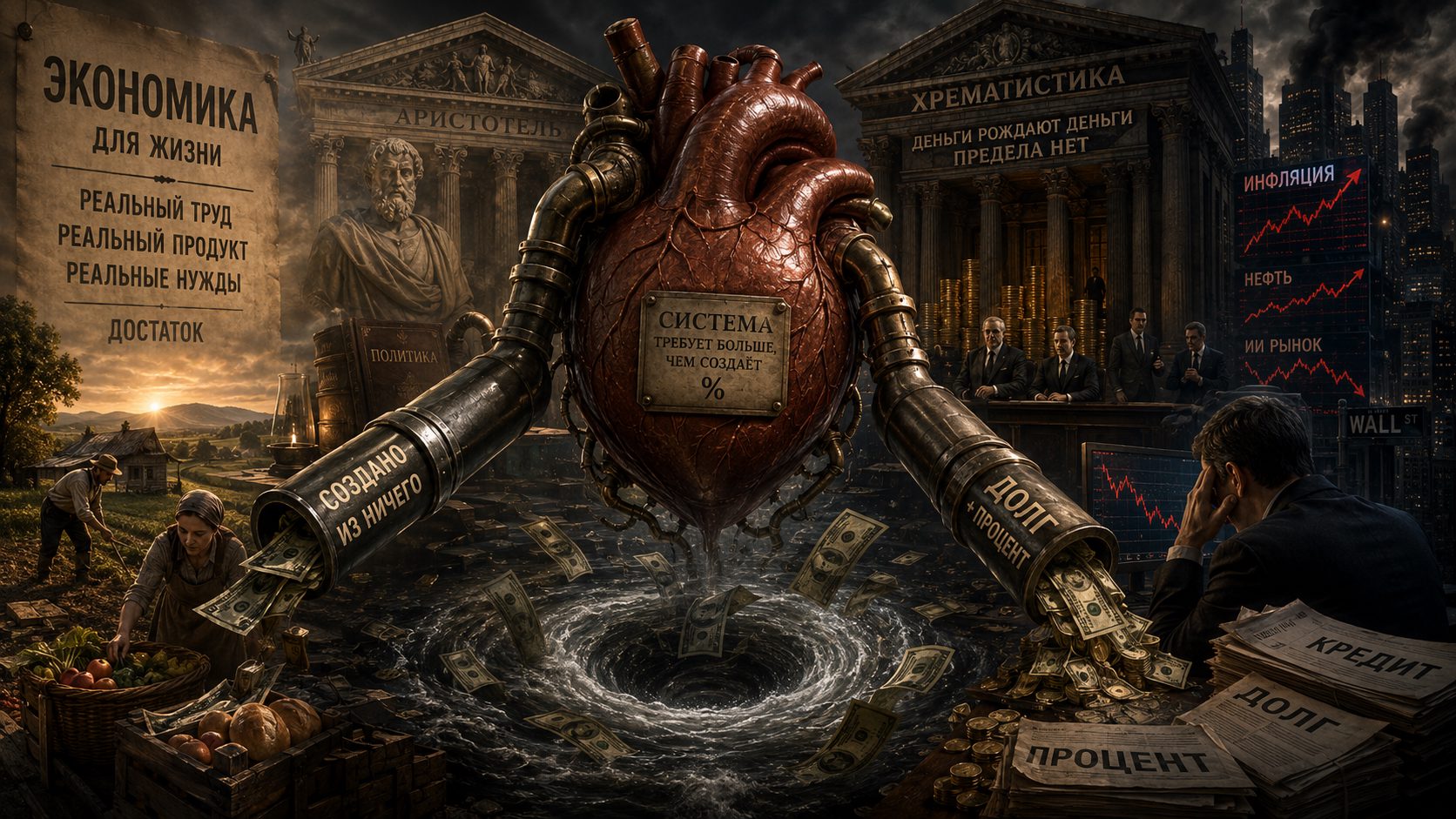
Money That Breeds: How Chrematistics Was Passed Off as Economics
Aristotle split household management in two: oikonomia, providing for real needs, and chrematistics, accumulating money for its own sake. The second won and named itself economics. Why the Greek called interest offspring, why all three Abrahamic faiths forbade usury, and what a central bank's refinancing rate really is.
The “science of economics” has managed to forget it. Because under the name “economics” the world has long been sold a different craft entirely: the art of making money from money. It has an ancient name — chrematistics. And at its root lies one legalised vice: greed.
Two words deliberately confused
Aristotle divided economic life in two. Oikonomia (from oikos, “household”) — providing for real needs: to grow, to make, to exchange, to feed the household and the city. It has a natural limit — sufficiency. And chrematistics — the accumulation of money for its own sake. It has no limit: however much there is, it is never enough.
The difference is not the size of the purse but the purpose. Oikonomia asks: “how much is enough to live well?” Chrematistics asks: “how do I turn ten into twenty?” When the second purpose defeats the first, the household stops serving the human being and begins to serve greed. We live in a world where the second has won — and named itself the first.
Money that “breeds”
Aristotle’s sharpest blow is about interest. In Greek, interest is tokos — “offspring,” “progeny.” He strikes the sorest spot: money that gives birth to money is unnatural, for a coin is not a cow — it should not calve. This is no naïveté of an ancient Greek, but an exact diagnosis of what would be built millennia later: a world where men grow rich not from labour and things, but from money itself, lent at interest.
And let us name it plainly: usury is greed raised into law. Not the vice of a single miser, but greed legalised, sanctified, and renamed a “science.” If this is not said aloud, all the rest loses its meaning: we will argue about mechanisms while carefully ignoring the licensed sin sitting at their centre.
Three religions said “no” — and the world said “holy”
A fact erased from “economic” education: all three Abrahamic traditions forbade usury. Jewish — “take no interest from him” (Leviticus 25:36–37). Christian — “lend, expecting nothing in return” (Luke 6:35); for centuries the Church called interest a sin, Dante placed usurers in hell, Aquinas argued the usurer sells what does not exist — time. Islamic — the outright ban on riba (Qur’an 2:275).
Three faiths that disagreed on everything agreed on one thing: making money from money is forbidden. And here is the uncomfortable question — not “who is to blame,” but: how did the world make holy and untouchable the very thing all three traditions plainly cursed? The sin was renamed a “service,” the usurer an “investor,” greed an “efficiency,” and doubt an “economic illiteracy.”
A heart that demands back more than it sent
Here is how the trap works, on a simple image. Imagine a heart pumping five litres of blood through the body — and demanding five and a half back. Where are the cells to find the extra half-litre? Only if the heart prints more blood — issues new debt.
That is how the system works. Today almost all money is not cash from the state, but debt created by banks: when a bank makes a loan it does not hand over someone else’s savings — it creates a new entry out of nothing. This is not a conspiracy theory — it is stated word for word in the Bank of England bulletin “Money creation in the modern economy” (2014): about 97% of money is created by commercial banks at the moment of lending. And all of it enters circulation already with interest ticking.
Now join it to interest. For the total sum of interest, the money was never created — so repaying all debt is physically impossible; one can only take new debt to service the old. The Nobel-laureate chemist Frederick Soddy showed as early as 1926: debt grows exponentially by compound interest, while real wealth — grain, houses, labour — cannot grow that way. The economy is driven to run ever faster not because human needs grow, but because the greed of interest demands blood that does not exist. When it can run no further, comes what is bashfully called a “crisis.” The sine wave of “boom and bust” is neither accident nor anyone’s malice — it is the breathing of a debt that cannot be repaid.
The refinancing rate is that very interest
Here is the slyest trick. The refinancing rate is presented as “medicine against inflation.” But that is the language of the system itself. In truth the rate is wholesale usury: the price at which the National Bank gives money to commercial banks. They add their own interest on top — and only then does the money reach business. And business builds both that interest and its own markup into the price of goods. So, as the tenge travels from the National Bank to the shop shelf, greed is added in layers — the bank’s interest on the state’s interest, and the markup on top — and all of it settles into the price you pay.
And how is this inflation “cured”? By raising the same interest. It is a doctor who, facing poisoning, prescribes more of the same poison “to cool things down.” Yes, dear credit dampens demand — but at the cost of strangling real production, and without once touching the root: the principle that money enters the economy as debt at interest. The National Bank — Kazakhstan’s or any other — honestly turns this knob inside a system where interest itself is placed beyond question, as a “law of nature.” They were never taught otherwise. But that is not the system’s excuse — it is its verdict: it is built so that the question “is interest needed at all?” simply never occurs.
The suppressed alternative they won’t teach you
The “light in the tunnel” — thinkers absent from the textbooks precisely because they strike at the foundation.
- Silvio Gesell proposed money that is unprofitable to hoard: over time it slightly “melts,” so it is put to work rather than locked away at interest. A fantasy? In 1932 the Austrian town of Wörgl issued such money — and in the depths of the Great Depression it beat unemployment and repaired roads and a bridge. It worked so well that the Austrian National Bank banned the experiment — precisely because it worked.
- Irving Fisher and the “Chicago Plan” (1930s): “100% money” — strip banks of the right to conjure money from air and return issuance to society. In 2012 IMF economists recalculated the plan and confirmed: less debt, fewer crises.
- In 2018 Switzerland seriously voted in the Vollgeld referendum — “sovereign money”: new money to be created only by the central bank, and no one else.
This is what plain popular intuition comes down to: the right to create money should belong to society — not to interest, and not to those who feed on it.
The choice they hide from us
Economics was invented so the household would be fed. Chrematistics — so that greed would grow. For five hundred years we have lived in a system where greed matters more than the household, and doubt of it is branded heresy or “illiteracy” — as once it was heresy to think the Earth goes round the Sun.
The mask will not fall soon. But the first step is always the same — to call things by their names. Usury is greed. What is worshipped as “economics” is largely chrematistics. And the real economy — the one that serves the human being, not interest — is neither invented nor lost. It was merely carried out of the textbooks. And it is brought back not by revolution, but by a simple question said aloud: why should money breed — and why must the heart give back more than it sent?
Sources: Aristotle, Politics, Book I · A. S. Pushkin, Eugene Onegin, ch. 1 · Bank of England, “Money creation in the modern economy” (2014) · F. Soddy, Wealth, Virtual Wealth and Debt (1926) · I. Fisher, 100% Money (1935); Benes & Kumhof, “The Chicago Plan Revisited,” IMF (2012) · S. Gesell, The Natural Economic Order (1916); Wörgl (1932) · “Vollgeld” referendum, Switzerland (2018)
If you have found a mistake or a typo in this article, tell us about it
Comments (2)
Log in to leave a comment →
Сильный текст — и редкий. Обычно про «экономику» пишут либо восторженно, либо апокалиптически, а здесь третья, почти забытая оптика — моральная. Разведение ойкономии и хрематистики объясняет то, что интуитивно чувствует каждый, кто хоть раз держал в руках график платежей по кредиту: система меряет успех не тем, сыт ли дом, а тем, выросло ли число. Сильнее всего цепляет метафора сердца — она превращает абстрактный «сложный процент» в физическую невозможность: крови на все проценты просто не напечатали. После этого «синусоида роста и краха» перестаёт выглядеть законом природы и начинает выглядеть конструкцией. И один честный вопрос, который текст сам ставит: если убрать процент — чем заменить его настоящую работу, распределение ограниченного капитала между тем, кто вырастит на него сад, и тем, кто его прожжёт? Гезелль, Вёргль и «суверенные деньги» — не лозунг, а гипотеза, которую можно проверять, а не только admire. Вот с этого вопроса вслух и начинается тот самый «свет в тоннеле». Спасибо, что зажгли.
Sign in to vote. 0 Sign in to vote.А чему учили вас под словом „экономика“?
Sign in to vote. 0 Sign in to vote.