

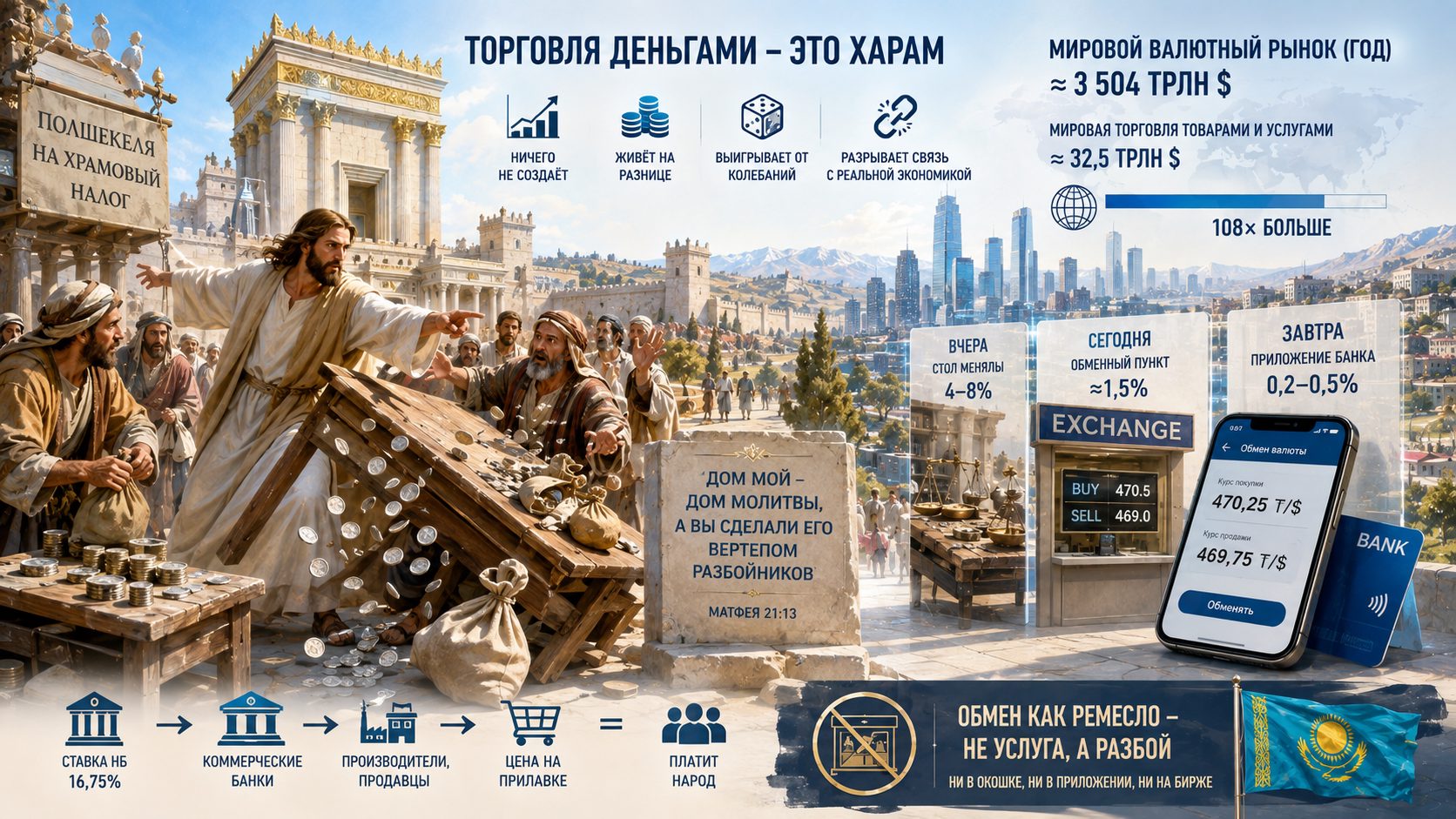
Shulhani: Trading in Money Is Haram
The shulhani was the money changer at his table in the Temple of Jerusalem, swapping foreign coin for the Tyrian shekel — the only currency the temple tax could be paid in. He took four to eight per cent and produced nothing: his income came from the fact that somebody else's payment was compulsory. Jesus overturned his tables.
Two thousand years later the table stands on every corner, the world’s currency market churns through the planet’s entire annual trade in three and a half days, and the digital exchange is not the death of the money-changer’s table but its perfection. Trading in money should not exist in any form: not at a window, not in an app.
The Temple in Jerusalem levied a tax — half a shekel a year from every adult man. It could be paid in one coin only, the Tyrian shekel: reliable silver, and no imperial images, which were inadmissible in the sanctuary. But people came from all over the world, and their purses held foreign coin.
Between a man and his obligation stood the money-changer. In Hebrew, shulhani, from the word for table. He took four to eight percent for the exchange.
He produced nothing. He performed exactly one service: he stood on a road that could not be gone around. His income was created not by his labour but by the compulsory nature of somebody else’s payment.
What happened next is known precisely. Jesus entered the Temple, overturned the tables of the money-changers, and said: “My house shall be called a house of prayer, but you have made it a den of thieves.”
The earliest surviving verdict on trading in money was not passed by an economist. And the verdict in it is not “the commission is too high” — it is robbery.
The verdict to start from
Let us say it at once, without caveats and without “on the one hand”.
Currency exchange offices should not exist. Not because they are obsolete, not because a cashier is expensive to keep, and not because “a card does it now”. Because trading in money is not economic activity. It grows nothing, produces nothing, transports nothing, repairs nothing. Its income consists entirely of the difference between two numbers, and the harder those numbers are shaken, the better it does. A trade that grows rich on the misfortune of an economy cannot be part of that economy.
This applies to every form of it at once: the window on the corner, the desk in a bank, the line in an app, the exchange floor. Moving the table into a phone changes nothing essential — as we show below, it only makes the robbery more convenient.
The wholesale half we have already taken apart
Money That Breeds dealt with the machine as a whole: real economics — the running of a household — against chrematistics, the art of making money from money; interest as greed written into law; money entering an economy as debt with the interest already accrued on it; the refinancing rate as wholesale usury, settling in layers into the price on the shelf; the prohibition on money breeding money in all three Scriptures; Gesell and Wörgl, closed down by the Austrian National Bank precisely because it worked.
No need to repeat it. The conclusion is enough: the machine is built so that money is obliged to lose value — otherwise there is nothing with which to service the debt it was created on.
The exchange office is that machine’s retail counter. The place where the loss of value manufactured upstairs is cashed out downstairs.
Three and a half days: look at the numbers
How large the shulhani’s table has grown can be seen from two figures, both taken from the most respected institutions of this very system — the World Bank and the Bank for International Settlements.
The counting has to be careful, or it is easy to claim too much. The currency market does not run all year round: five days a week, roughly 250 trading days. So both trade and turnover are taken per the same trading day — otherwise the comparison is not honest.
| What is counted | Per trading day | Per year (~250 days) |
|---|---|---|
| All world trade in goods and services | $130 bn | $32.5 trn |
| Turnover of the world currency market | $9,600 bn | ~$2,400 trn |
| How many times larger the market is | 74 × | 74 × |
The first line is everything humanity grew, extracted, assembled and shipped across borders in a year: oil, grain, machine tools, microchips, freight, software. The second is the turnover of trading in money itself.
Now the same thing, made visible.
Of every 100 dollars on the currency market, less than one and a half pays for a real good:
Paying for goods and services  ▎ $1.4
Trading in money               ████████████████████████████████████████ $98.6
A year of the currency market — 250 working days:
Serving world trade   ▏ 3.4 days
Serving itself        ███████████████████████████████ 246.6 days
For three and a half days out of two hundred and fifty the market does the job it was invented for. The other two hundred and forty-six and a half it is busy with itself.
And one more thing, rarely said. Not all trade requires an exchange at all: deals inside the eurozone need none, and a contract written in the seller’s currency needs one conversion instead of two. So trade’s real need for a currency market is smaller still than a hundred and thirty billion, and the gap is wider.
Let us name the counter-argument honestly: part of the turnover is hedging against fluctuation, and it grows along with trade. Subtract every bit of it. Seventy-four to one will not thereby become one to one, and a hundred turnovers per one good cannot be explained by any trade whatever. The toll on the road is now taken not from a pilgrim but from an entire country.
How the percentage changes, and why that is not an improvement
Three eras of one and the same table.
| Where the table stands | Who takes it | How much per exchange | Does the customer see it |
|---|---|---|---|
| The Temple in Jerusalem | shulhani | 4–8% | Yes, haggled in person |
| Exchange office | a desk behind glass | ≈1.5% (National Bank cap: 7 ₸ per dollar) | Yes, two numbers on a board |
| Bank app | code | fractions of a percent | No |
The percentage falls, the volume grows, the visibility disappears. This is not a softening of manners; it is a perfecting of the collection.
And here is how it looks for you personally, without the trillions. The rate is around 470 tenge, the permitted difference is 7 tenge:
| Action | Amount |
|---|---|
| Bought $1,000 at 473.5 | paid 473,500 ₸ |
| Sold $1,000 back at 466.5 | received 466,500 ₸ |
| Result of two operations | −7,000 ₸ |
Seven thousand tenge gone for holding somebody else’s banknotes in your hands and giving them back. Not one good was bought, not one service rendered, nothing in the country produced. A family exchanging two thousand dollars back and forth in a year hands over 14,000 tenge annually for nothing — and that is only the legal cap, only cash, only one person.
Multiply by a country. This is how a people is robbed: one and a half percent at a time, lawfully, in broad daylight, with a receipt.
“But I need the exchange, I buy from abroad”
You do not. You already pay by card in your own currency, and the conversion happens by itself, at the moment of purchase. No window, no queue, no cashier. This is not the future; it is the day before yesterday of technology.
So two things everyone is used to calling by one word must be separated.
Conversion is a technical operation: move a sum from one money into another so the goods can travel. Its place is inside the payment system, at cost, invisible — as invisible as the work of the post office when you send a letter.
Exchange as a trade is an establishment whose income is precisely the difference. It lives not on carriage but on fluctuation. It needs the rate to be shaken: the harder, the better its business. That is not a service to an economy; it is a bet against one.
The digital exchange office — a perfected death for the real economy
Banks are closing exchange offices: in Astana alone there are fewer than a year ago. It is easy to conclude that the trade is dying on its own.
It is not dying. It is moving from the wall into the app.
And here is what happens in the process. The difference that used to hang on a board above the window as two numbers, where any passer-by could see how much was being taken from him, disappears inside a rate that nobody sees. The shulhani’s four to eight percent turn into fractions of a percent — but on a volume he could never have dreamt of, and without a single witness.
The table has not vanished. It has become invisible, and therefore perfect. The robbery used to be visible on a board. Now it is in the code.
Why it will not die out on its own
The English trade-union figure Thomas Dunning wrote this in protest against the slave trade. Marx quoted him in Capital, and ever since the words have been attributed to Marx:
“Guarantee 10 percent and capital will consent to any employment; at 20 percent it becomes lively; at 50 percent it is positively ready to break its own neck; at 100 percent it tramples on all human laws; at 300 percent there is no crime it will not risk, even at the chance of the gallows.”
The passage opens by noting that capital “avoids noise and has a timid nature”. It does not go head-on. It looks for where it is quiet and where there is a difference.
Trading in money is the quietest of all its forms. No workshop, no raw material, no workers, no defects, no warehouse. Only the difference between two numbers, and volume. Expecting such a trade to die out from progress is like expecting the slave trade to end when freight gets cheaper.
Hence the thing it is time to say out loud: capitalism is not a good. It was appointed a good after the fact, when chrematistics took the place of economics along with its name, its faculties and its textbooks. Real economics — the kind that feeds the household and the city — has not been invented away or lost. It was carried out of the lecture halls. It has to be brought back.
Mankurts with diplomas
Here one is usually told: “you are simply financially illiterate.”
The opposite is true. That literacy is precisely the thing.
The several hundred textbooks a student memorises over five years are built so that the question “is interest needed at all?” never arises in them. Interest is placed outside the brackets there as a law of nature — like gravity. Speculation is taught as liquidity, usury as investment, greed as efficiency. The graduate walks out with a diploma, takes a seat in a bank or a ministry, and conscientiously turns the handles of a machine that fleeces his own people. He is not a villain. He is a mankurt — a man whose memory of who he is and whose he is has been taken away, and who has been left with the ability to serve.
Medical education is built the same way: a doctor is taught the protocol, not the outcome, and honestly prescribes what he was taught by those who profit from it. We took that mechanism apart in Medicine That Isn’t Held Accountable for the Result — there the money follows the procedure, and the patient’s health is not even a metric.
One principle, two industries: train a person to serve the machine and call it a profession.
Inflation is manufactured in one building
It is time to name who does this, or the conversation stays a complaint.
Ask anyone where inflation comes from and you will hear: world prices, war, a bad harvest, the dollar. An element of nature, valiantly fought. Now follow the path of a tenge from issue to price tag.
Money enters the economy as debt. The price of that debt is set by the National Bank, through the base rate — also known as the refinancing rate. Today it is 16.75% a year. This is usury exactly, only wholesale: not a moneylender at the bazaar but an institution with a coat of arms on its facade.
From there it travels in layers:
| Link | What it adds to the price |
|---|---|
| National Bank | base rate — 16.75% |
| Commercial bank | its own margin on top of the rate |
| Producer and seller | the cost of credit in the cost base, plus a markup |
| The buyer at the counter | pays all of it at once, as a single figure |
The rate does not fight prices. The rate sits inside prices.
And now the thing this article is worth writing for. Prices rise — and the same institution declares a fight against inflation. Its instrument: raising that same rate. That is, making dearer the credit already stitched into every price tag in the country.
A doctor whose patient has been poisoned adds more of the same poison — “to cool him down”.
And the third move, the most profitable. Every increase makes money more rewarding than goods: holding becomes more profitable than producing. Whoever grasps this before the others buys currency and waits. A speculator needs no factory, no field, no workers; he needs the National Bank to raise the rate once more and drop the tenge once more. He is not fighting the system. He is its best pupil.
The circle closes, and all three of its links sit in one building:
- The National Bank injects interest into the economy through the rate.
- The interest drives prices, passing in layers to the counter.
- The National Bank declares a fight against prices — and raises the interest higher.
Inflation here is neither an element of nature nor world conditions. It is a manufactured article. It has a blueprint, an address and a signature.
Ludwig Erhard, author of the post-war German miracle, put it briefly: “Inflation is not a law of development, but the work of fools governing the state.” Not an element. Somebody’s choice. And here it is made every six weeks, on the published schedule of meetings.
Half-measures do not work
Closing the windows and stopping there is exactly the half-measure after which the table simply moves into the phone. For the trade to disappear rather than hide, both it and the reason people go to it must be removed. Two men have shown how that is done.
Look at what Erhard did in June 1948. He did not cut a rate and did not ban interest by decree. In a single night he destroyed the debased money, introduced a new mark, freed prices — and refused to print. He removed the machine, not the prop under it. Gesell reached the same place by another road: he did not decree interest downwards, he redesigned money itself.
And here is what happens when the prop is touched and the machine is left standing.
Turkey. For years the president held to a thought that sounds almost like the conclusion of our previous article: a high rate is the cause of inflation, not the cure. He pressed the central bank into cutting it. Inflation reached eighty-five percent and the lira went into free fall.
This is not proof that interest is useful. It is the price of a half-measure. Turkey removed the lever and left the machine: money there still entered the economy as debt at interest, the debt was in a foreign currency, and the country’s savings had long been in dollars. In such a construction the rate does not cure — it props. Knock out the prop and leave the ceiling, and that is not liberation but collapse.
We have a lesson of the same kind at home. Until 20 August 2015 the tenge was held inside a corridor. It was defended while the reserves lasted, and then it burst: from 188 to 255 in a single day. The price was held; the machine was not touched.
One law for three cases: if you fix the price without touching the construction, the construction wins.
What should be there instead
Not “regulating exchange offices” and not “fighting speculation” — that is the machine’s own language. Three things in substance.
Conversion at cost, inside the settlement system. A technical operation, with no establishment feeding off it. The difference between two numbers stops being anybody’s income and becomes what it actually is: a transfer cost tending to zero.
Not one business whose earnings are the movement of a rate. Not at a window, not in an app, not on an exchange floor. A trade that wins when a country’s money is shaken cannot be part of that country’s economy. That is the shulhani — except he no longer stands in the Temple; he stands everywhere.
And above all, upstream rather than downstream. As long as money is obliged to lose value, people will escape it: through the window, through the app, through cryptocurrency, through a bag under the mattress. The work lies where Aristotle, Gesell and Erhard were looking — in the design of money itself. Remove the reason people flee a currency, and the money-changer’s table will run out of customers before it runs out of licence.
A country that takes on the construction rather than the window will get what cannot be bought with reserves or with interest: money there is no need to escape from. Not because escaping was forbidden. Because there is no reason to.
The tables in the Temple were overturned by one man, and it took a minute. They were two thousand years in the rebuilding — and now they cannot be seen.
Sources
- Bank for International Settlements: global foreign exchange turnover, April 2025
- World Bank: exports of goods and services, world (NE.EXP.GNFS.CD)
- The Tyrian shekel and the Temple tax: why that particular coin was required
- T. J. Dunning, “Trades’ Unions and Strikes” (1860) — quoted by Marx in Capital, vol. I
- National Bank of Kazakhstan: rules for exchange operations in cash foreign currency
- 20 August 2015: the tenge moves to a free-floating rate
- Ludwig Erhard’s reforms of 1948
- Carnegie: why Turkey’s president cut interest rates against inflation
The grounding on Aristotle, the three Scriptures, Gesell, Wörgl, Soddy, the Chicago Plan and Vollgeld is in Money That Breeds.
If you have found a mistake or a typo in this article, tell us about it
Comments (0)
Log in to leave a comment →
No comments yet. Be the first.