

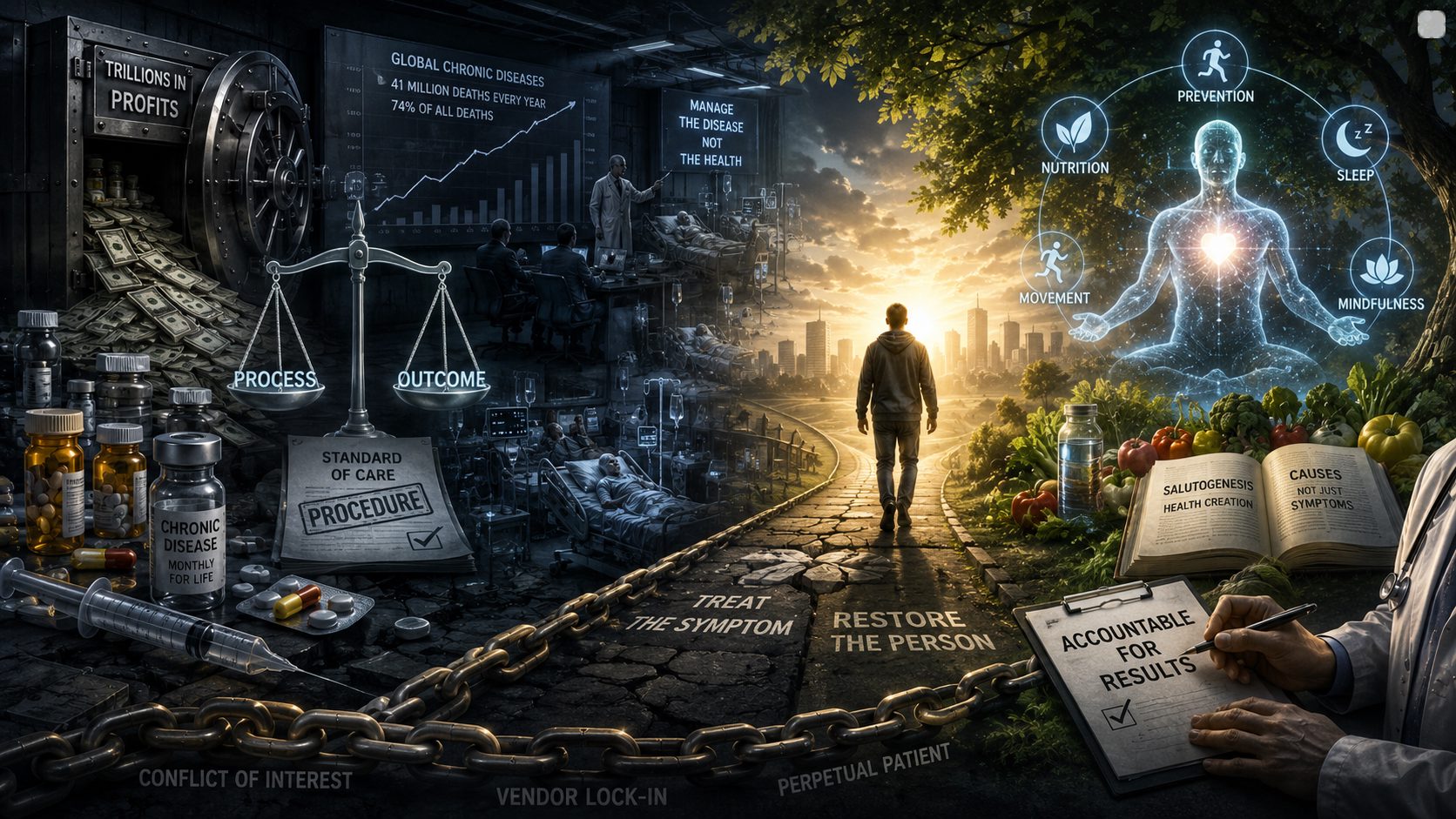
Medicine That Isn't Held Accountable for the Result
The global pharmaceutical market is $1.5 trillion a year, while chronic disease takes 41 million lives — 74% of all deaths, and the share is rising. The reason is structural: a doctor is judged for following the protocol, not for whether the patient recovered. The opioid epidemic and the Sacklers' $7.4 billion show where that leads.
I’m no enemy of science. Antibiotics, vaccines, insulin for type 1 diabetes, surgery pulled humanity out of an age when half of all children didn’t reach adulthood. That is exactly why I have the right to say the other half out loud: modern healthcare keeps a ledger it never prints — and it’s about money, accountability, and the very definition of “health.”
A trillion goes in — the epidemic grows
The global pharmaceutical market is about $1.5 trillion a year. Now the other column. According to the WHO, noncommunicable diseases kill ~41 million people a year — 74% of all deaths on the planet — and the share is rising, not falling. Cardiovascular disease ~18 million a year, cancer ~10 million, and more than 530 million people live with diabetes.
Ask a simple question: if trillions truly reversed disease, why is the burden swelling? The answer is uncomfortable: the system has learned to manage chronic disease brilliantly, but barely tries to reverse it — because a lifelong prescription sells every month, and remission doesn’t sell at all.
Accountable for the process, not the outcome
Here is the core. The law judges medicine by the standard of care — did the doctor do what the profession accepts. Whether you were cured is legally irrelevant. That’s why you can’t sue “for not being cured”: the law knows no such claim, only deviation from protocol.
Consider the construction: you pay enormous sums, it doesn’t help, they write the next drug — “this one’s more effective” — and so on for years. And there’s no one to answer, because formally everything was done “right.” This is a system accountable for following procedure and unaccountable for the result. In any other industry it would be called what it is.
It studies the breakdown, not health
Medical science knows pathogenesis — how the body breaks — far more deeply than salutogenesis — where health comes from (Aaron Antonovsky’s term). Medical schools give a sliver of time to nutrition, sleep, stress, lifestyle, prevention. They train a brilliant diagnostician and prescriber — not a mentor of health. The philosopher Ivan Illich named it bluntly back in 1975 (“Medical Nemesis”): medicine expropriated health, turning a person into a lifelong consumer of services.
When management beats a cure
The cleanest example of where the incentives lead is the opioid epidemic. Per the CDC, from 1968 to 2020 more than 1.1 million people died of overdoses in the US; the wave was largely driven by the aggressive marketing of Purdue’s OxyContin, which spent years assuring doctors the addiction risk was “minimal.” The Sackler family agreed to pay $7.4 billion — money that will resurrect no one. Alongside it: “disease-mongering,” repackaging normal states as diagnoses to fit a pill. And the link between the one who prescribes and the one who sells hasn’t vanished: the US Open Payments database alone shows billions in industry payments to physicians.
But you can’t throw out the baby with the bathwater
Here I’m obliged to draw a line, because beyond it are other people’s lives. That same “system” took childhood leukemia from near-total mortality in the 1960s to ~90% cure. Modern antivirals fully cure hepatitis C — in a single course. The HPV vaccine collapses cervical cancer. Insulin in type 1 is not a “hook” but a replacement for what the body has physically stopped producing.
The enemy is not treatment. The enemy is the incentive system that profits from its endlessness, and the legal construction that strips it of accountability for the outcome. To reject medicine out of hatred for its greed is to punish yourself for someone else’s sin.
What to demand
Not to flee doctors — but to demand a different medicine:
- one accountable for the result, not only the protocol;
- one that seeks the cause, not silences the symptom until the next visit;
- one that aims for remission where it’s possible (type 2 diabetes — DiRECT, Lancet 2018: nearly half of patients reached remission without drugs through weight loss);
- one whose incentives align with the patient’s health, not with their lifelong dependence;
- one that teaches health as seriously as it teaches disease.
And this must be said
Even knowing that capital smothers any truth that threatens its profit. But the truth their money cannot smother is not a loud slogan — it’s the unshakable, structural one: trillions go in, the burden grows; the system is judged for process, not result; it studies the breakdown, not health; and it wears an authority that places it beyond ordinary challenge. These are their own figures and their own laws. Capital cannot refute that.
The best healer does often live within the person. But the best medicine is the one that helps wake it — not the one that milks his fear to the last breath.
Sources: WHO — noncommunicable diseases (74% of deaths) · BMJ 2016 — medical error (Makary & Daniel) · CDC — overdose deaths · NPR — Purdue/Sackler $7.4B · Lancet 2018 — DiRECT
If you have found a mistake or a typo in this article, tell us about it
Comments (0)
Log in to leave a comment →
No comments yet. Be the first.