

The dragon at the inflection: why a slowing China is more dangerous than a rising one
For thirty years the argument was when China would overtake America; in 2026 the question is whether it has already passed its peak. A rising power is patient; one that suspects time is against it becomes impatient. Four camps of experts and the blind spot of each, an independent diagnosis, and a forecast for 2026-2036.
For thirty years the whole world argued about one thing: when will China overtake America? In 2026 the question quietly flipped to its opposite: has China already passed its peak? And that is a different, far more dangerous framing. Because a rising power is patient — time is on its side. A power that has begun to suspect that time is working against it becomes impatient. It is in that gap — not in the GDP growth rate — that the fate of the coming decade is hidden, for China and for everyone near it.
Before offering our own diagnosis, let us look from altitude at those who have already offered theirs. Because there is one thing to know about China experts: almost every one of them views the dragon through a particular lens — and that lens is rarely neutral.
The map of opinions and its blind spots
Today the argument about China runs between four camps, and each has its strength and its blindness.
“Peak China” and the “danger zone.” Michael Beckley and Hal Brands (the book Danger Zone) made the idea mainstream: China is already on a plateau — strong enough to challenge the order by force, but ever less certain that time is on its side, and therefore prone to a risky lunge in the 2020s, above all over Taiwan. The school’s strength is sharp political instinct. Its weakness is bias: this is the view of American security “hawks,” where demography is turned into a verdict, and the urgency of the threat conveniently coincides with the task of mobilizing Washington. Demography matters, but it is the least flexible of the variables; it does not cancel economics, industrial output, or technology.
The economic pessimists. Derek Scissors and analysts close to him have for years meticulously counted China’s weaknesses — debt, real estate, productivity — and are almost always right on the details. Their blind spot is the “perpetual bear”: one who predicts a crisis every year will one day be right, but will have missed everything China built in the meantime.
The optimists of the model. Keyu Jin (The New China Playbook) knows the system from the inside and convincingly shows its ingenuity — regional competition, industrial policy, speed. Her bias mirrors the pessimists’: sympathy for the model leads to an underestimation of the structural rot and the political risk of one-man rule.
The multidimensional centrists. Evan Medeiros and Oriana Skylar Mastro reject the very binary of “peak or rise”: China is neither sinking nor omnipotent, but a long-term, multidimensional rival that is more likely to wait and build strength than to rush into an adventure. This is the soberest camp — but sometimes so cautious that it stops predicting at all.
The conclusion from this map is simple: everyone is right — and therefore no one is. The binary “China is rising or falling” is false. It is doing both at once — and that is where the independent analysis begins.
Diagnosis: two countries in one body
Look at the figures of 2026 without ideology, and you see neither a rise nor a collapse, but the exhaustion of one growth model before the next has been found.
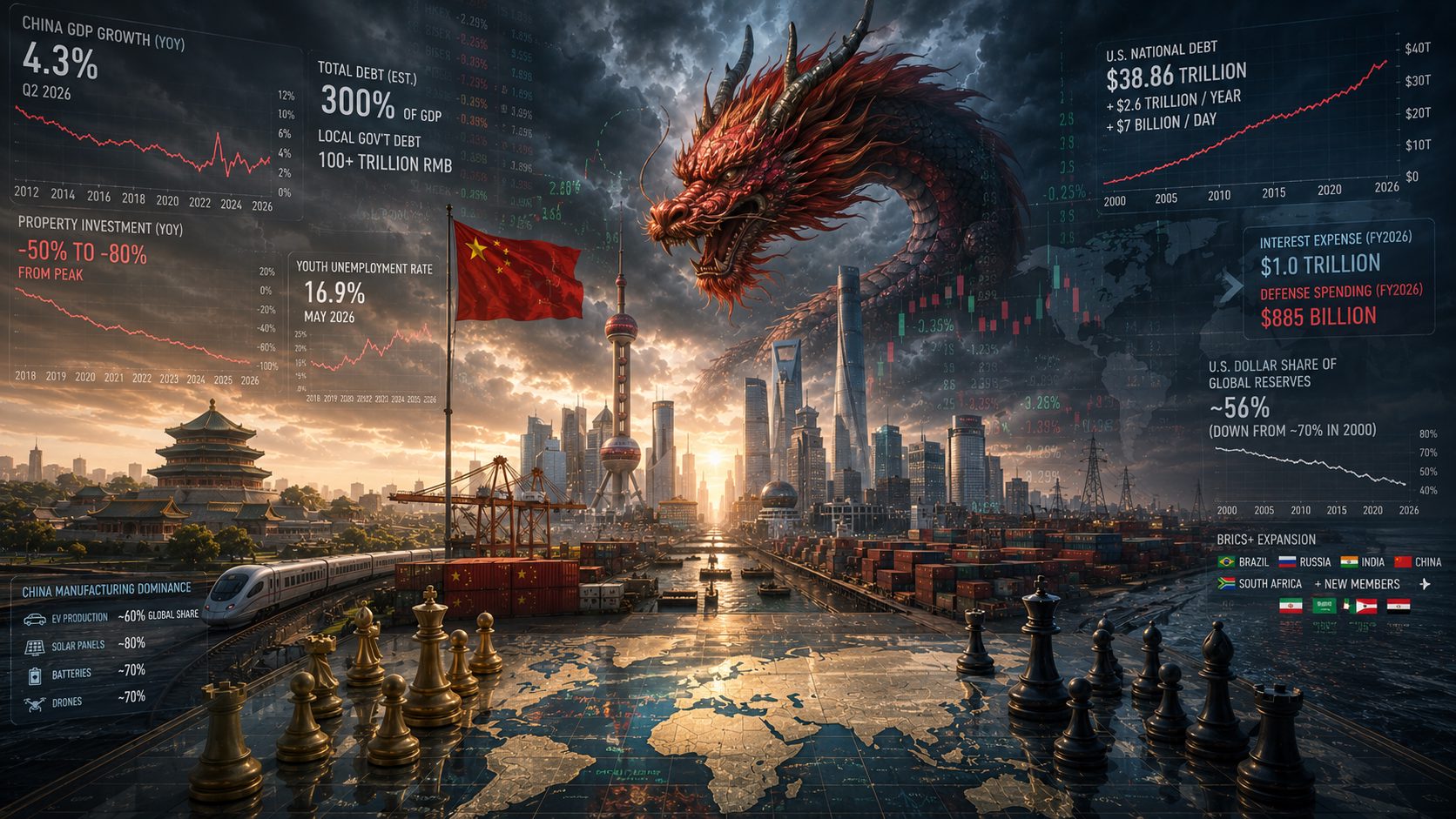
The old model — investment, construction, exports, cheap labor, catch-up development — has run out of breath before our eyes. Growth in the second quarter of 2026 was 4.3%, the lowest in three and a half years, and the slowdown has become structural, not cyclical. Real estate, for years a quarter of the economy, has collapsed: investment has fallen 50–80% from its peak, with no convincing bottom in sight. The economy has lived in deflation for nearly ten quarters — consumer prices near zero — and that is a Japanese demand trap: people do not spend because they expect tomorrow to be cheaper, and by expecting it they make tomorrow poorer. Local-government debt has passed 100 trillion yuan; the total debt burden is around 300% of GDP. Youth unemployment is near 17%. Demography has turned: the population is aging and shrinking, and that is no longer a forecast but a fact.
But in the same body lives a second country — and it is not falling but rising. China has become an industrial superpower of a new kind: it dominates the production of electric vehicles, solar panels, batteries, drones — not the assembly of others’ goods but entire value chains. Under an external blockade on chips, it has thrown everything at technological sovereignty, and in the “new productive forces” — from batteries to applied AI and robotics — it is not a follower but one of the pace-setters. The problem of this second country is not weakness but surplus: its factories produce more than the world is ready to buy, and China’s overcapacity spills outward as cheap exports, triggering trade wars everywhere — from Washington and Brussels to the very Global South that Beijing is courting.
Here is the inflection: not a “strong China” and not a “weak China,” but a China whose old economic engine is stalling while its new one is spinning up — and spinning up in a world that fears that power.
Politics: the choice of control over reform
The key to the next decade lies not in the numbers but in one strategic choice Xi Jinping has already made. Facing the exhaustion of the model, the leadership had two paths: reform (hand more to the market, to consumption, to the private sector — and give up part of the control) or consolidation (tighten the screws and replace the legitimacy of growth with the legitimacy of strength and nation). Xi chose the second — and it shows in everything.
The purges in the army — dozens of senior PLA and defense-industry officers removed, campaigns of loyalty and ideology — are not a fight against corruption but a centralization: the leadership is preparing an instrument it must trust unconditionally. “Common prosperity,” pressure on private capital, ideologization — all of it optimizes not for GDP but for the survival of the regime and the unification of the country. And here is the disturbing logic that the economists underestimate and the hawks overstate: a power that has swapped the legitimacy of growth for the legitimacy of nation needs external victories to compensate for stagnation at home. A slowdown does not humble such a regime — it raises the price of inaction.
Forecast: the decade of the turn (2026–2036)
Now to the datable and checkable — so that years from now it is clear who read the map and who read the feed.
Economy: Japanification, not collapse. Both “China’s collapse” and “overtaking America” are mistaken extremes. The most likely path is a slow deflationary drift: growth slides toward 2–3%, a balance-sheet recession drags on for years, but there is no systemic crash — the state has too many levers. China most likely plateaus roughly level with the US in nominal GDP and may never cleanly overtake it. Checkable marker: if by the early 2030s China’s nominal GDP has still not durably surpassed America’s, the “overtaking” is cancelled — a historic event in itself.
Model: the workshop and laboratory of the world. The bet on the “new productive forces” will double. China will be both the factory and, increasingly, the laboratory of the physical world — in batteries, EVs, solar, robotics, applied AI. The consequence: chronic overcapacity and therefore trade walls around the whole perimeter, including those Beijing calls friends. Marker: a rising Chinese share of global industrial output alongside a multiplication of anti-dumping barriers against it — by the end of the decade both will intensify.
Taiwan: the main tail risk, but not the most likely scenario. Against the loudest school, I argue: over the next decade the most likely path is not a landing but a victory without a fight — blockade, “gray zone,” diplomatic isolation of the island, political capture from within. A full-scale invasion is too risky, and Xi prefers a bloodless triumph. But the “danger zone” of the late 2020s is real: it is a window of miscalculation where accident matters more than intent. Alarm markers: not rhetoric but quarantine drills around the island, rehearsals of a blockade and — most tellingly — if Washington, under domestic pressure, begins to distance itself from Taiwan (and the first signals appeared after the Beijing summit of Trump and Xi), Beijing will read it as a green light for coercion.
The world: a split into two circuits. Technology, payments, and supply chains diverge into two hemispheres — American and Chinese — while both court the Global South. Beijing is building an alternative governance circuit (its “global governance initiatives”); de-dollarization proceeds at the margins. But the paradox of the decade: China remains the indispensable industrial node even for its own rivals — the divorce will be expensive, slow, and incomplete.
The black swan — succession. Xi removed the horizon-limit on power but created no mechanism of transfer. A system without a clear successor is fragile precisely at the top. If in this decade the question of Xi’s health or departure arises, the entire structure enters a zone of maximum turbulence. This is the least discussed and most underestimated risk.
Why this concerns us in particular
For Kazakhstan, China is not a distant dragon but the nearest neighbor and a rising center of gravity. As Russia weakens and Europe is far away, Beijing turns westward — and Central Asia turns from a “backyard” into a strategic corridor: the Middle Corridor bypassing Russia, energy, investment, transit. This is a chance — and a trap. The chance: to become needed by everyone at once. The trap: that same tax of a transitional era — the pressure to pick a side between China, Russia, and the West. The deeper the world splits into two circuits, the dearer the price of a multi-vector course — and the more valuable the skill of holding it.
The practical conclusion is not “befriend one against another” but “see the asymmetry”: China will be at once a generous investor and a hard creditor, a partner and a competitor, a window onto the world market and a channel of dependence. It is naive both to fear it and to worship it; the sober course is to bargain, to diversify, and not to mistake proximity for destiny.
In place of a conclusion: the inflection as the diagnosis of the era
What is worth remembering is not the growth rate nor the date of “overtaking.” What is worth remembering is the shape: China is at an inflection, where the old strength is departing and the new has not yet settled, and it is precisely this asymmetry that makes it more dangerous than on a smooth ascent. A rising giant waits. A giant that has begun to suspect that time is against it hurries. The task of the thinking observer is not to guess “will it rise or fall,” but to hold both countries in one body at once and to watch the markers, not the headlines.
Ten years from now it will be clear who read this inflection right. And, as always, the privilege of seeing it in time belongs not to whoever cheers loudest for one side, but to whoever looks at the dragon without fear and without awe. It is for that gaze — free and sober — that attention is worth paying.
Sources: Foreign Affairs — The Delusion of Peak China · AEI — Has China Peaked? A Debate · Foreign Policy — Beckley vs Keyu Jin · CSIS ChinaPower — U.S.–China 2026 · Foreign Affairs — China Could Win Taiwan Without Fighting · CKGSB — China Economy 2026
If you have found a mistake or a typo in this article, tell us about it
Comments (1)
Log in to leave a comment →
Мен әдейі ыңғайлы «көтере ме, әлде төмендей ме» деген тәсілден бас тартып, оның орнына күні көрсетілген расталатын диагнозды ұсындым. Қазір сізге сұрақ: төрт сарапшы лагерінің қайсысы ең қателеседі және неге? Я сознательно отказался от удобного «поднимется или упадёт» и поставил проверяемый диагноз с датой. А пока — вопрос к вам: какой из четырёх экспертных лагерей ошибается сильнее всех и почему? I deliberately abandoned the convenient "will it rise or fall" approach and instead offered a verifiable diagnosis with a date. For now, a question for you: which of the four expert camps is most wrong, and why?
Sign in to vote. 0 Sign in to vote.