

When interest outguns the army: how America's debt foretells the next decade
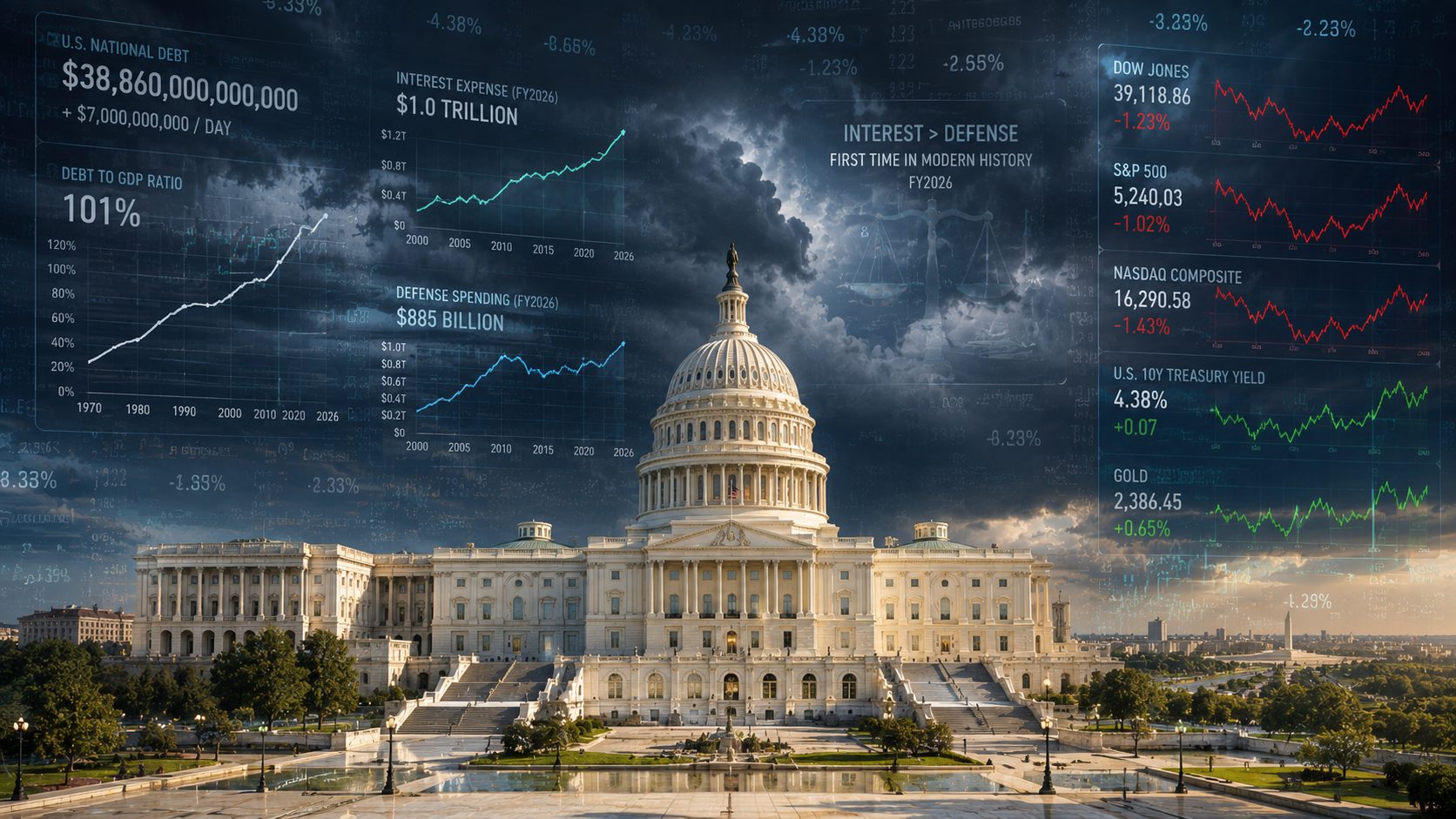
In 2026 the United States pays more on its debt than on its army: about $1.0 trillion in interest against $885 billion for defence. The federal debt stands at $38.86 trillion and grows by $7 billion a day. No great power that crossed this line stayed great for long — Spain, France, Britain. What that means for 2027–2035.
Historians have a name for this moment. Niall Ferguson, building on Paul Kennedy’s classic The Rise and Fall of the Great Powers, framed it almost as a law: no great power that comes to spend more on servicing past debt than on its own defense stays great for long. Habsburg Spain, Bourbon France, imperial Britain — all crossed this line, and all entered their autumn behind it. In 2026, America crossed it.
The mass reader will see here another scare story about debt. But if you look not from the ground but from altitude — with the eagle’s eye that sees not the event but the cycle — this number opens up the map of the coming decade. Let us read it.
Method: to see forward, look back
History, like life, is cyclical — and that is not poetry but a working tool of forecasting. Ray Dalio, having studied five centuries of the rise and fall of powers, described the “Big Cycle”: empires pass through Rise, Top, and Decline over roughly 250 years, and almost always by the same script. First — productivity, a strong currency, victories. Then success breeds excess: the country grows used to living on debt, prints money, wages expensive wars, and its currency turns from a privilege into a burden. Of the roughly 750 currencies that have existed since 1700, about 20% survive today — and every one of them has been devalued. Reserve currencies are not eternal: the guilder yielded to the pound, the pound to the dollar. Not one handover was either voluntary or peaceful.
Here is the knot the attentive reader asked us to untie: the link between debt and great wars. It is not mechanical (“debt causes war”); it is structural. A debt peak is the marker of the exhaustion phase, when the reigning hegemon can no longer pay for the order it built, while the rising challenger is not yet ready to shoulder it. In that gap the system re-prices power — and it does so, as a rule, through conflict.
Look at the seams. The Dutch overstrained themselves in the Anglo-Dutch wars and collapsed under debts they could not repay. Britain twice — in the First and Second World Wars — smothered the fire with debt, drove it to nearly 250% of GDP, and emerged the formal victor but a monetary bankrupt: in 1944 at Bretton Woods the dollar took the reserve-currency crown. Every great war of the twentieth century coincided not with “average” but with abnormally high debt of the departing leader. Debt was not the cause but the symptom — the temperature of a dying order.
Diagnosis: where America stands now
Lay the template over the facts of 2026, and the picture becomes clinically clear.
The national debt of the United States is 38.86 trillion dollars, and it grows by about 7 billion a day, 2.6 trillion a year. Debt held by the public is 101% of GDP, and the curve is tilted upward. Interest is already a trillion a year and, by projection, will double by the mid-2030s. This is the line already crossed: interest over guns.
But beneath the numbers is structure. Dalio points to an early sign of a shift of power: when a rich country begins to borrow from a poorer one that saves more. The US entered this phase back in the 1980s, beginning to borrow from China — and since then creditor and debtor have swapped roles historically. Add to this what Dalio states plainly: the dollar is late in its cycle, its share of global reserves is slowly but steadily declining (from about 70% at the turn of the century toward today’s 55–58%), and trust in fiat money is eroded by debt, inflation risk, and geopolitical fragmentation.
In other words, America is not at the beginning, nor even at the peak, of the Big Cycle. It is at the inflection from Top to Decline. Not a crash tomorrow; a relative decline stretched over years, almost invisible in any single year but, over a decade, irreversible.
Forecast: the transition zone of 2027–2035
Now to the point for which such an article is written. Not a description of the present, but a datable, checkable claim about the future — so that years from now one can say who read the map right.
The thesis: the second half of the 2020s and the early 2030s are a transition zone of the world order, structurally the most dangerous stretch of the Big Cycle. Not because “someone is evil,” but because that is how the inflection works: the departing hegemon is expensive and irritable, the rising one impatient, and the money that binds the system is losing trust. In this window one should expect three things at once: a monetary reset (erosion of the dollar’s share, a rise in gold and workaround settlements, trade blocs instead of a single market); a sharpening of great-power friction (the classic “Thucydides trap” between the US and China, where a strong power’s fear of a rising one has historically led to war more often than to peace); and an elevated risk of wars on the periphery — where spheres of influence are being redrawn.
To make this a forecast and not a prophecy, here are three counters by which the reader can check me by the early 2030s:
- Interest versus discretionary spending. The line with defense has already been crossed; the next milestone is when debt service overtakes all discretionary spending at once. If this happens in the first half of the 2030s (and budget models point exactly there) — the cycle is on schedule.
- The dollar’s share of world reserves. The alarm threshold is a sustained fall below 50%. A slow slide is the norm of decline; a break below that mark is a signal of acceleration.
- The debtor–creditor inversion and de-dollarization at the margin. A rising share of gold in central-bank reserves, of bilateral settlements bypassing the dollar, of BRICS+ attempts to build a parallel circuit. Not a replacement of the dollar tomorrow — but multiplying insurances against it.
If by 2032–2035 all three converge — then we are living inside a change of order, not inside another business cycle. I claim they will converge.
Why this concerns us in particular
There is a temptation to say: this is a clash of titans across the ocean. But in a reserve-currency transition it is not the titans who suffer most, but small open economies — such as Kazakhstan’s. They are the first to feel the currency swings (the tenge and the ruble are a derivative of the dollar’s strength), the first to bear the costs of fragmenting trade, and it is on them that the main tax of a transitional era presses hardest — the demand to pick a side. In a unipolar world one could be “multi-vector.” In a world that re-prices power, neutrality grows dearer every year.
The practical conclusion for our reader is not “flee” but “see”: diversify — from currencies to markets to alliances — and do not mistake the inertia of a departing order for its solidity. Those who in the 1930s thought the pound eternal, and in the 1980s that the USSR was forever, were wrong not about the facts but about the optics: they looked at the system at the moment it was already tilting.
In place of a conclusion: the number worth remembering
The number worth remembering is not 38 trillion — that figure will be larger tomorrow. What is worth remembering is the crossing: the day interest on the debt first overtook the army. This is not an accounting trifle but a historical marker — the same one that lit up over late Spain, late France, late Britain. It does not guarantee catastrophe and it names no date. It says one thing: the season is ending.
History does not repeat word for word, but it rhymes, and the rhyme of this decade is monetary. The task of the thinking person is not to panic and not to gloat, but to read the cycle before everyone else reads it. Ten years from now it will be clear who was looking at the map and who at the news feed.
And, finally, the reason such analysis is possible at all. To discern the decline of the strong without flattering the strong and without fearing them — that is the privilege of independent thought. Where the decline of power is looked at openly and in time, a society has a chance to prepare. Where it is forbidden to look — it is met without warning.
If you have found a mistake or a typo in this article, tell us about it
Comments (1)
Log in to leave a comment →
Это ставка вдолгую, а не колонка на злобу дня. Вернитесь к трём счётчикам через десять лет. А пока один вопрос к вам: какой четвёртый индикатор вы бы добавили?
Sign in to vote. 0 Sign in to vote.