

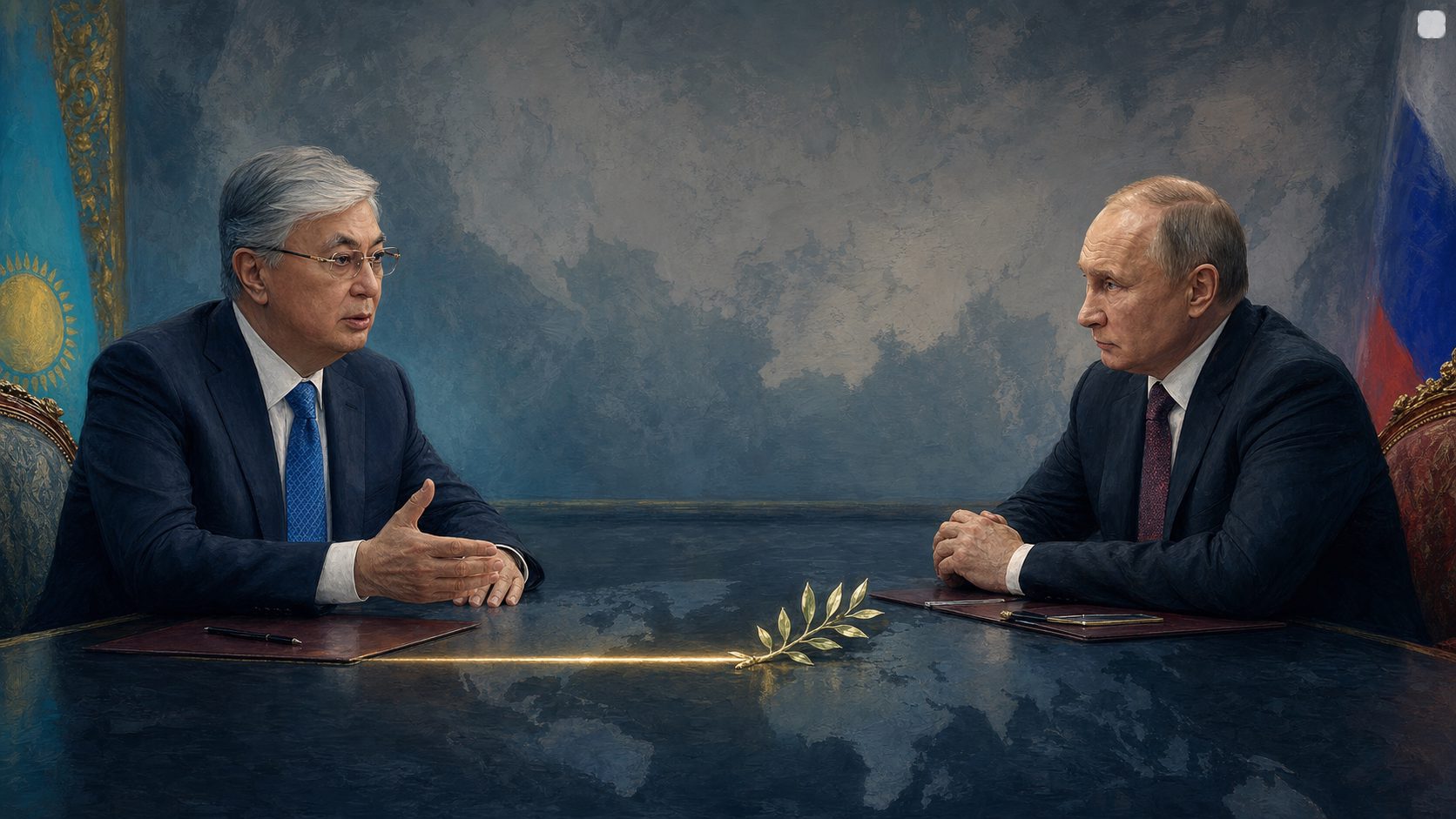
Not a Pivot, but a Warning: What Tokayev Told Putin in Omsk
In Omsk, seated beside Putin, Tokayev proposed freezing the war in Ukraine and returning to the Istanbul Formula 2.0. Why this is not a pivot away from Moscow, and why it is not only about humanity: about 80% of Kazakhstan's oil exports run through the Caspian Pipeline Consortium to a terminal near Novorossiysk.
The meeting, on the sidelines of the 22nd Forum of Interregional Cooperation, had been prepared as routine — trade, energy, good-neighbourliness. But Kassym-Jomart Tokayev stepped outside the protocol: “Perhaps the time has come to freeze this conflict and return to the Istanbul Formula 2.0” — under the guarantees of the great powers, Russia included. And he added something that lands harder than any geopolitics: the young men dying on both sides are “the gene pool of fraternal peoples,” and “all of this must be stopped.”
Kyiv responded at once: Ukrainian Foreign Minister Andrii Sybiha called the statement “realistic, timely and wise.” The Kremlin answered with restraint through Dmitry Peskov: Tokayev’s position is “consistent,” but “that does not mean we agree” — though “Kazakhstan remains our closest partner and ally.” The freeze itself Putin declined.
Why it rang louder than usual
A call for peace surprises no one anymore — the whole question is the terms. What surprised here was not the words but the stage. Tokayev said this not from a UN podium nor in a Western interview, but in Russia, next to Putin, at a forum devoted to the friendship of the two countries. Calling for peace where it is safe is one thing. Saying it to the face of the man on whom your pipelines, your transit and your seven-thousand-kilometre border depend is quite another.
This is not a pivot away from Moscow
It would be a mistake to read Omsk as an anti-Russian pivot. At the very same meeting Tokayev reaffirmed the strategic partnership, recalled nearly $28 billion in trade and the joint project to build Kazakhstan’s first nuclear power plant. The economy, transit and geography have not gone anywhere. Astana’s multi-vector policy is not about choosing a side, but about avoiding critical dependence on anyone. Tokayev did not take a side. He marked a limit.
Someone else’s war is no longer someone else’s
And here is the most important part — the one the loud headlines mention least. About 80% of Kazakhstan’s oil exports run through the Caspian Pipeline Consortium to a terminal on the Black Sea near Novorossiysk. In July, drone strikes on tankers forced Kazakhstan to cut production and halt shipments. For Ukraine, Russia’s oil infrastructure is a legitimate military target; but our oil flows through the very same pipe.
The alternatives — the Trans-Caspian route, China, the Caucasus — so far exist more in presentations than in steel. You cannot redirect tens of millions of tonnes of oil with a political statement: it takes years, ports, tankers, treaties. So the call to stop the war is not only about humanity. It is about Kazakhstan’s budget, its exports and its security.
A “freeze” is not yet peace
Here let me allow myself some sobriety. To stop the shooting is to save thousands of lives immediately, and that alone is reason enough to say the idea out loud. But a frozen conflict is not the same as peace. Transnistria, Abkhazia and Karabakh smouldered for decades precisely as such “pauses.” Everything depends on guarantees: who gives them, who monitors their fulfilment, and whether Ukraine itself agrees to such a formula. There is no peace about Ukraine without Ukraine.
And, honestly: the weakest part of the speech is the claim that “the nature of the conflict is not entirely clear.” The motives are complex, but the chronology is simple. Diplomatic language must not dissolve the fact that borders were being redrawn by force. For a country with our geography, the inviolability of borders is not an abstraction but a question of survival.
Boldness abroad — and vulnerability at home
This boldness has a flip side worth stating plainly — not as a reproach, but as a risk analysis. To correct Putin in public is to wound him personally. And Moscow holds more than diplomacy in reserve: oil transit through the CPC, the military tie of the CSTO (in January 2022 it was precisely those forces that helped Tokayev during the unrest), the Russian-speaking north, and the long habit of certain Russian politicians of casting doubt on Kazakhstan’s borders. The Kremlin does have a set of levers for an “undemocratic” reply — from economic pressure to information campaigns — and it cannot be ruled out that it will not forget the public correction.
And here is the key paradox. On July 7 the Constitutional Court “reset” Tokayev’s presidential terms, opening his path to run again even after 2029 — almost literally repeating Putin’s own move of 2020. But a legitimacy that rests on the apparatus and the courts, rather than on a living mandate from society, is exactly what makes a leader more vulnerable to outside pressure. An apparatus can be bent; a mandate won in fair competition is far harder to bend. That is why the strongest armour of a sovereign foreign policy is not tighter screws at home, but strong institutions: an independent parliament, a free press, a genuine turnover of power.
My opinion
Tokayev said more than Russia’s allies usually allow themselves — and less than full legal clarity would demand. He called for the war to stop but did not name the aggressor; he spoke of guarantees but did not explain how they would work; he offered a formula but refused to mediate. For a diplomat, that is reasonable caution. For history, it is still only a first step.
And yet the step matters. The world looks less and less like a system in which a few superpowers decide for everyone else; the weight of “middle” states — those able not to follow automatically in someone’s wake — keeps growing. True multi-vector policy begins not when you pose for photographs with leaders, but when you can tell each of them an uncomfortable truth — and keep the relationship afterwards. But to speak such truths with impunity, you need more than a vertical of power behind you: you need the trust of your own society.
In Omsk, Kazakhstan took a small step in exactly that direction. The word “peace” has been spoken. Now deeds will decide everything.
Sources: Euronews · The Astana Times · The Moscow Times · Bloomberg · Constitutional Court: The Washington Post · The Insider · Kaktus.media (video)
If you have found a mistake or a typo in this article, tell us about it
Comments (0)
Log in to leave a comment →
No comments yet. Be the first.