

Python: from data to your own digest Lesson 23 of 56
On a schedule: arguments, a journal, a lock and an exit code
The twenty-third lesson of the Python course. A program that works through the night without you: arguments instead of editing the source, a journal with levels instead of `print`, a lock against two runs at once, and the exit code — the one thing the scheduler actually reads. Plus cron, launchd and systemd.
Why this is needed
The digest has learned to fetch data, put it into a database and answer with queries. One thing is left: all of that happening without you.
A program started by a scheduler lives in another world. Nobody sees its output. Nobody edits the day in its source. It may start a second time while the first is still running. And the only thing the system will learn about it is the number it returns.
So this lesson is not about cron. It is about the four things without which cron is useless.
The whole thing at once
The file is kesteme.py. Run it with python kesteme.py from inside the environment.
The required part is the first three blocks: the arguments, the journal and the lock. The fourth shows the exit code, which is the reason a scheduler looks at a program at all.
"""Lesson 23: a program that works while you are away.

It is time the digest ran on a schedule. Three things separate that from hope:
arguments instead of editing the source, a journal instead of print, and one
copy running instead of two.
"""

import argparse
import logging
import subprocess
import sys
from pathlib import Path

HERE = Path(__file__).resolve().parent
LOG = HERE / "svodka.log"
LOCK = HERE / "svodka.lock"

print("== arguments instead of editing the source")
parser = argparse.ArgumentParser(description="The digest for one day")
parser.add_argument("--day", default="today", help="the day as YYYY-MM-DD")
parser.add_argument("--dry-run", action="store_true", help="count without writing")
parser.add_argument("--verbose", action="store_true", help="a fuller journal")
# The arguments are handed in outright, so the lesson prints the same for all.
args = parser.parse_args(["--day", "2026-01-15", "--verbose"])
print("day:", args.day, "| dry run:", args.dry_run, "| verbose:", args.verbose)
print("defaults:", parser.parse_args([]).day, parser.parse_args([]).dry_run)

print()
print("== a journal instead of print")
logging.basicConfig(
    filename=LOG, filemode="w", encoding="utf-8",
    level=logging.DEBUG if args.verbose else logging.INFO,
    format="%(asctime)s | %(levelname)s | %(message)s",
)
log = logging.getLogger("svodka")
log.debug("detail: parsing %s", args.day)
log.info("day %s: 3 values taken", args.day)
log.warning("no rate for 2026-01-14, skipping")
try:
    1 / 0
except ZeroDivisionError:
    log.exception("division by zero while averaging")

# The time in the journal belongs to the run, so the lesson prints what comes
# after it, and does not print the stack lines log.exception added at all.
for line in LOG.read_text(encoding="utf-8").splitlines():
    if " | " in line:
        print(line.split(" | ", 1)[1])
print("and after it the file holds the stack — everybody's is their own")

print()
print("== one copy running instead of two")


def start():
    """Takes the lock, or refuses to work."""
    try:
        LOCK.touch(exist_ok=False)
        return True
    except FileExistsError:
        return False


print("the first run took the lock:", start())
print("a second run while it is held:", start())
LOCK.unlink()
print("after it is released:", start())
LOCK.unlink()

print()
print("== the scheduler reads the exit code")
worker = HERE / "rabota.py"
worker.write_text(
    "import sys\n"
    "sys.stderr.write('the source did not answer\\n')\n"
    "raise SystemExit(2)\n", encoding="utf-8")
done = subprocess.run([sys.executable, worker], capture_output=True, text=True)
print("exit code:", done.returncode, "| on stderr:", done.stderr.strip())
print("zero means all is well:", subprocess.run([sys.executable, "-c", "pass"]).returncode)

worker.unlink()
LOG.unlink()
It prints:
== arguments instead of editing the source
day: 2026-01-15 | dry run: False | verbose: True
defaults: today False

== a journal instead of print
DEBUG | detail: parsing 2026-01-15
INFO | day 2026-01-15: 3 values taken
WARNING | no rate for 2026-01-14, skipping
ERROR | division by zero while averaging
and after it the file holds the stack — everybody's is their own

== one copy running instead of two
the first run took the lock: True
a second run while it is held: False
after it is released: True

== the scheduler reads the exit code
exit code: 2 | on stderr: the source did not answer
zero means all is well: 0
Taking it apart
Arguments instead of editing the source
parser.add_argument("--day", default="today", help="the day as YYYY-MM-DD")
args = parser.parse_args(["--day", "2026-01-15", "--verbose"])
argparse turns a program into a tool: the day, the mode and the verbosity are chosen at the start, not by editing a file. For a schedule that is not convenience but necessity — you cannot edit code from a line of cron.
Three things it gives for nothing: a --help with every description in it, a clear error on an unknown argument, and defaults that are visible in one place. action="store_true" is a flag: it is either there or it is not.
Usually one writes parser.parse_args() with nothing in the brackets, and the real command line is parsed. The lesson hands the list in outright so that the output is the same for everybody; in your program the brackets will be empty.
Picture it. A car key. A program with arguments is a car you can start; a program with the number written inside is a car whose wheel is welded in one position.
A journal instead of print
DEBUG | detail: parsing 2026-01-15
INFO | day 2026-01-15: 3 values taken
WARNING | no rate for 2026-01-14, skipping
ERROR | division by zero while averaging
print writes into nowhere: at night nobody is looking at a terminal, and cron will at best post the output to you. logging writes into a file, and every line has a level and a time.
The levels are not decoration. DEBUG is turned on while something is being investigated; INFO is the ordinary course of things; WARNING is “we carry on, but notice this”; ERROR is “it did not work”. The level is set once, and the --verbose from the first block does exactly that: level=DEBUG instead of INFO.
log.exception(...) inside an except writes the stack of the error into the file — the one you read in lesson ten. That is the main reason to keep a journal: in the morning you have not “the program fell over” but the line it fell over on.
And a small thing that matters: log.info("day %s: %d taken", day, n) — with percent signs rather than an f-string. That way the text is assembled only if that level is on.
One detail of the program does not travel into real work: filemode="w" erases the journal on every run, and it stands here only so that the lesson’s output is the same for everybody. In a real program the mode is "a", appending — which is the default anyway — and to keep the file from growing without end there is RotatingFileHandler, by size, or TimedRotatingFileHandler, by day.
A lock: one copy running instead of two
the first run took the lock: True
a second run while it is held: False
The night’s run ran long, the time for the next one came — and now there are two. Both read the same source, both write into the same table; at best you pay in double traffic, at worst you get half the data from one and half from the other.
LOCK.touch(exist_ok=False) creates the file and fails if it is already there. That is a lock: the check for “is it taken” and the taking, in one indivisible act. An if LOCK.exists() on its own will not do — a second run fits between the check and the creation.
The lock is always released in a finally: a program that left its lock behind after a crash will never start again, and mending that is a job for hands.
The exit code: the one thing the scheduler reads
exit code: 2 | on stderr: the source did not answer
zero means all is well: 0
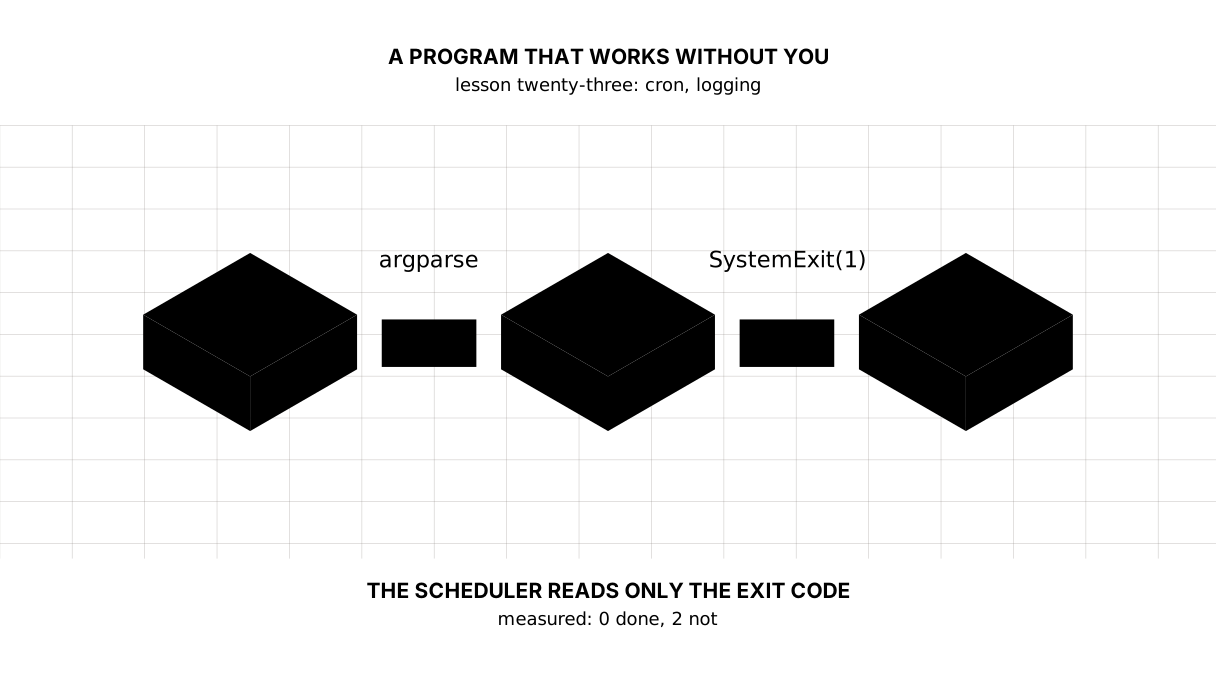
The scheduler does not read your journal. It looks at the number the program returned: 0 means it worked, anything else means it did not.
What happens to that number next depends on the scheduler, and the difference matters. systemd really does read the status: a service has Restart=on-failure, and a failure shows in systemctl status. Plain cron restarts nothing by itself: it can mail you whatever the program printed (MAILTO), and there its part ends. Retries, a message in a messenger and monitoring are things configured separately; the exit code only gives them their cue.
So a night-time program has a contract: raise SystemExit(1) when the work was not done, and zero when it was. The error itself is better printed to stderr — cron keeps the two streams apart.
The schedule itself
One line. On Linux and macOS it is crontab -e:
# minute hour day month weekday  command
30 7 * * *  /home/user/digest/.venv/bin/python /home/user/digest/main.py --day today >> /home/user/digest/cron.log 2>&1
Three rules everybody trips over:
- Full paths only. cron has neither your
PATHnor your current folder — hencePath(__file__).resolve().parentin the program and the full path to the environment’s Python here. - The timezone is the system’s, not yours.
30 7on a server in UTC is half past twelve in Almaty. - Redirect the output. Without
>> ... 2>&1cron will try to post it, and there is usually no mail on a server.
On macOS the same is done by launchd (a .plist file in ~/Library/LaunchAgents), on a modern Linux by a systemd timer (a .service and a .timer), on Windows by Task Scheduler. They differ in syntax; everything this lesson is about is the same for all of them.
The map of the lesson
Say it in your own words
Without looking, answer out loud or on paper. The answers are at the end of the lesson.
- Why is the day chosen with an argument rather than a line in the source?
- How does
loggingdiffer fromprintfor a program that runs at night? - What is a lock for, and why does
if LOCK.exists()not replace it?
Warm-up
Three short steps before the exercise: predict, fill in, fix. The answers are at the end of the lesson, but answer them yourself first.
1. Predict. What does this program print?
import logging
import sys

logging.basicConfig(stream=sys.stdout, level=logging.INFO,
                    format="%(levelname)s: %(message)s")
log = logging.getLogger("demo")
log.debug("a detail")
log.info("done")
log.warning("something is off")
2. Fill in the gap. In place of ... set the default that gets printed when the command line is empty.
import argparse

parser = argparse.ArgumentParser()
parser.add_argument("--day", ...)
print(parser.parse_args([]).day)
3. Fix it. The scheduler starts the program from a folder of its own, and the file beside it stops being found. Make the path such that it does not matter.
# the program puts a file beside itself and then walks off into another folder —
# which is exactly how a scheduler starts it
import os
from pathlib import Path

(Path(__file__).resolve().parent / "dannye.csv").write_text("2026;8.0\n", encoding="utf-8")
os.chdir("/")                      # a scheduler starts it from its own folder
print("found the file:", Path("dannye.csv").exists())
Exercise
Required. Write the digest’s night run. It needs: the arguments --day (with a default) and --dry-run; a journal in a file, with levels and times; a function run(day, dry) that takes the lock, writes into the journal what it is doing, releases the lock in a finally, and returns 0 on success and 1 when the lock is held.
Call it three times: an ordinary run, a run while the lock is held (make the lock by hand), and a run with --dry-run. Print the exit code of each, and at the end the journal without its times.
The expected output:
the first run, code: 0
a run while the lock is held, code: 1
a dry run, code: 0
the journal:
  INFO | day 2026-01-16: started
  INFO | day 2026-01-16: 2 rows written
  WARNING | day 2026-01-16: another run is under way, leaving
  INFO | day 2026-01-16: started
  INFO | day 2026-01-16: counting without writing
Done when: the output matches line by line; the lock is released in a finally rather than after the successful branch; a held lock gives a WARNING and a code of 1 rather than a crash; every path is built from Path(__file__).resolve().parent.
On your own data. Put your own program on a schedule on your own machine — cron, launchd or Task Scheduler — for five minutes from now. Wait for it and read the journal. That is the only way to find out whether you wrote the path to Python correctly.
Optional.
- Add a
--log-leveland learn to turnDEBUGon from the command line. - Make the program fall over on purpose and see what
log.exceptionput in the journal. - Start two copies at once (
python main.py & python main.py) and check that the second left with a code of1.
Where this goes in the project
The digest becomes a service. Once a day it fetches the rate itself, puts it into the database, writes into the journal what it did, and returns zero — and you hear about it only when the zero stops coming.
Still open. Our lock is a file, and the trouble with it is the opposite of the obvious one: it does survive a crash. Kill the program, pull the power — the file stays where it was, and the next run finds the lock taken with nobody holding it. In the morning it comes off by hand. The cure is to write the process number and the time into the lock: if no process with that number exists, the lock is stale and can be removed on the spot. And the journal grows without limit — rotation waits where the server does.
The answers
To the questions
- Because a line in the source cannot be changed from a schedule: cron can start a command, not edit a file. An argument turns the program into a tool with modes, and
--helpinto the place where those modes are described. printwrites where nobody is at night.loggingwrites into a file, marks importance with a level and the moment with a time, andlog.exceptionputs the stack of the error beside it. In the morning that is the difference between “it fell over” and “it fell over here”.- A lock keeps two runs from doing one job twice.
if LOCK.exists()does not replace it because a second run fits between the check and the creation of the file: what is needed is one indivisible act, andtouch(exist_ok=False)is that act.
To the warm-up
- Two lines:
INFO: doneandWARNING: something is off.DEBUGis below the level that was set, so it is not seen — the level is the switch for detail.
INFO: done
WARNING: something is off
default="today". A default is the answer to “and if it was not given”, and it belongs where the argument is declared.
import argparse

parser = argparse.ArgumentParser()
parser.add_argument("--day", default="today")
print(parser.parse_args([]).day)
today
- The path
Path("dannye.csv")is relative to the current folder, and the scheduler sets that. Build from the program’s own folder, and where it was called from stops mattering:
import os
from pathlib import Path

HERE = Path(__file__).resolve().parent
(HERE / "dannye.csv").write_text("2026;8.0\n", encoding="utf-8")
os.chdir("/")                      # a scheduler starts it from its own folder
print("found the file:", (HERE / "dannye.csv").exists())
(HERE / "dannye.csv").unlink()
found the file: True
Sources
If you have found a mistake or a typo in this article, tell us about it
Comments (0)
Log in to leave a comment →
No comments yet. Be the first.