

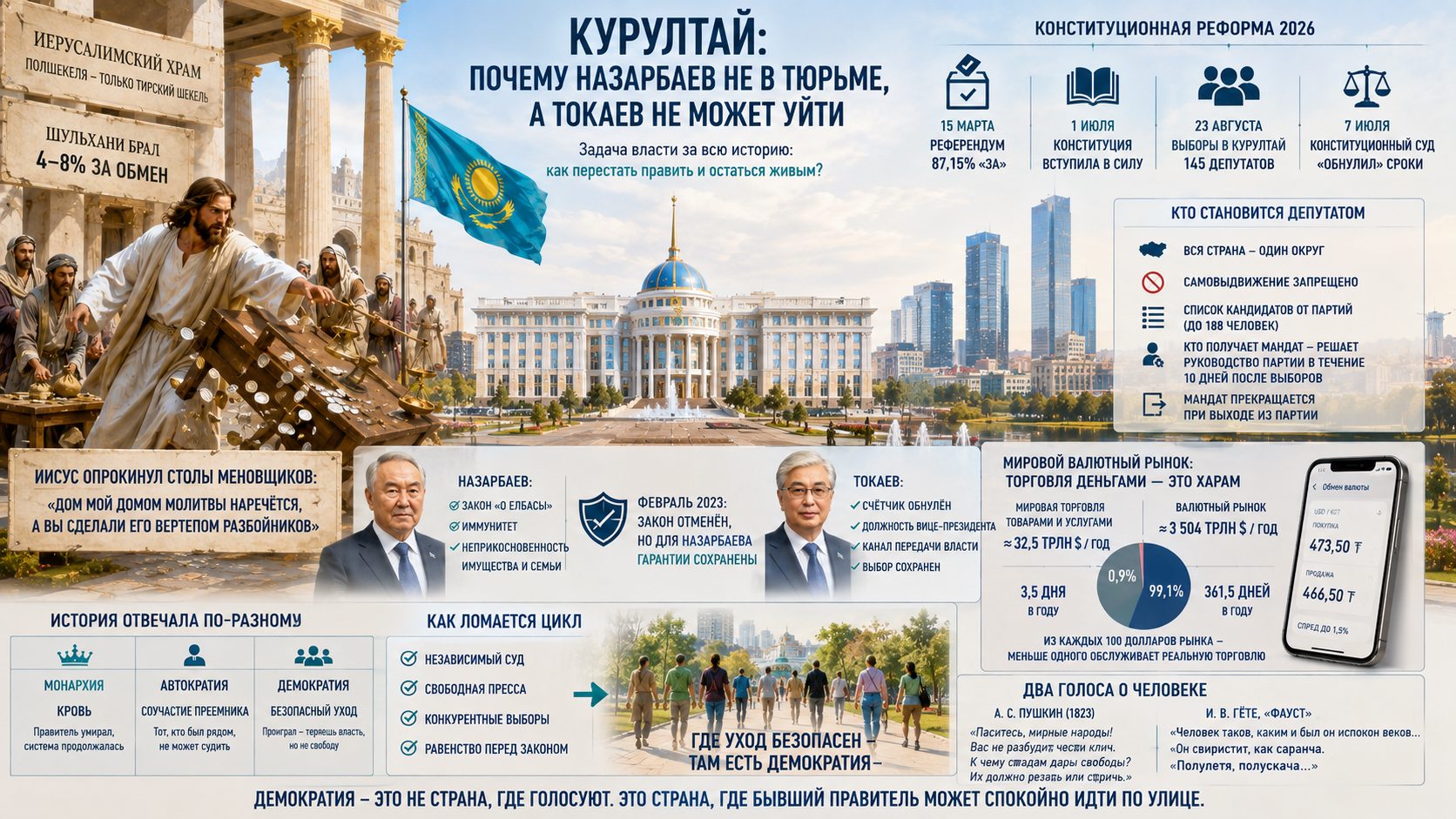
The Kurultai: why Nazarbayev is not in prison, and why Tokayev cannot leave
On 23 August Kazakhstan elects its Kurultai for the first time — a single-chamber parliament under a new constitution in which some 84% of the text was rewritten. The argument is about the reset of presidential terms, but that is a consequence. No system has solved how a ruler stops ruling and survives.
Monarchy solved it with blood. Autocracy solves it with a successor bound by complicity. And only where leaving stopped being lethal did what we call democracy appear. We read the reform against that measure — and end with two quotations that said it earlier and better.
A note first: this is analysis and opinion, not a verdict. Every checkable claim is sourced at the end. Everything else is my assessment, and arguing with it is welcome.
Part I. What formally happened
Briefly, then we go deeper.
15 March 2026 — referendum on a new edition of the Constitution: turnout 73.12%, 87.15% in favour, more than 9.1 million people voting. Roughly 84% of the text changed — the largest constitutional revision in the country’s independent history.
1 July 2026 — the Constitution takes effect; the bicameral Parliament stands down.
23 August — the Kurultai is elected: 145 deputies for five years, seven parties, 545 candidates, 34.3 billion tenge in costs.
Here is the first figure that breaks the “streamlining” frame. The old Parliament had 148 deputies — 50 senators and 98 members of the Mazhilis. The new one has 145. A difference of three people. This reform is not about size.
7 July 2026 — the Constitutional Court, answering a request from the President himself, ruled that terms served under the 1995 Constitution do not count. The wording “the same person may not be elected to this office more than once” survived verbatim. The counter is back to zero.
That is what is being discussed. Now for what matters more.
Part II. The mechanism neither side talks about
Before we go to history, one technical detail. It matters more than the reset, and neither the government nor its critics examine it.
How a person becomes a deputy of the Kurultai:
- The whole country is one constituency. You vote for a party, not a person.
- Self-nomination is not provided for in law. Only a registered party may nominate.
- A list may hold up to 188 candidates for 145 seats — 30% longer than the number of mandates.
- After the count, a party’s seat total is arithmetic. But who fills those seats — the party’s governing body decides, within ten days of the election.
- A mandate ends if the deputy leaves the party.
Add it up. The voter determines how many seats a party gets. Who occupies them is determined by the apparatus. And the same apparatus can take the mandate away.
Ask yourself: to whom is such a deputy accountable? Not to you — you did not elect him by name and you cannot decline to re-elect him by name. He is accountable to whoever wrote him into that ten-day decision.
Officially this is called “strengthening the role of parties”, and formally that is true. But strengthening parties means something where anyone can found one. The seven parties on the ballot are exactly the seven the state has registered. The largest — Adilet — was founded on 7 May 2026, registered on 1 June, absorbed the former ruling party Amanat (previously Nur Otan) on 14 June, is chaired by a former head of the Presidential Administration, and fielded 186 of the 545 candidates. The OSDP, the one party with an opposition reputation, fielded 33.
The presidential quota in parliament really was abolished, and that is true. But the deputy’s accountability did not move to the voter. It moved to the apparatus.
Single-mandate districts, restored in 2023, are gone too. They were the only door for an independent politician. It was opened and closed again within three years.
Now — why it is built this way.
Part III. The oldest unsolved problem
There is a question older than states, parties and constitutions. It is simple:
How do you stop ruling and stay alive?
Everything else in the architecture of power follows from the answer.
Monarchy answered with blood. An heir has no interest in destroying the legitimacy of his own line: condemning the father, he signs his own sentence. So the ruler died in bed and the system continued. Hereditary monarchy lasted for millennia not because humanity was stupid, but because it was the only working solution to the exit problem. Note how it solved it: by placing the ruler entirely beyond judgement. The price was irremovability. It was paid for thousands of years.
Modern autocracy lost blood as a mechanism. Inheritance by birth is no longer legitimate — but the problem remains. And it acquired a substitute: a successor bound not by kinship but by complicity. You need someone who cannot prosecute because he was there. Not “will not” — cannot, because any trial of a predecessor inevitably reaches those who served under him.
Everything else follows. Managed parties, control of registration, no self-nomination, a court that interprets the Constitution at the request of the person it constrains. This is not caprice or greed. It is engineering for a single task.
And only the third answer produced what we call democracy: making the exit safe.
Not through the virtue of rulers but through construction. Separate the office from the person, so leaving office is not the loss of protection. Make the court not the victor’s weapon. Guarantee that the loser loses power but not liberty and not property.
From which follows a definition I consider more accurate than the textbook one:
Democracy is not a country where people vote. It is a country where a former ruler can walk down the street.
Elections are the consequence. Where losing means prison, elections cannot be honest: no procedure will make a person voluntarily surrender the thing that protects his freedom. Safe exit first, real voting second. Not the other way round. Every attempt to put elections ahead of exit safety produces the same picture: the procedure exists, the result is settled.
Part IV. Why Nazarbayev is not in prison
Now apply the measure to our own history.
Nazarbayev is not in prison, and not because his innocence has been established. Nor because his guilt has — no charge was ever brought. He is not in prison because his safety was the price of the transfer of power. That is not a guess: the price was written into law.
The law “On the First President of the Republic of Kazakhstan — Elbasy” gave him immunity from arrest, search, questioning and prosecution, inviolability of his property, and extended that protection to family members living with him.
What comes next is the interesting part, and it is documented fact rather than interpretation.
In February 2023 Tokayev signed the instrument repealing that law. “De-Elbasisation” happened: the status was abolished, the honorary senator title removed, the family privileges withdrawn. But:
“All guarantees of inviolability are retained for Nazarbayev, while they no longer extend to members of his family.”
Everything was removed except one thing. Except the single clause the whole construction had been built for.
What happened to those the guarantee stopped covering is known. His nephew Kairat Satybaldy received six years for embezzlement in September 2022. He returned more than 700 billion tenge in assets to the state. And he was released early, after returning them.
Note the form: not justice, a settlement. Money for freedom. And the man at the top of the same chain was never even charged.
Part V. Why Tokayev cannot leave
Here I will be careful and precise, because the difference between analysis and accusation is fundamental.
I do not claim that Tokayev committed crimes: no charge was brought, there was no trial, and I have no right to assert otherwise. But the arithmetic does not require it.
Tokayev worked inside Nazarbayev’s system for three decades: foreign minister, prime minister, chairman of the Senate. He is not an outsider who arrived from elsewhere. And the point is not personal guilt but a rule:
The first conviction of a former ruler in a country’s history is not a verdict on one man. It is a message to the sitting one about his own future.
Whoever establishes such a rule establishes it about himself. So the predecessor is not tried — not out of gratitude but out of self-preservation. Gratitude is too weak a word here: gratitude fades, arithmetic does not.
And here is the consequence that closes the circle. Tokayev today is solving exactly the problem Nazarbayev was solving in 2019: how to hold power longer and hand it to someone who will not touch him.
The only difference is that he has someone else’s experience in front of him — and that experience is negative. Nazarbayev wrote his guarantee into law. The law was repealed. The guarantee survived — but what preserved it was not the text; it was the successor’s need. A personal guarantee outlived the law only because the man who honoured it needed to.
Personal guarantees end when the need for them ends. That has already been tested, in this country, within living memory.
Part VI. The Kurultai as an answer to the exit problem
The reform reads differently now.
The reset gives the right to stay, not the obligation. The vice-presidency, restored after a thirty-year gap and appointed by the President with the Kurultai’s consent, gives a channel for handing power to a personally chosen individual.
Two doors. And, more important than either, the ability not to choose between them right now.
That is the difference from his predecessor. Nazarbayev chose — he left the office and kept the levers. The choice turned out to be irreversible: January 2022 showed that “gone but still here” breaks under load, and there was no way back. The new architecture corrects that error. The decision can be taken late, with the situation in view.
The product of this reform is not a term running to 2036. The product is optionality.
The vice-presidency has a history in Kazakhstan, and it is instructive. Erik Asanbayev held the post from December 1991 to February 1996. In February 1996 he was sent to Germany as ambassador and the office was abolished — precisely as the super-presidential model was taking shape. A spare part in a construction where power converges on a single point. Now it returns, at the moment the counter is reset.
We examined comparable machinery in another field — in the piece on Palantir, where a special class of shares gives the founders 49.999999% of the votes regardless of their economic stake. The conclusion there: a company’s future is set by its charter, not by its founders’ rhetoric. The same rule applies here. Read the procedure, not the address to the nation.
Part VII. The pyramid that outlived every signboard
Now let us rise above Kazakhstan, because the matter is not Kazakhstan.
The exit problem is a special case of a general construction. Let us name it plainly: every society in recorded history is built as a pyramid of extraction. At the top, those who receive more than they produce. At the bottom, those who produce more than they receive. Between them, an estate whose job is to explain why it must be so.
The signboards changed. The construction did not.
Feudalism extracted by right of birth, and the explanation was God: the estates were ordained from above.
Capitalism extracts by right of property, and the explanation became contract: the parties are free and equal, therefore the outcome is just.
Socialism and communism extracted by right of the vanguard, and the explanation became the people themselves: the party knows their interests better than they do.
Notice what is common. In every formation the word “people” sits at the very centre of the justification. And in every one it names the object, not the subject. Everything is done for the people and in the name of the people — and in no formation are the people the ones doing it.
Check it against figures, closer to home. According to Credit Suisse research reported by the Financial Times, 162 people — 0.001% of the population — own 55% of Kazakhstan’s wealth. Meanwhile 96.6% of adults, about 11.7 million people, have an annual income of no more than ten thousand dollars. The FT noted that many of those 162 are connected to Nazarbayev. The data is from 2018, but the order of magnitude has not inverted since.
That is the pyramid in numbers. Not a metaphor, not rhetoric — a distribution.
Part VIII. Democracies are not exempt — they pay more for the same thing
Here honesty is required, or the whole analysis turns into a conversation about the backward East.
The exit problem is solved nowhere, finally. It is only softened — and softened expensively.
Look at what surrounds the departure of power in the most mature democracies: presidential immunity, the pardon, statutes of limitation, amnesties, the institution of the “former president” with protection and an allowance. All of it is technique for the same problem. It exists not because rulers there are better or worse, but because without it leaving becomes dangerous again.
And the tests come regularly. Nicolas Sarkozy in France received criminal convictions. Silvio Berlusconi in Italy spent years legislating precisely where his own trials were running. In the United States the prosecution of a former president split the country on exactly the question we are examining: is this justice or the victor’s weapon — with both sides making the accusation, and both offering arguments.
The conclusion is not “everyone is the same”. The difference is enormous and measurable. But it is measured not by the presence of elections but by the safety of losing. Democracy is not the absence of the pyramid. It is a pyramid with a working lift going down: you can descend from the summit alive.
Where there is no lift, the summit is not vacated. And then everything else — parties, chambers, referendums, names borrowed from the age of khanates — is trim on a single load-bearing problem.
Part IX. “They deserve what they chose” — true and untrue
This is the hardest passage, and I will take it without softening in either direction.
Against the proposition there is a strong argument. Choice presupposes alternatives and information. Where the ballot is composed in advance, party registration is controlled and the press is quiet, the word “chose” does not describe what happened. Blaming a person for a choice never offered to him is dishonest. We have written about what happens when the press goes silent: it is not only criticism that disappears — the very possibility of learning the alternative disappears with it.
But it does not follow that there is no responsibility. There is. It simply is not where people look for it.
The pyramid does not stand on its summit. The summit is its narrowest part, 0.001%. The pyramid stands on its base, and is rebuilt by that base every day. A bribe to a traffic officer is not “necessity” — it is a vote for the system, cast away from the polling station. A nephew placed by a phone call is the same principle of inheritance, one floor down. Silence when a neighbour is squeezed is an agreement that nobody has protection, the silent man included.
Every level reproduces the one above it. A ruler handing posts to his own and a man placing his son through a connection are following one rule; only the scale available to them differs.
In that sense “deserved” is the right word. Not in the sense of “they voted for it”. In the sense that a construction reproduced daily on every floor looks, at the top, exactly the way it looks.
And this is why I will not call a people a crowd or a herd. Not out of caution, but because it is inaccurate. A herd does not build a pyramid — a herd cannot. Pyramids are built by people each of whom is individually rational and acting in his own interest, and who together produce what none of them separately wanted. That is not stupidity. It is a coordination trap, and it is far more durable than stupidity, because escaping it requires somebody to take the first risk alone.
Part X. The mirror
This has been said earlier and better than I can say it. I will bring two witnesses — and draw attention to who exactly is speaking.
Alexander Pushkin, 1823. He is twenty-four, in southern exile, his hopes for reform have just collapsed. In the 1921 translation by Babette Deutsch and Avrahm Yarmolinsky:
With freedom’s seed the desert sowing,
I walked before the morning star;
From pure and guiltless fingers throwing —
Where slavish plows had left a scar —
The fecund seed, the procreator;
Oh vain and sad disseminator,
I learned then what lost labors are…Graze if you will, you peaceful nations,
Who never rouse at honor’s horn!
Should flocks heed freedom’s invocations?
Their part is to be slain or shorn,
Their dower the yoke their sires have worn
Through snug and sheepish generations.
And Goethe, Faust, “Prologue in Heaven”. Mephistopheles reports to the Lord on mankind, in Bayard Taylor’s 1870 translation:
The little god o’ the world sticks to the same old way,
And is as whimsical as on Creation’s day.
Life somewhat better might content him,
But for the gleam of heavenly light which Thou hast lent him:
He calls it Reason — thence his power’s increased,
To be far beastlier than any beast.
Saving Thy Gracious Presence, he to me
A long-legged grasshopper appears to be,
That springing flies, and flying springs,
And in the grass the same old ditty sings.
Would he still lay among the grass he grows in!
Each bit of dung he seeks, to stick his nose in.
Now the reason I quoted both of them in this particular way.
In Goethe, this is the devil speaking. Not the author, not the Lord — Mephistopheles, and he is speaking in an argument. The Lord answers him that man errs as long as he strives. Goethe deliberately placed the most convincing, most observationally grounded indictment of humanity in the mouth of the one party with an interest in a guilty verdict. That was done on purpose: the view of people as locusts is not a lie, it is supported by evidence. It is simply not complete, and completeness is the one thing the devil does not have.
And in Pushkin this is a poem of despair. Written at the blackest point, and Pushkin did not stay there: fourteen more years lay ahead of him, and everything we remember him for. “Graze if you will, you peaceful nations” is not a verdict on a people. It is a diagnosis of the poet’s own condition, made by himself.
Both quotations are the voice of a man whose hands have dropped. Quoting them is useful, because they are accurate. Stopping at them means agreeing with Mephistopheles — and even the Lord did not.
Part XI. What actually breaks the cycle
Ending on helplessness would be dishonest, so here is what history shows.
The cycle broke not when better rulers arrived. It broke when leaving became safe — and almost always through a morally uncomfortable procedure.
The British aristocracy first learned not to destroy one another when power changed hands, and parliamentarism came afterwards. Spain’s transition after Franco ran through the Moncloa Pacts and an amnesty that cut in both directions. South Africa and Chile traded part of the prosecution for truth and disclosure.
The conclusion is unpleasant but robust: the exit problem is usually solved by not trying the predecessor. Amnesty is the price of transition. Morally it satisfies nobody, and there is little justice in it.
But the amnesty is not what decides the matter. What decides it is what gets built while the amnesty holds: a court the next victor will not be able to use. If no such court is built during the years of forgiveness, the trade was made for nothing, and in a generation the whole thing repeats with new surnames.
Apply the measure to this reform. It makes the exit safe for one man — through a personal guarantee and a personally chosen successor. It does not make it safe for anyone — through a court independent of whoever is on top today.
And the personal guarantee has already been devalued once, right here: the Elbasy law was repealed in a day. What survived was not the text but the successor’s need. Tokayev is building the very guarantee that failed in front of him.
Conclusion
The reform is real: 84% of the Constitution changed, a chamber abolished, the presidential quota removed, parliament given powers it did not have. This is not a change of scenery.
But the direction is single. The one genuinely binding constraint has been lifted. The one entrance not controlled by the apparatus has been closed. The deputy’s accountability moved from the voter to the party leadership. And an office has been created for handing power to a personally chosen individual — or for not handing it over at all.
None of this is about one man’s ambition. It is about a problem humanity solved neither under feudalism, nor capitalism, nor socialism: how to let go of power and survive. As long as the answer is a successor rather than a court, the signboard over the pyramid can change as often as it likes. The proportions inside it will not.
23 August is not the end of the reform. It is its first test. And what is being tested is not the Kurultai.
Sources
- Kurultai of Kazakhstan — Wikipedia (ru) — composition, powers, the historical institution
- 2026 Kurultai election — Wikipedia (ru) — date, candidates by party, party leadership changes
- Parliamentary reform in Kazakhstan — Wikipedia (ru) — working group, timeline, “we must not rush”
- Adilet party — Wikipedia (ru) — founding, merger with Amanat, leadership
- The new Kurultai and the election rules — 365info.kz — threshold, quotas, the ten-day allocation of mandates, ban on self-nomination
- Tokayev’s presidential term reset — Meduza — Constitutional Court ruling of 7 July 2026 at the President’s request
- Why Kazakhstan needs a new constitution and a vice-president — Zerkalo — the vice-presidency, Tokayev’s 2022 and 2024 statements, lawyer Yerzhan Yesimkhanov’s comment
- Tokayev proposes a unicameral parliament — zakon.kz — the address of 8 September 2025
- Kazakhstan repeals the law on the first president — Vedomosti — repeal of the Elbasy law
- Kazakhstan abolishes the privileges of Nazarbayev and his family — RTVI — personal immunity retained while family immunity was withdrawn
- The privileges of Nazarbayev and his family — Sputnik Kazakhstan — contents of the Elbasy law
- Satybaldy’s sentence altered — Forbes.kz — sentence, asset return, commutation
- Kairat Satybaldy released — Ratel.kz — release
- 162 people own half of Kazakhstan’s wealth — NUR.KZ — Credit Suisse research as reported by the Financial Times
- 0.001% of the population owns 55% of the wealth — Ratel.kz — income distribution, the 96.6% figure
- Erik Asanbayev — Wikipedia (ru) — the vice-presidency, 1991–1996
- Constitution of Kazakhstan as in force from 01.07.2026 — Paragraph — current text
- Constitutional law “On the Kurultai and the status of its deputies”, 5 June 2026 — Paragraph — deputies’ status
- Comparative analysis of the 1993, 1995 and 2026 Constitutions — Kazakhstan International Bureau for Human Rights — article-by-article comparison
- Alexander Pushkin, “Behold a sower went forth to sow” (1823), tr. Babette Deutsch & Avrahm Yarmolinsky — RuVerses — English text
- J. W. von Goethe, Faust, tr. Bayard Taylor — Project Gutenberg — English text of the Prologue in Heaven
- Kazakhstan to spend 34.3 billion tenge on the Kurultai election — Lada.kz — election budget
If you have found a mistake or a typo in this article, tell us about it
Comments (0)
Log in to leave a comment →
No comments yet. Be the first.