

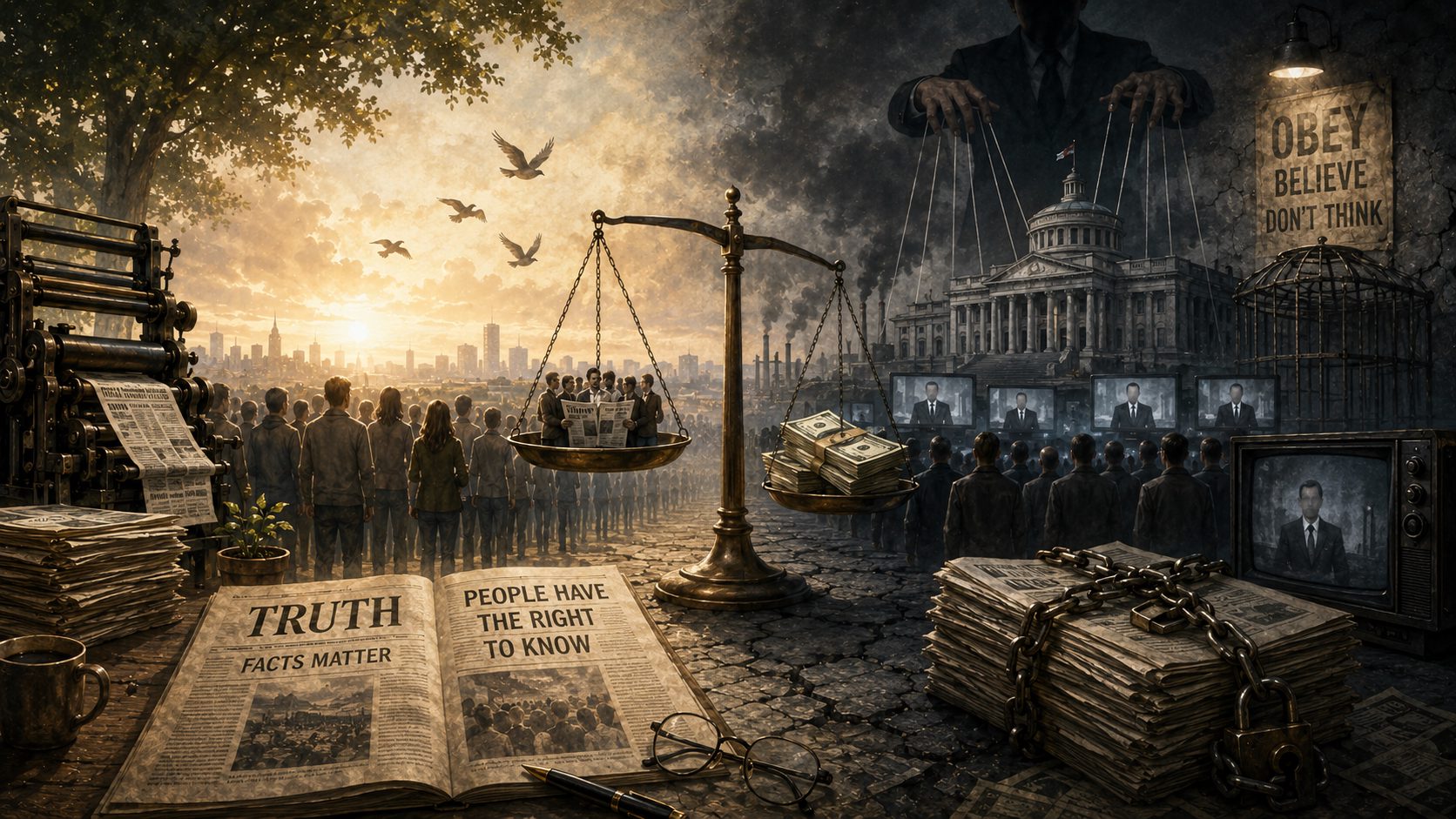
Subscribed From Above: The Price of Silence
Kazakhstan's state information order runs to about 67 billion tenge a year, while schools, hospitals and local administrations are still handed subscription quotas from above. What that money buys, how support for the press differs from a leash, and why the famine and Semipalatinsk are stories about a silent press.
Let me say this up front: this is an opinion, not a verdict. Everything here that can be checked comes with a source at the end of the text — the figures, dates and documents can be verified without taking my word for any of them. Everything else is my assessment, and arguing with it is not merely allowed but necessary.
The Quota
There is a habit that looks harmless. Year after year, government bodies and large companies “subscribe” to certain publications. A school, a kindergarten or a hospital receives a quota — a list of what to subscribe to. The circulation stays alive not because readers chose it, but because the subscription was handed down from above.
Officially, none of this exists. Back in February 2019 the government answered a parliamentary inquiry with perfect clarity: subscriptions taken out by employees of an organisation must be voluntary, and coercion into a contract is not permitted — that is Article 14 of the Law on Mass Media. The practice has not gone anywhere since: kindergarten teachers, schoolteachers and doctors regularly tell journalists what “voluntary” looks like from close up.
Standing next to the quota is a second pillar — money. Kazakhstan’s state information order came to roughly 63 billion tenge in 2024, and the Ministry of Culture and Information has budgeted approximately 67 billion a year for 2025–2027 — over 200 billion across three years. That is comparable to the cost of several large hospitals.
And here is the detail that says more than the sum itself. When the Legal Media Center asked the ministry not even for a breakdown by outlet, but simply for the total amount of grants awarded to private media, the ministry refused, classifying the figure as “for official use only.” Public money spent on public speech turned out to be information not intended for the public.
Remember this point. Everything that follows is explained by it.
A Newspaper Is an Instrument. It Has a Sensor
Set morality aside for a moment and look at a newspaper as a device.
A publication is a machine that converts reader attention into money, and money back into attention. It has a feedback loop: if a piece goes unread, revenue falls, and the newsroom finds out. Circulation, clicks, subscription renewals — these are not vanity, they are a sensor. It tells a journalist the one thing they cannot learn any other way: hit or miss.
Now wire the power supply around the sensor. Money arrives from the budget and through the quota — regardless of whether anyone reads the paper. Formally nothing is wrong: the newsroom is staffed, the journalists are paid, the paper comes out. But the instrument has gone blind. Circulation no longer measures interest; it measures the compliance of accounting departments. The feedback loop now closes not on the reader but on whoever controls the budget.
What follows is arithmetic that requires no one’s ill will. If revenue depends on an official, then risk is also denominated in that official. It takes seeing a neighbouring newsroom’s contract quietly “not renewed” exactly once — and caution stops being a character trait and becomes editorial policy. Nobody issued an order. It is simply that in a system where money comes from above, the newsroom pays the cost of an inconvenient story while the benefit goes to a reader who did not pay for it.
This is not a story about bad people. Journalists inside such a system understand it better than we do. They were simply left without alternatives for a very long time.
State Money Is Not a Verdict: Where the Line Runs
It is easy to slide into the slogan that the state should not give the press a single tenge. World history does not support that slogan.
The United States, 1792. The Postal Act set token postage rates for newspapers: press delivery was effectively subsidised by ordinary mail. This was direct state support — and it is precisely what created a dense network of independent papers in the young republic. The crucial detail: the privilege applied to any newspaper simply for existing. Nobody decided which ones deserved it.
Sweden, since 1971. Direct press subsidies were introduced so that towns would not be left with a single newspaper. The money is distributed by a body kept at arm’s length from government, and the formula is deliberately counterintuitive: support goes to the second-largest outlet in a market — that is, to whoever argues with the leader. If two outlets are equal in size, neither receives anything. The Nordic countries have spent decades near the top of the world press freedom index while taking state money.
Hungary, 2018. A different script. KESMA was founded in September; by November, 476 outlets had been “donated” into it — newspapers, radio stations and websites previously owned by proprietors friendly to the government. Nobody imposed a ban. A different lever did the work: state advertising. According to the media analysts at Mertek, of roughly €365 million in government advertising spend in 2020, 37% went to KESMA entities and a further 49% or so to the public broadcaster and pro-government outlets. The market is formally free. The oxygen is distributed by hand.
From this comes a working test worth keeping in mind. The question is not whether the state pays. There is only one question:
Can the payer change the amount because of what was published?
If the allocation follows a rule that cannot be re-tuned for a particular story, that is support. If the allocation depends on discretion and is decided afresh each time, it is not support — it is a leash. The length of the leash is beside the point: what matters is that it exists and that both sides know it.
This is exactly why the “for official use only” stamp on the information-order budget is not a bureaucratic triviality. A rule can only be checked once it is published. A closed allocation is, by definition, discretion.
The Price of Silence Is Measurable
Press freedom sounds abstract right up until you start counting.
The Nobel laureate economist Amartya Sen produced a conclusion that has never been overturned: no substantial famine has occurred in an independent country with a functioning democracy and a free press. Not because democracies are richer — India in the 1950s was destitute. But because famine is a failure of distribution, and it only kills on the condition that nobody wrote about it in time. The Bengal famine of 1943 happened under wartime censorship. The Great Leap Forward famine in China in 1958–1961, which took tens of millions of lives, unfolded beneath newspaper headlines about record harvests: the reporting lied upward, the press lied downward, and at the top they genuinely did not know for a long time. Independent India, for all its poverty and chaos, has known no major famine since.
The Asharshylyk, 1930–1933. This is our own case — and the heaviest in this list.
In three years Kazakhstan lost, by various estimates, between 1.3 and 4 million people. The commission of the 2013 international conference, together with the Ptukha Institute of Demography, counted 1,258,200; Robert Conquest put it at 2.3 million; Abylkhozhin, Kozybaev and Tatimov at 3.25 million; Khangeldy Abzhanov, director of the Valikhanov Institute of History and Ethnology, says no fewer than 4 million. That spread is itself part of the subject: there is still no exact figure, because there was no one and nowhere to count at the time. The share of Kazakhs who died was 38–42% — the highest mortality of any people in the USSR. Livestock fell from roughly 40 million head to about a tenth of that. Around a million people fled: 676,000 left for good, 454,000 later returned, and some 200,000 ended up abroad — in China, Mongolia, Iran, Afghanistan and Turkey.
Now the part that bears directly on our subject. Across all those years, not a single report of the famine appeared in the Soviet press. The newspapers printed bulletins about the successes of collectivisation and sedentarisation. A catastrophe that killed up to two-fifths of a people did not exist as a fact, because it did not exist as a publication.
When newspapers stay silent, information looks for detours — and they are narrow. In July 1932 five Kazakh public figures — the writer Gabit Musrepov, Mansur Gataulin, Mutash Davletgaliev, Embergen Altynbekov and Kadyr Kuanishev — sent Goloshchyokin and the regional party committee the “Letter of the Five” about what was happening on the steppe. On 5 July the committee rejected their arguments as nationalist sentiment, and the authors were threatened with expulsion from the party and criminal prosecution. In 1932–1933 Turar Ryskulov wrote to Stalin; his letter of 9 March 1933 is a detailed analysis of the famine’s causes with proposals for stopping the deaths. The difference between a letter and a newspaper is purely arithmetical: a letter has one addressee, and that same addressee decides what to do with it. Ryskulov was shot in 1938.
There was an external circuit too — and it showed that an unfree press is not only ever one’s own. On 31 March 1933 the British journalist Gareth Jones published his report “Famine Rules Russia” in London’s Evening Standard. That same day Walter Duranty, head of The New York Times Moscow bureau and winner of the 1932 Pulitzer Prize, printed a reply — “Russians Hungry, But Not Starving” — calling Jones’s dispatches “a big scare story.” In a private conversation with a British diplomat that September, Duranty put the number of deaths from lack of food at as many as ten million. He never once wrote that publicly. The New York Times has since acknowledged that his reporting was “largely discredited.”
This is the full schematic of how the price of silence works. Censorship removes the fact inside the country; obligingness removes it from outside. Between those two operations a third of a people disappears — and for the next ninety years historians argue about exactly how many, because the only ones who could have counted in time said nothing.
Chernobyl, 26 April 1986. The reactor exploded at night. The Soviet press said nothing. The May Day parade in Kyiv went ahead on 1 May — with children, in the streets, under an elevated radiation background. The price of a few days of quiet is measured here not in reputation or ratings, but in doses.
Semipalatinsk. Over forty years, 456 nuclear tests were conducted at the site. Data on the population’s health was classified; officially the problem did not exist, because there was nowhere to read about it. On 25 February 1989 the poet and deputy Olzhas Suleimenov went on live republican television — under the rules he was supposed to present his election platform, and instead he spoke about radioactive gas leaking from the test site. On 28 February the creation of the Nevada–Semipalatinsk movement was announced. According to Kazakh sources, around four million signatures were gathered within a month. Testing effectively stopped, and on 29 August 1991 the site was closed by decree.
Note the architecture of that story. Not a court, not a parliament, not international pressure. Information reached people — and within a month the authorities had no choice left. This is the strongest argument for a free press that Kazakhstan possesses, and it is entirely our own.
Shanraq has published on this before — One word of truth: diseases that may not be spoken about do not disappear, they grow in the dark. Famine, radiation and disaster merely make the pattern visible, because they are counted in lives.
Silence Is Paid in Cash
Catastrophes are rare. The bill for quiet, however, arrives every month — and it looks far more mundane.
In our analysis What the world’s history of fighting corruption teaches us, the conclusion is stated bluntly: wherever the press has been strangled and competition abolished, corruption always comes back. A free press, the right to speak aloud and the rotation of rulers are not window dressing — they are a working tool against theft. Stealing is physically harder in the light: too many eyes.
This is not a poetic metaphor but a measured relationship. In a paper with a telling title — “A free press is bad news for corruption” (Journal of Public Economics, 2003) — the economists Aymo Brunetti and Beatrice Weder ran the data for 97 countries and found a robust link: more press freedom, less corruption. More important than the correlation is their second finding: causation runs from the press to corruption, not the other way round. The point is not that rich, honest countries can also afford free newspapers. The point is that newspapers able to write are what produce that honesty.
The logic is the same as with the sensor. Every oversight body has a boss, a budget and a career — that is, a person who can make a phone call. An independent journalist’s boss is the reader. That is why independent journalists routinely find what is hidden from prosecutors: not because they are cleverer than prosecutors, but because they are harder to summon to an office.
And here the circle closes. Corruption behaves like a tax nobody ever voted for: it is never put to a vote in parliament, yet everyone pays it — in a markup on the price, in the quality of a road, in a queue at the hospital. The 67 billion tenge a year of information order is only the part of the bill visible on a budget line. The main part is presented to us later, and never itemised.
The Rut: Why the Press Matters More Where Power Does Not Change Hands
There is a regularity older than any modern political science.
In the Muqaddimah (1377), Ibn Khaldun described a cycle that has been rediscovered dozens of times since: power won through solidarity and risk turns within three generations into an administration living on rent, loses contact with those it governs — and collapses. A dynasty, he wrote, rarely outlives three generations. The mechanism he identified would today be called informational: power that stops needing consent stops receiving information. Nobody lies to it out of malice — there is simply no longer anyone who can tell it the truth without risk.
Britain in the 18th and 19th centuries offers a second lesson, about the instrument. From 1712 newspapers were subject to a stamp duty that was raised again and again; contemporaries called these “taxes on knowledge.” Formally there was no censorship: print what you like. It was merely that a cheap mass-market paper became economically impossible, while a respectable and loyal one remained perfectly profitable. The duties were only abolished in 1855 and 1861. The lesson worth absorbing: the press is almost never banned. Its economics are changed instead. A ban is visible and produces martyrs; unprofitability is invisible and produces only tired people who changed careers.
Now, why this is a conversation for today. On 1 July 2026 a new Constitution came into force in Kazakhstan: a presidential term of seven years, and no person may be elected to the office more than once. On 7 July the Constitutional Court clarified that election or appointment to the office after the new Constitution took effect counts as the first — even if the person held it previously. In practice this means the term counter has been reset to zero.
I will not offer a legal assessment of that decision — that is a matter for lawyers and voters. But it has a consequence that bears directly on our subject. In a system where power changes hands regularly, society has two feedback channels: elections and the press. If one channel narrows, the load on the other rises rather than falls.
The right to be heard puts it more briefly: a bad parliament is better than a good silence. Argument and slowness are signs of a working feedback loop; unanimity speaks not of agreement but of fear. The same holds for newspapers. A managed press is not the cause of this rut. It is a headlight that shines only where it has been permitted to point. You can travel a long way down such a rut. The problem is that you learn about the turn at the moment of the turn.
A Propagandist Is Not a Journalist
The difference is simple and does not depend on political views.
A journalist serves the reader and the checkable fact. A propagandist serves the client and the required conclusion. The first helps you think; the second helps you not to.
In The Origins of Totalitarianism (1951) Hannah Arendt noticed something more unpleasant than “people are being deceived.” The ideal subject of totalitarian rule, she wrote, is not the convinced fanatic but the person for whom the distinction between fact and fiction, between true and false, has simply ceased to exist. The goal of managed information is not to make you believe a particular lie. The goal is to train you into the belief that nothing can be verified anyway, and therefore there is no point trying.
George Orwell wrote a preface to Animal Farm that never appeared with the book — it was found and published only in 1972. It was called “The Freedom of the Press,” and its central point is not about state censorship. Orwell wrote that in wartime England inconvenient things went unprinted with almost no formal ban at all: publishers and editors understood on their own what was better left alone. “If liberty means anything at all,” it says there, “it means the right to tell people what they do not want to hear.” The most effective censorship is the kind that never has to be applied, because people have already applied it to themselves.
We Have Done This Before
It is worth remembering that an independent Kazakh press is neither a borrowing nor a novelty.
The first issue of the newspaper Qazaq appeared on 2 February 1913 in Orenburg. It was made by Akhmet Baitursynuly, Alikhan Bokeikhan and Mirzhaqyp Dulatuly. Through to January 1918 it ran 265 issues with a circulation of around three thousand copies, individual issues reaching eight thousand; it was subscribed to by Kazakhs across ten provinces. The first forty-six issues were financed by the philanthropist Mustafa Orazayev; after that the paper was published by the Azamat cooperative.
Here is what matters: Qazaq had neither a state subsidy nor a quota. It had subscriptions, and it had people who considered it worth paying for. On a print run of three thousand copies, that newspaper shaped the political language of a nation — and that is exactly why it eventually had to be shut down.
Three thousand subscribers who chose for themselves outweighed any circulation handed down from above. This is not a metaphor. It is a measurable historical result.
What Depends on the Reader
Less than one would like, and far more than is generally assumed.
In a letter to Edward Carrington of 16 January 1787, Thomas Jefferson wrote his famous line: were it left to him to decide between a government without newspapers and newspapers without a government, he would not hesitate a moment to prefer the latter. The quotation is usually cut off there — a shame, because a condition follows. He would mean, Jefferson specifies, that every man should receive those papers and be capable of reading them. A free press that nobody reads is free in exactly the sense that a switched-off instrument is free.
What this means in practice:
- Pay for what you chose yourself. One paid subscription to an outlet that can lose you weighs more than a hundred likes. You are not donating — you are switching the sensor on.
- Ask who pays. Not “do I like the conclusion,” but “who funds this newsroom, and can they change that funding because of this story.” The answer to the second question predicts content better than any statement of principles.
- Separate fact from assessment. “The court clarified that the count of terms starts afresh” is a fact and can be checked. “This is a catastrophe” or “this is stability” is an assessment — including mine. Do not mistake the second for the first, even when you agree.
- Share the source, not the screenshot. A screenshot cannot be verified — which is precisely why it is so convenient for those who do not want it verified.
- Do not mistake exhaustion for a conclusion. “They all lie, nothing can be changed” is not scepticism. It is precisely the result that is worth spending 67 billion a year on.
The 2026 World Press Freedom Index compiled by Reporters Without Borders places Kazakhstan 149th out of 180 with a score of 34.41 — down eight places in a year; the organisation cites tightening legislation, indirect pressure and impunity in cases against journalists. This is neither a verdict nor grounds for despair. It is a reading from an instrument — the one that measures how well we are hearing each other.
Dictators do not emerge because someone was born a villain. They are made by the consent of the majority and the silence of those who understand perfectly well. Press freedom does not begin in a newsroom. It begins the moment a reader stops being what they were assigned to be.
That is my opinion. Check it — and decide for yourself.
Also on Shanraq
- What the world’s history of fighting corruption teaches us — why corruption always returns wherever the press has been strangled
- Corruption: the tax nobody ever voted for — who ends up paying that bill
- One word of truth: why we need someone to say it aloud — on the price of silence and the diseases that grow in the dark
- The right to be heard — why a bad parliament beats a good silence
Sources
Press and corruption: a measured link
- Aymo Brunetti, Beatrice Weder. A free press is bad news for corruption — Journal of Public Economics, vol. 87 (2003), pp. 1801–1824 — data from 97 countries; causation runs from press freedom to lower corruption
- The same paper, open access — EconPapers / RePEc
Kazakhstan: the money and the quota
- “A secret shrouded in darkness”: the Ministry of Culture refuses to name the sum of the state media order — Kazakhstan International Bureau for Human Rights — 63bn tenge in 2024, ~67bn a year in 2025–2027, classified “for official use only”
- The Ministry of Culture allocated 60bn tenge to the state information order in 2024 — Kursiv
- “For official use only”: what in Kazakhstan only officials are allowed to know — Human Rights Protection Centre — how media spending becomes an official secret
- Database of state order recipients — Legal Media Center
- The government comments on teachers being forced to subscribe to newspapers — Inform.kz — official position: voluntary only, Article 14 of the Law on Mass Media
- Forced newspaper subscription: a legal analysis — De Facto law firm — there are no legal grounds for compulsory subscription in either the public or the private sector
- Forced subscription to print publications is unlawful — Noks.kz
- Kazakhstan — World Press Freedom Index 2026, Reporters Without Borders — 149th of 180, score 34.41
- 2026 RSF Index: press freedom at a 25-year low
The 2026 constitutional reform
- Kazakhstan’s Constitutional Court allows Tokayev to run for a new term — Kommersant, 7 July 2026
- Kazakhstan’s Constitutional Court “resets” the presidential terms — The Moscow Times, 7 July 2026
How press support is built elsewhere
- Direct media subsidies to news media: a Nordic overview — Nordicom — the Swedish model since 1971
- Press Subsidies and Local News: the Swedish Case — Reuters Institute, Oxford
- The rise of KESMA: how Orbán’s allies bought up Hungary’s media — International Press Institute — 476 outlets, shares of state advertising
- KESMA — State Media Monitor
- Postal Service Act (1792) — subsidised newspaper delivery in the United States
- Taxes on knowledge — the British newspaper stamp duty, 1712–1861
The price of silence
- Amartya Sen. Poverty and Famines (1981) and Development as Freedom (1999) — on famine, democracy and a free press
- Great Chinese Famine, 1958–1961
- Kazakh famine of 1930–1933 — death toll estimates, livestock losses and flight
- How the victims of the Asharshylyk of 1930–1933 were counted — “History of Kazakhstan” portal
- The “Letter of the Five” — “History of Kazakhstan” portal — July 1932, its authors and the party committee’s response
- Ryskulov’s struggle against the genocide of the Kazakhs — “History of Kazakhstan” portal — his 1932–1933 letters to Stalin
- A Tale of Two Journalists: Walter Duranty and Gareth Jones — National Museum of the Holodomor-Genocide — the duelling publications of 31 March 1933
- The New York Times can’t shake the cloud over a 90-year-old Pulitzer Prize — NPR — how the paper assesses Duranty’s reporting today
- The Chernobyl disaster: timeline and the 1986 May Day parade
Kazakhstan: when the voice got through
- The Nevada–Semey anti-nuclear movement — National portal “History of Kazakhstan”
- The Nevada–Semey movement was founded on 28 February 1989 — Inform.kz
- 10 questions about the Nevada–Semey movement — Masa Media
- The newspaper Qazaq and the national intelligentsia — qazaq1913.com
- The newspaper Qazaq — A. Baitursynuly Kostanay University
The classics of the question
- Thomas Jefferson to Edward Carrington, 16 January 1787 — Founders Online
- George Orwell, “The Freedom of the Press” — the unpublished preface to Animal Farm — The Orwell Foundation
- The same text in an open library — orwell.ru
- Hannah Arendt. The Origins of Totalitarianism (1951)
- Ibn Khaldun. The Muqaddimah (1377) — on the cycle of dynasties and three generations
- Edward Herman, Noam Chomsky. Manufacturing Consent (1988) — the filter model, including dependence on the source of funding
If you have found a mistake or a typo in this article, tell us about it
Comments (3)
Log in to leave a comment →
У Shanraq нет государственного информационного заказа. Нет бюджетных денег. Нет и не будет разнарядки. Площадка содержится на мои личные средства, а для читателя она бесплатна — то есть удерживать вас здесь нечем, кроме самих текстов. Это и есть тот датчик, о котором идёт речь в статье: единственный, кто может его отключить, — вы.
Sign in to vote. 0 Sign in to vote.Shanraq компаниясының ешқандай үкіметтік ақпарат келісімшарттары жоқ. Бюджеттік қаржыландыру жоқ. Квоталар жоқ және ешқашан болмайды да. Платформа менің жеке қаражатыммен қамтамасыз етіледі және оқырмандар үшін тегін — яғни сізді мұнда мәтіндердің өзінен басқа ештеңе ұстап тұрмайды. Мақалада талқыланған сенсор осы: оны өшіре алатын жалғыз адам - сіз.
Sign in to vote. 0 Sign in to vote.Shanraq doesn't have any government information contracts. There's no budget funding. There are no quotas, and there never will be. The platform is maintained with my personal funds, and it's free for readers—meaning there's nothing keeping you here except the texts themselves. This is the sensor discussed in the article: the only one who can turn it off is you.
Sign in to vote. 0 Sign in to vote.