

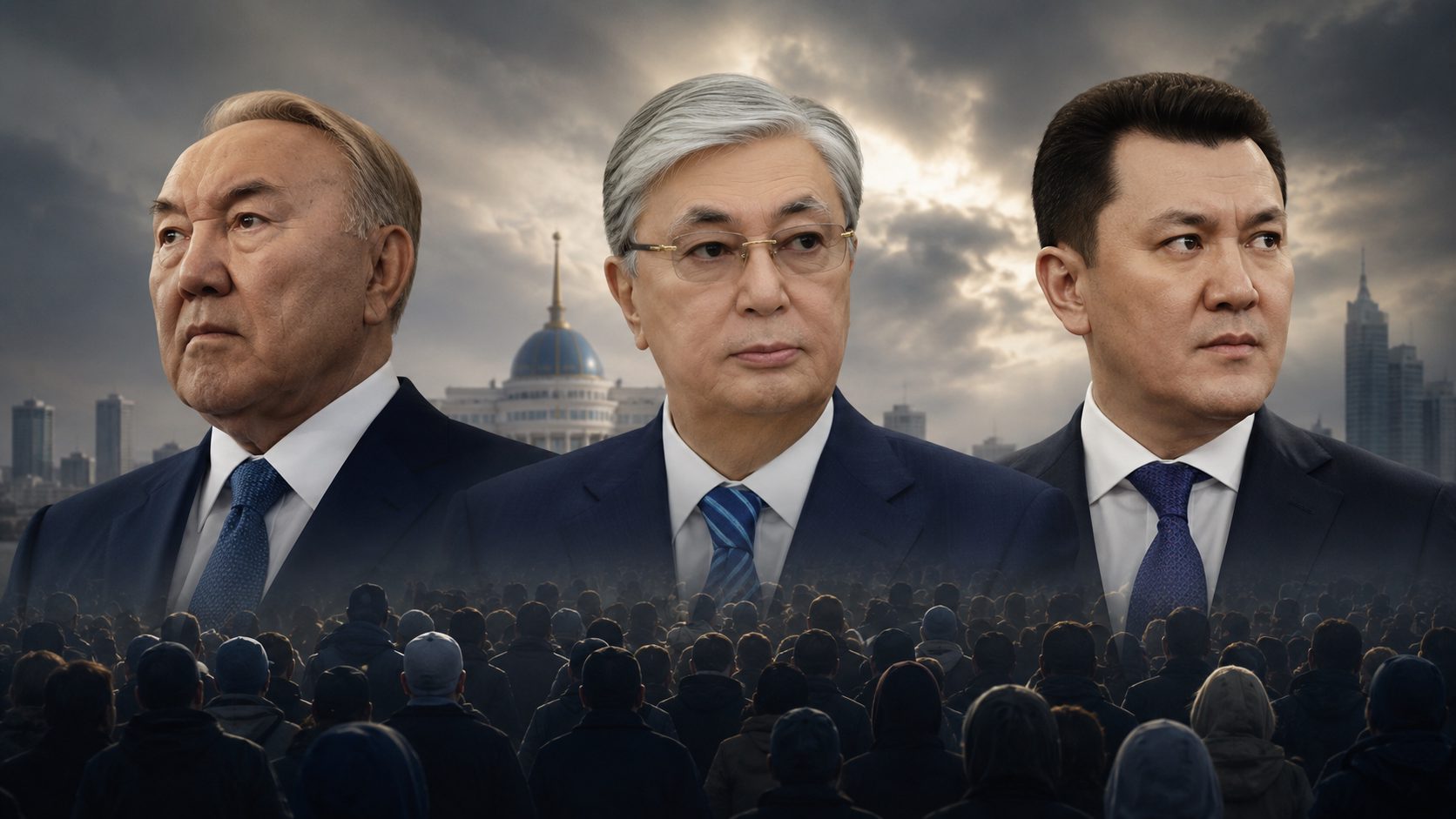
Why Erlan Karin became Kazakhstan's vice-president and what comes next
On 31 August the Kurultai confirmed Erlan Karin as Kazakhstan's first vice-president by 141 votes of 145. He is now first in line for power. He was chosen not for what he has but for what he lacks: no party, no business, no mandate — all of it forbidden to a vice-president by law.
| What is known about him | What follows from it |
|---|---|
| Thirty years in the apparatus, not one asset of his own | He can guarantee nothing |
| Ran the working group on the 2025–2026 reform | He wrote the office he now occupies |
| Explained Zhanaozen and January to the country | Nobody declassifies their own wording |
| Not one work on economics in thirty years | Prices and inflation are not his subject |
Who Erlan Karin is: thirty years in the apparatus without an asset of his own
Erlan Karin is fifty. Born on 26 May 1976 in Aksukent, Sayram district, Turkestan region; a historian by training, a candidate of political sciences with a dissertation on national security, author of five books and more than two hundred articles.
His record of service reads as three biographies in a row.
The analyst: history teacher in Aktobe, director of the Central Asian Agency for Political Studies, adviser to the prime minister, head of the Centre for Anti-Terrorist Programmes. In 2003–2004, first deputy chairman of the Asar party — that is, the party of Dariga Nazarbayeva. He entered politics through the Nazarbayev family, survived its fall, and stayed.
The apparatchik: head of the domestic policy department of the Presidential Administration, secretary of Nur Otan for strategic development, visiting professor at the American University in Washington, director of the Kazakhstan Institute for Strategic Studies, chairman of the board of the state broadcaster Qazaqstan.
Tokayev’s man: adviser, assistant, state secretary from 5 January 2022, state counsellor, first deputy head of the Presidential Administration, vice-president.
Now look at what the list does not contain. No security service under his command. No region. No business. No money. No party that would follow him rather than the office.
He rose on the production of meaning — on books, doctrines, explanations. This is the first figure of that type at the summit of Kazakh power. It is not an accident but a condition of selection.
The office of vice-president of Kazakhstan: what it grants and what it forbids
The post appeared in the new Constitution, adopted by referendum on 15 March 2026 and in force since 1 July. The Senate and the Mazhilis were abolished and replaced by a single-chamber Kurultai of 145 deputies.
The essential change is not the office but the queue. Previously, if a president’s powers ended early, they passed to the chairman of the Senate. There is no Senate. The new order runs: vice-president → chairman of the Kurultai → prime minister.
The difference is fundamental. The Senate chairman was elected by the senators themselves; he held a procedural legitimacy of his own. The vice-president is appointed by the president with the Kurultai’s consent, and the president also determines the scope of his powers.
Then comes the list of what a vice-president may not do: sit as a deputy, hold any other paid post, engage in business, or belong to a political party.
Read it again. What is forbidden is precisely what an independent base is made of: a mandate, money, a party. The first man in line for power is left one road to it — inheritance from the sitting president.
That is the answer to “why him”. He was chosen not for strength but for its absence. Which is why 141 deputies out of 145 found nothing to argue about: there was nothing, the candidate being safe by construction.
Karin wrote the reform that created his own office
In 2025–2026 Karin headed the working group on parliamentary reform — the reform that abolished the Senate, created the Kurultai and established the vice-presidency.
When experts called it a simple deletion of the upper chamber, he objected: “A reform is not a mechanical process. What is at issue is the formation of an independent single-chamber Parliament with all the procedures, rules and mechanisms that follow from it.”
He was right on the substance and left out the main thing: among the mechanisms that followed was the chair he took ten months later.
This is a rare position. An heir usually receives someone else’s construction and is afraid to touch it, not knowing which joints bear the load. Karin drew them. He knows what holds this system up and what is decoration — and that knowledge cannot be taken away by decree or handed to anyone else.
His own formula runs: “Bızdıñ ideologia — Ata zañ”, our ideology is the Constitution. Said by the man who wrote that Constitution.
Zhanaozen 2011 and January 2022: what he was doing while people were shot
On 16 December 2011 striking oil workers were shot in Zhanaozen. Karin was then secretary of Nur Otan for strategic development and simultaneously an expert consultant at the Centre for Strategic Research and Analysis of the Presidential Administration.
Six days later he explained it publicly: “It seems to me wrong to connect the disorders that occurred only with the strike and the problems of the oil workers” — that, he said, “oversimplifies the analysis of causes”. The main role, in his view, was played by “marginal youth” who could not find a place. And he urged separating the striking workers from those who “organised and staged these pogroms”.
Take the construction apart. A seven-month strike is declared an insufficient explanation. Causation shifts to unnamed organisers. The workers are moved into the category of victims and thereby removed from the political story. The question of who ordered fire on strikers disappears from the frame.
Ten years later came January 2022. Tokayev gave the order to “open fire to kill without warning”; officially 238 people died, 19 of them law enforcement officers; the violence against protesters was never investigated. The state’s version: twenty thousand militants and external forces.
The frame is the one used in 2011. And on 5 January Karin becomes state secretary.
There is no public record of his part in the decisions themselves. What is visible is the official function, the same in both cases: to build the state’s version of the event. He is not the man who gives the order. He is the man who explains to the country what happened — and explains it so that the order falls outside the frame. By one analytical account, his duties included managing the “red lines” for the media.
The repression archives are open, the January files are not
From 2020 to 2023 Karin chaired the State Commission for the Full Rehabilitation of Victims of Political Repression. The result is substantial: 311,000 people rehabilitated and 31 volumes of documents, and more than 2.4 million archive cards declassified.
Now set two figures side by side. Two and a half million documents about repressions eighty years old: open. About January 2022, four years old: not one page. The trials of Massimov and Abish were held behind closed doors, the files classified.
On 26 March 2025 Karin set out the rule by which this works: “We should not set the different periods of our history against one another”, “we must simply draw the right lessons and move on”, and let the examining be done by “professional historians and specialists… without emotion and without politicisation”.
Said by the man who personally chaired the commission that set the Soviet period against the Kazakh one. So the rule against contrasting periods does not always apply. It switches on when the question is Zhanaozen, January, or the Nazarbayev years.
“Draw lessons and move on” is a polite form of closing the question. Handing history to “specialists without politicisation” turns a live case into an archival discipline, where there is no longer anyone to answer to.
Archives are opened where the guilty are other people and long dead. One’s own are left to the specialists.
The Kazakh language: Karin speaks it, but writes no books in it
Karin knows Kazakh and speaks it fluently. He gives hour-long interviews in it: Bas taqyryp on the National Channel, Uäde on Jibek Joly, a conversation on Nartay Aralbayuly’s channel.
He also names the language problem correctly. On 5 February 2026, as deputy chairman of the Constitutional Commission, he stated that for Kazakh to become the language of administration, the laws and above all the Constitution must be written in the state language correctly and clearly. And he stressed separately: “The draft of the new Constitution in the state language is not a translation” — it was months of joint work by lawyers and linguists.
The diagnosis is right. The same thing counted in figures: the Kazakh Wikipedia is written by 386 people a month — nineteen authors per million inhabitants against Estonia’s six hundred and fifty-nine — and 96.5 per cent of state paperwork in Kazakh consists of translations. A language lives where things are created in it, not where they are translated into it.
Now his own bibliography by language of publication.
| Book | Year | Language |
|---|---|---|
| Balbaltas. From the Orkhon to the Caspian | 2013 | a Kazakh title exists |
| Soldiers of the Caliphate: Myths and Reality | 2014 | Russian |
| Successor or Succession? Transferring power in Kazakhstan | 2014 | English |
| Between ISIS and Al-Qaeda | 2017 | Russian |
| Operation Zhusan | 2020 | Russian |
| Consolidated catalogue of cartographic materials | 2023 | Russian |
| From Cassackia to Kazakhstan | 2024 | Russian |
In the Kazakh Wikipedia, in the article about him, the section “Kıtaptary” lists those same books under their Russian and English titles, untranslated. The Kazakh encyclopaedia itself concedes that he has no Kazakh editions.
The print runs match: two thousand copies, fifteen hundred, one thousand, one thousand. For a country’s chief ideologist these are reporting units, not editions.
There is the contradiction, and it is sharper than any accusation of not loving the language. The rule he correctly formulated for state papers he did not apply to his own work. A scholarly book is precisely the kind of original text a corpus grows from; he has seven, and six are written in Russian. For thirty years he formulated meaning at the very top — and formulated it in a language other than the one whose fate he discusses.
This is not a peculiarity of his but an order established before him. Under Nazarbayev and under Tokayev it looks the same: a few sentences in Kazakh at the start, then an hour, two hours, the whole substance, in Russian. In that practice Kazakh is not a working language but an introduction to one.
And there is an admission that this is so, from Karin himself. When he says the Kazakh text of the new Constitution is “not a translation”, he is reporting what the previous ones were. Until 2026 the country’s principal document existed in the state language as a translation from Russian. That was said not by an opponent of the authorities but by the deputy chairman of the Constitutional Commission, and said as an achievement.
From this follows a simple rule of reading. In this system words are the cheapest resource, and therefore cannot serve as evidence. To declare that the Constitution must be written in Kazakh costs nothing. To write your own book in Kazakh costs effort and part of your readership — and there the choice went the other way, seven times running. Judge by what cost something.
A person’s language shows not in a school certificate but in the one he writes in when he writes for himself.
The second reset: the Constitutional Court cleared Tokayev for another term
While the successor’s office was being discussed, something more important happened alongside it.
The rule of “one seven-year term without the right of re-election” is formally preserved, and Tokayev’s powers expire in November 2029. But the Constitutional Court ruled that taking office after 1 July 2026 counts as a first term even for someone who has held it before: “The fact that a person occupied one of the said offices during the period of the 1995 Constitution does not in itself constitute… a constitutional impediment.”
Compare that with what the same man said in January 2024: the single-term rule “will never change”. The rule indeed was not changed — the Constitution under which it was counted was replaced. Today Tokayev calls it premature to discuss standing in the next election.
This is the device examined in Tokayev is not leaving: the norm stays in the text and does not apply to the incumbent. Only this time it was not a term inside the Constitution that was reset but the Constitution itself.
And here is what follows for Karin. The machine for leaving and the machine for staying were built at the same time. A man genuinely leaving in 2029 needs one sentence: “I will not stand.” It costs nothing today and a great deal if broken — which is exactly why it would be evidence. It has not been said.
Until it is, the vice-president is not an heir but a safety catch.
What Karin cannot do: inflation, chrematistics and the cost of living
Now for the part that concerns not the elites but you.
Take his bibliography: Soldiers of the Caliphate, Balbaltas, Between ISIS and Al-Qaeda, Operation Zhusan, From Cassackia to Kazakhstan. Jihadism, security, history, identity. More than two hundred articles.
On economics, not one work. Not on prices, not on money, not on production, not on where inflation comes from.
Look at the ideology he wrote for the state: “A Just Kazakhstan”, “Taza Qazaqstan”, “Law and Order”, “a new public ethic”. Cleanliness, conduct, order, respect. All of it about how people behave. Nothing about what they produce and what they pay.
The figures are these. Annual inflation in Kazakhstan is running at about 10.3–10.4 per cent; analysts expect around 10 per cent for the year and a base rate of 16 per cent by its end. Which means money in a pocket loses a tenth of itself in a year, and credit costs so much that producing on borrowed money is all but impossible.
The root was named by Aristotle and examined separately: oikonomia is the management of a household for the sake of life; chrematistics is the multiplication of money for the sake of money. Here the second is passed off as the first, and state policy is built on it. The country ships out ore, ships in goods made from it, gives the added value away and receives inflation in return.
And what this picture does not contain is weather. Ludwig Erhard, who raised from ruins a country with no raw-material advantage whatever, put it without hedging: “Inflation does not descend upon us as a curse — it is always caused by frivolous or even criminal policy.” Germany in 1948 had wrecked factories and no ore to export. A few years later it had an economic miracle, because decisions were taken: currency reform, the freeing of prices, a bet on production.
So ten per cent inflation at a sixteen per cent rate is not weather. It is somebody’s signature. Somebody decided to ship ore rather than build processing. Somebody holds a rate at which you cannot produce on credit. Every such decision has a surname and a date, and that is the only thing that matters to a person counting money until payday.
Karin will not go near those decisions. Not because he is stupid, but because in thirty years he has not written a line on economics: it is not his subject and never was. An ideologist in power improves not the standard of living but the explanation of why it is what it is.
What awaits Kazakhstan under Karin in the coming years
Nothing changes before 2029. Until Tokayev says “I will not stand”, both doors are open, and that is the whole point of the design. Uncertainty is the instrument of holding on: nobody defects to a successor who may never take the chair, and nobody moves against a president who may leave of his own accord.
The economic course will not change at all. It did not change when the president changed in 2019, it did not change after January 2022, and it will not change because a vice-president has appeared. Ten per cent inflation at a sixteen per cent rate is the result of management, not of circumstances: the same people, the same bet on exporting raw material, the same unwillingness to build processing. The face signing the decisions will change; the decisions will stay, because there is nobody to change them and no reason to.
If Karin does take the chair, the authoritarian construction will survive but change its footing. He is a legalist and a moralist, not a strongman and not a populist: he would rule through rules and campaigns. Closer to the Singaporean model than the Russian one. But not a democracy, and it is not worth hoping for one.
The main risk is not where it is looked for. A security man in power is dangerous because he can shoot. An ideologist is dangerous because he can redefine what counts as true — and he has been doing that professionally for thirty years. If things go badly his instinct will not be troops but a rewritten story and shifted red lines. He can do both.
The second risk is his own defencelessness. A man with no money, no armed force and no region has nothing to fall back on if the elite decides otherwise. He cannot resist. We have seen this: Nazarbayev, with the most complete set of guarantees imaginable, lasted three years. An heir without a base of his own lasts exactly as long as he is acknowledged — which promises not a smooth transition but a very abrupt one.
And the part that depends only on us. Why Russia did not attack Kazakhstan has been written about here before: what saved us was neither our own arrangements nor the CSTO but the fact that Kyiv did not fall in three days. One thing has changed since: at the top there is no longer a single person with independent international weight. Tokayev has none; Karin has none by law.
A country that cannot check what happened in January is defenceless against its repetition: the closed trials took away not justice but the ability to recognise a beginning. This is the one part of the construction that can be repaired at home, without agreeing anything with anyone. It is the part left untouched.
All of the above is easy to test. Watch not the words — he is a professional in words — but whether anything of his own appears: the first people in posts who owe him personally, the first extension of his powers beyond what the president defined, the first independent public weight. If it appears, the transit has begun. If not, the office was made not for handing power over but for holding on to it.
He will not leave in 2036 either
Here I speak for myself, and this is the author’s personal opinion rather than a conclusion drawn from documents.
Tokayev will leave neither in 2029 nor in 2036. Everything needed for that is already done and described above: the Constitution replaced, the count of terms reset by a court ruling, a successor appointed with no right to anything of his own, and the promise that “the rule will never change” having shown what it is worth. Only a pretext is missing, and in systems like this a pretext is always found.
And it is not only about him. It is about the fact that this passes.
The people are not ready for the values of freedom and, in my view, are not straining to become ready. They are used to being grazed and shorn. This was not said by me — it was said two hundred years ago by Pushkin, and not a line of it has aged:
Свободы сеятель пустынный,
Я вышел рано, до звезды;
Рукою чистой и безвинной
В порабощённые бразды
Бросал живительное семя —
Но потерял я только время,
Благие мысли и труды…Паситесь, мирные народы!
Вас не разбудит чести клич.
К чему стадам дары свободы?
Их должно резать или стричь.
Наследство их из рода в роды
Ярмо с гремушками да бич.
November 1823.
In plain English: a desert sower of freedom, I went out early, before the star; with a pure and guiltless hand I cast the living seed into enslaved furrows — and lost only my time, my good thoughts and my labour. Graze on, peaceful peoples! The cry of honour will not wake you. What use are the gifts of freedom to herds? They are for slaughtering or shearing. Their inheritance, from generation to generation, is a yoke with bells on it, and the whip.
Ukraine refused to be a herd, and we have not yet — written here before. Nothing has changed since: the Constitution was rewritten with turnout and approval, the Kurultai was elected, the vice-president confirmed by 141 votes of 145. No objection was heard anywhere.
While that holds, the surname in the chair does not matter. Tokayev, Karin, a third man — the shearing goes on as before, and only the hand changes.
Sources
Our earlier articles
- Tokayev is not leaving: a reset term and the division of Nazarbayev’s legacy
- Kurultai: why Nazarbayev is not in prison and Tokayev cannot leave
- Why Russia did not attack Kazakhstan: Crimea, Kyiv and our north and east
- Money that calves: how chrematistics was passed off as economics
- Three hundred and eighty-six people: who writes the Kazakh Wikipedia
- Blind spots: what neither Kazakhstan’s admirers nor its critics see
- Ukraine refused to be a herd. We have not yet
The appointment and the office
- Zakon.kz: Tokayev proposes Erlan Karin, 141 votes of 145
- Digital Business: the vice-president’s powers and prohibitions
- Tengrinews: what the new Constitution changed, in force from 1 July 2026
- MK, January 2026: the new office as the start of a succession operation
Karin’s biography and functions
- Biography of Erlan Karin: posts, books, parties
- RIA Novosti, 05.01.2022: appointed state secretary
- Caspian Institute: the state counsellor’s role and place in the system of power
- Zakon.kz: Karin on the critics of the parliamentary reform
- Aikyn.kz: Karin on the Kazakh language and the Constitution
Zhanaozen, January and the archives
- Karin on the causes of the Zhanaozen events, 22 December 2011
- RIA Novosti, 07.01.2022: the order to open fire to kill without warning
- Prosecutor General’s Office: the number of deaths in the January tragedy
- Human Rights Watch: no justice for the victims of the January protests
- Akorda: the rehabilitation commission’s results — 311,000 people, 31 volumes
- MK: more than 2.4 million archive cards declassified
- Informburo: “do not set periods of history against one another, move on”
Terms and the reset
- Forbes: the Constitutional Court clears the way for another term
- Interfax: Tokayev calls it premature to discuss standing again
Economics
- Bureau of National Statistics: inflation in Kazakhstan
- National Bank: analysts’ forecasts for inflation and GDP
- Kapital.kz: the forecast for annual inflation and the base rate
Recordings
If you have found a mistake or a typo in this article, tell us about it
Comments (0)
Log in to leave a comment →
No comments yet. Be the first.