

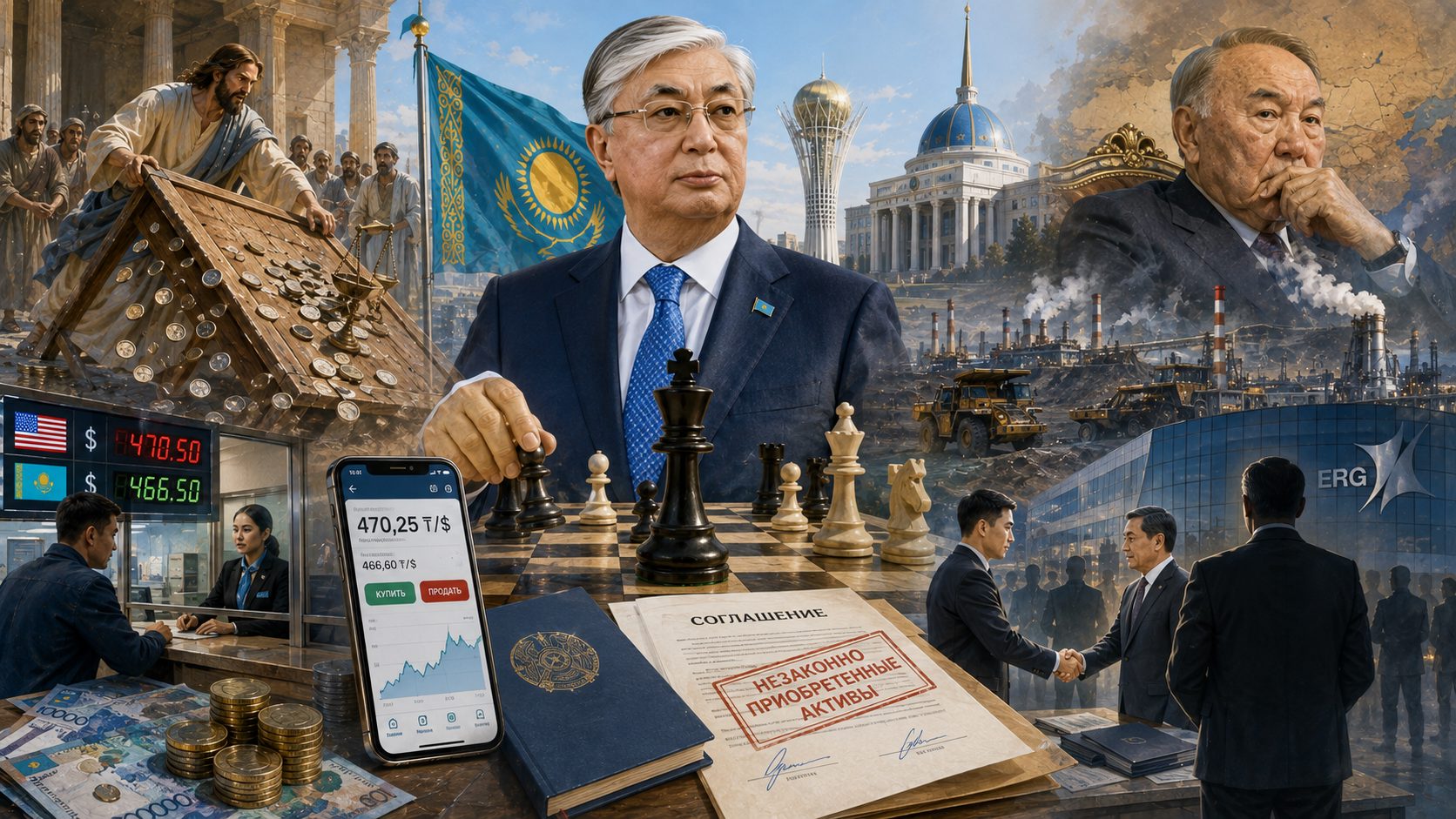
Tokayev isn't leaving: a reset term and the division of Nazarbayev's estate
In three months Tokayev gained the right to rule until 2036 and a vice-presidency he fills himself, one that inherits power without an election. In the same months 40% of ERG changed hands for 1.4 billion dollars, to a man of thirty-five. The state has called these assets illegal — and is negotiating the price.
Let me say this at the outset: this is an opinion, not a verdict. Everything checkable carries a source link at the end. The rest is my assessment, and it is open to argument.
Intentions cannot be read. What has been built can.
The promise he made to himself
After January 2022 it was Tokayev himself who proposed the rule: a single seven-year term with no right of re-election. He gave the reason plainly — to reduce the risk of power being monopolised. And it was he who answered the question of whether a term reset was intended: it was not.
15 March 2026 — a referendum on the new Constitution: turnout 73.12%, 87.15% in favour, roughly 84% of the text changed. On 1 July it entered into force.
On 7 July the Constitutional Court ruled that those elected under the 1995 Constitution may be re-elected once the 2026 Constitution is in force.
The single-term rule remains in the text. One man has been placed outside it.
If he wins the 2029 election he governs until 2036. Asked whether he would stand, he replied that it was “premature to speculate.”
The man who established the rule against monopolising power became the first to whom it does not apply.
Consent that cannot be withheld
On 5 June 2026 Tokayev signed the constitutional law creating the post of vice-president.
The office is not elective: the president proposes the candidate and the Kurultai consents. But after two refusals the president may dissolve the Kurultai.
A parliament that can refuse only at the price of its own dissolution cannot refuse.
And third: under the new Constitution, on the death or resignation of the president his powers pass to the vice-president. Not an election. A transfer.
The sum: the successor is appointed personally by the president, nobody can object, and power is inherited without the voter.
In our article on the Kurultai we wrote that no system of power has solved the problem of a ruler leaving safely. Tokayev’s answer is now visible: do not leave. And if you must, hand over to an appointee.
He stripped Nazarbayev of the title Elbasy, repealed the law on the First President, removed the name from a university. And assembled a construction in which he will need none of that himself.
Who is left alone
Asset recovery is in its fourth year. The law has been in force since 12 July 2023, and the commission is chaired by the prime minister.
The periphery was taken: Nazarbayev’s nephew Kairat Satybaldy, Kairat Boranbayev, a company linked to Aliya Nazarbayeva, an oil terminal in Aktau worth 66 million dollars, a company belonging to Bolat Nazarbayev’s daughter.
The core was not touched. Dinara and Timur Kulibayev — 3.7 billion dollars each by Forbes’s estimate — keep their businesses. Timur Kulibayev was reportedly discussing, in early 2025, transferring around a billion dollars to the state.
Not “recovered.” Discussing a transfer. Negotiating a sum is not justice. It is a tariff.
Nazarbayev himself has never been touched. He is 86, and in May and December 2025 he was received at the Kremlin.
They pluck around the edges and leave the middle alone. Both sides read it the same way.
Where it came from
Kazchrome, Aluminium of Kazakhstan, the electrolysis plant, SSGPO, Kachary Ore — all of it was built by the state, on the labour of several generations. It is why Rudny, Khromtau, Aksu and Kachar were raised on bare steppe.
In the early nineties Trans World Group arrived in post-Soviet metallurgy — the London structure of the Reuben brothers, working alongside the Chernoy brothers. By 1996 it was the world’s third-largest aluminium producer.
The trio grew up inside it. They did not arrive to replace it.
Akezhan Kazhegeldin, prime minister from 1994 to 1997, states it directly: Machkevitch, Chodiev and Ibragimov were operators, not owners. The masters, and the money, were the Reubens. The scheme took shape in 1995 and 1996: take 40% of the shares into management without purchase, clear the debts, inject capital. The Donskoy ore plant, the Aktobe ferroalloy works, the Aksu power station.
The enterprises were not sold. They were handed into management — to those Nazarbayev chose.
In 1999 the Reuben brothers and the brothers Lev and Mikhail Chernoy lost control, and the operators became owners. ENRC is registered in Luxembourg: the plants stand in Rudny and Khromtau, the legal entity in another country.
Who first thought of the separation — the junior partner or Nazarbayev — nobody will know. The result is known: without backing in Astana the junior would not have beaten the senior. And he did.
Kazhegeldin is a political opponent of Nazarbayev living in exile, which is worth bearing in mind. No substantive rebuttal of his account exists.
These men have not been convicted. In 2013 Britain’s Serious Fraud Office opened an investigation into ENRC on suspicion of bribery. It ran for nine years and was dropped in August 2022 for insufficient evidence. Today it is ENRC that is suing the British, claiming more than 290 million dollars.
Nobody can call them criminals. No court has established it.
But something else has been established: Britain’s strongest investigative body spent nine years and tens of millions of pounds and could not get to the bottom of it.
Why London could not get to the bottom of it
The reason is not a weak investigation. It is written into English law.
English courts do not pass judgment on the sovereign acts of a foreign state. The House of Lords put it this way: a court cannot sit in judgment upon an act of a foreign sovereign, effected by virtue of his sovereign authority abroad. All the more so when the act concerns property on that state’s own territory.
And what would have had to be examined? The decision to hand 40% of state enterprises into management without purchase. Taken in Kazakhstan. Concerning Kazakh property. By the head of the Kazakh state.
Second: under Britain’s State Immunity Act 1978, a serving head of state enjoys personal immunity from British jurisdiction.
Now the calendar. Nazarbayev was head of state from 1990 until March 2019. The investigation began in 2013 — for the first six of its nine years he was the sitting president. After that the law on the First President applied, repealed only at the end of 2022, after the case had already been closed.
The investigation could examine the company’s conduct — payments, intermediaries, accounts. It could not examine the decision that created the wealth. Not because it worked badly. Because the subject was beyond its reach in law.
Whose it was
The author of these fortunes is Nazarbayev. That is not an accusation but a description of procedure: the enterprises were not sold at auction and did not go to the winner of a tender; they were handed over by decision of the head of state. That decision has no co-authors.
Ownership is another matter. An operator acts for someone. The Reubens provided the money — but money is not the same as the right to receive. The right to receive was given by Nazarbayev.
Whose the assets substantively were has been established by no court. And it is now clear why: the one body that took it on ran into a sovereign act and the immunity of a head of state.
It cannot be asserted that Nazarbayev was their owner — nobody has proved it. But something more precise can be said: for thirty years there was nobody to put the question of the real owner, and the man whose decision created all of it was, for all thirty years, shielded from the question by his office.
The London proceedings reach their final stage in late summer 2026. And in May 2026 two of the three founders left the capital.
Thirty-five years old, one and a half billion
At the end of May 2026 around 40% of Eurasian Resources Group changed hands. Patokh Chodiev and the heirs of Alexander Machkevitch sold their combined stake for 1.4 billion dollars. The heirs of Alijan Ibragimov retain 20.7%, and the state, through Samruk-Kazyna, holds 40%.
The buyer is Shakhmurat Mutalip, born in 1990. Thirty-five years old, president of the boxing federation. According to media reports he is Patokh Chodiev’s nephew and the common-law husband of Dariga Nazarbayeva, the first president’s eldest daughter. Both relationships I report as journalists have stated them.
A third of the country’s metallurgy changed owner for one and a half billion dollars. Kazakh journalists put the question straight into their headlines: who stands behind Mutalip?
There is no answer.
On 4 June The Insider wrote that the state had probably, in effect, gained control of most of ERG’s shares. The wording is cautious and the evidence circumstantial: a pledge of shares, and the fact that the head of Samruk-Kazyna, Nurlan Zhakupov, joined ERG’s board on 15 May — two weeks before the deal. In July Bloomberg reported that the owners were discussing splitting the company.
Under the carpet, in plain view, the estate of an ageing Nazarbayev is being divided. Not after his death. Now. And divided by agreements whose contents the public is not told.
Five trillion and five hundred and ninety-three billion
The president announced agreements with asset holders worth more than 5 trillion tenge.
The chairman of the Finance Ministry’s state property committee, at a briefing on 12 June 2026, gave a different figure: 593.2 billion tenge had reached the special fund, of which 553.7 billion went to 483 social and infrastructure projects.
The visible portion is about twelve per cent.
The gap may have a lawful explanation: the agreements include property and investment obligations that do not pass through the fund as cash. In which case there is one question: who keeps a consolidated public account of these five trillion, and why does it not exist?
Taken from the people, returned to the state
The law is called “On the return to the state of illegally acquired assets.” That is how the state itself named it, in the title of its own law.
If the acquisition was illegal, then someone acquired illegally.
What follows is this. The illegality is recognised — by law. The property is returned — by agreement. The guilty, with a handful of exceptions, are not identified — by verdict.
The state has recorded a crime against society and replaced the identification of the criminals with a negotiation over price.
There are two substitutions here, and both should be named.
The first is who it is returned to. It was taken from people: money from ore, oil, metal and budget construction — from the very things the country lives on. It is returned to the state. Of the five trillion, 553.7 billion reached social projects — roughly every ninth tenge. The rest moves among those doing the negotiating.
The second is who is being negotiated with. The author of the decisions that created this wealth, and the heirs of this property, should answer before a court, and their guilt should be established by a court. Instead of a court, the state sits down with them and discusses a sum.
What was taken from the people is not returned to the people. It is redistributed at the top — between those who hold power and those whose acquisition the state, by its own law, called illegal.
The autocrat’s hereditary disease
By what criterion did Nazarbayev choose Tokayev in 2019? A career diplomat. No clan, no business, no base in the security services, no regional machine.
In his memoir My Life: From Dependence to Freedom, Nazarbayev writes that the choice met resistance: the objection was that Tokayev had spent his whole life in diplomacy, had some three years of economic experience, and would not carry the presidential burden.
The elite was saying: he is too weak. That is precisely why he was chosen. The weakness was the qualification.
The mechanism was the same. Tokayev had been Senate speaker since 2013 — the constitutional successor. On 19 March 2019 the powers passed to him automatically, without an election.
Tokayev is now building the same machine, only drawn tighter: the Senate speaker was at least elected by senators, whereas the vice-president is appointed by the president alone.
Here is the defect. A safe successor is chosen for having no base of his own. But a man without a base owes nothing to anyone. While he is out of power that makes him harmless. The moment he holds power it makes him uncontrollable.
The quiet diplomat, taken because he could not threaten, stripped his patron of the title, repealed the law on the First President, gave the capital back its name — and the patron’s nephew went to prison.
The very quality for which he is chosen is the one that cannot afterwards be held.
A strong successor is dangerous before the handover, a weak one after it. The construction offers no third option.
And the disease is hereditary in the exact sense: it passes with the chair. The man chosen for being safe, once in the seat, picks his own successor by the same criterion. Nazarbayev infected Tokayev not with convictions but with a construction.
A testable prediction
On 23 August Tokayev said the vice-president’s name would be announced within seven to ten days, and that it would be “a well-known person whom everyone knows well.”
From all of the above follows a prediction about the type of figure: a deputy with no clan, no security base, no business empire, owing his position entirely to one man — and well known enough for the appointment to carry weight.
If the person named turns out to have a base of his own — a large business, a security bloc, a regional machine — this analysis is wrong, and I will say so plainly.
It can be checked within days.
Questions that remain unanswered
To the president: do you intend to stand in the 2029 election? “Premature to speculate” is not an answer to a question you yourself considered important enough, in 2022, to write into the Constitution.
To the government and the asset recovery commission: where is the consolidated public account of the agreements worth 5 trillion tenge — how much was received in cash, how much in property, how much in investment obligations, and who verifies their performance?
To Samruk-Kazyna: did the fund, or structures connected to it, participate directly or indirectly in financing the purchase of the ERG stake in May 2026?
To the Prosecutor General: for how many of the assets found to have been illegally acquired have the acquirers been identified and convicted, and in how many did the case end in an agreement without any finding of guilt?
These are not rhetorical questions. Answers will be published on this site unedited and unconditionally.
What I don’t know
I don’t know whose money bought the ERG stake. The Insider’s account rests on circumstantial indicators, as the outlet itself notes.
I don’t know whether Tokayev will stand in 2029. The possibility has been created — that is a fact; the intention is not.
I don’t know whether there is an understanding about Nazarbayev’s immunity. I see a pattern: the periphery is touched, the core is not. It admits of explanation through such an understanding, but does not prove one.
I don’t know the name of the future vice-president.
My opinion
I will be told that everything described is lawful. That is true: a referendum, a court’s interpretation, a signed law.
That is the point. Autocracy today arrives not with tanks but with a legal department. It has no need to break the law if it can write it.
I do not think Tokayev began with this design. A man who introduces a rule against monopolising power probably means it. But the environment does not weigh intentions: it rewards one kind of conduct and punishes another, and after a few years the reformer finds he has built what he set out to dismantle.
What troubles me is not that he wants to stay. Everyone does. What troubles me is that nobody is left who could say no: a parliament under threat of dissolution, a court that reads the Constitution in the required direction, a press on the state payroll, and a successor who is appointed.
It was taken from the people. It is returned to the state. What reaches the people are crumbs from the main pie. The difference between those sentences is what is meant to be hidden.
Sources
The Constitution and the term reset
- Meduza, 07.07.2026: Tokayev’s presidential term reset through the new Constitution
- Forbes.ru: the Constitutional Court allowed Tokayev to stand for another term
- The Bell, 07.07.2026: Tokayev’s presidential terms reset through the new Constitution
The 2019 transfer of power
- Vlast, 19.03.2019: Tokayev to become Nazarbayev’s successor
- Kommersant, 01.12.2023: Nazarbayev’s memoir — the choice of Tokayev met resistance
- Tokayev’s biography: a diplomatic career, Senate speaker since 2013
The vice-presidency
- Tokayev signed the law on the president and the institution of vice-president
- Vedomosti, 23.08.2026: the vice-president to be appointed within 10 days
- Kommersant, 23.08.2026: Tokayev named the timing for announcing the vice-president
- Maulen Ashimbayev on a possible appointment, 23.08.2026
- Zakon.kz, 19.02.2026: Ashimbayev commented on rumours of a vice-presidential appointment
Asset recovery
- The law “On the return to the state of illegally acquired assets,” 12.07.2023
- Zakon.kz, 12.06.2026: 593.2 billion tenge reached the fund, 483 projects worth 553.7 billion
- Tengrinews: how Kazakhstan recovers assets taken out of the country
- Eurasianet: money clawed back from Nazarbayev’s circle
The history of the assets: TWG, the trio, ENRC
- Akezhan Kazhegeldin on the origin of the capital of Nazarbayev’s inner circle: the trio as operators, the Reubens as owners
- Trans-World Group: owned by David and Simon Reuben, its scale and the loss of its assets
- Kommersant: the rise and fall of Trans World Group
- Kommersant: Trans World Group — the aluminium roof springs a leak
- Eurasian Natural Resources Corporation: history, the London listing and the delisting
- Spotlight on Corruption: the SFO’s settlement with ENRC
Why an English court does not take on such cases
- Belhaj v Straw, UK Supreme Court 2017 — the leading modern treatment of the foreign act of state doctrine
- The same case on the UK Supreme Court’s site
- The act of state doctrine: substance and limits
- The State Immunity Act 1978, full text
- How the 1978 Act extends immunity to heads of state
- Immunity of a serving head of state and the narrow limits of the commercial activity exception
- Law Gazette: ENRC seeks more than 167 million from the SFO, the final stage of the litigation
ERG and the May 2026 deal
- Eurasian Resources Group: ownership structure
- The Insider, 04.06.2026: the state has probably gained control of most of ERG’s shares
- The Diplomat, August 2026: the state tightens its grip on ERG
- Bloomberg, 10.07.2026: the owners are discussing a breakup of ERG
- Ulysmedia: ERG changes owner
- “A little-known businessman”: Shakhmurat Mutalip, his assets and connections
Our earlier articles
If you have found a mistake or a typo in this article, tell us about it
Comments (0)
Log in to leave a comment →
No comments yet. Be the first.