

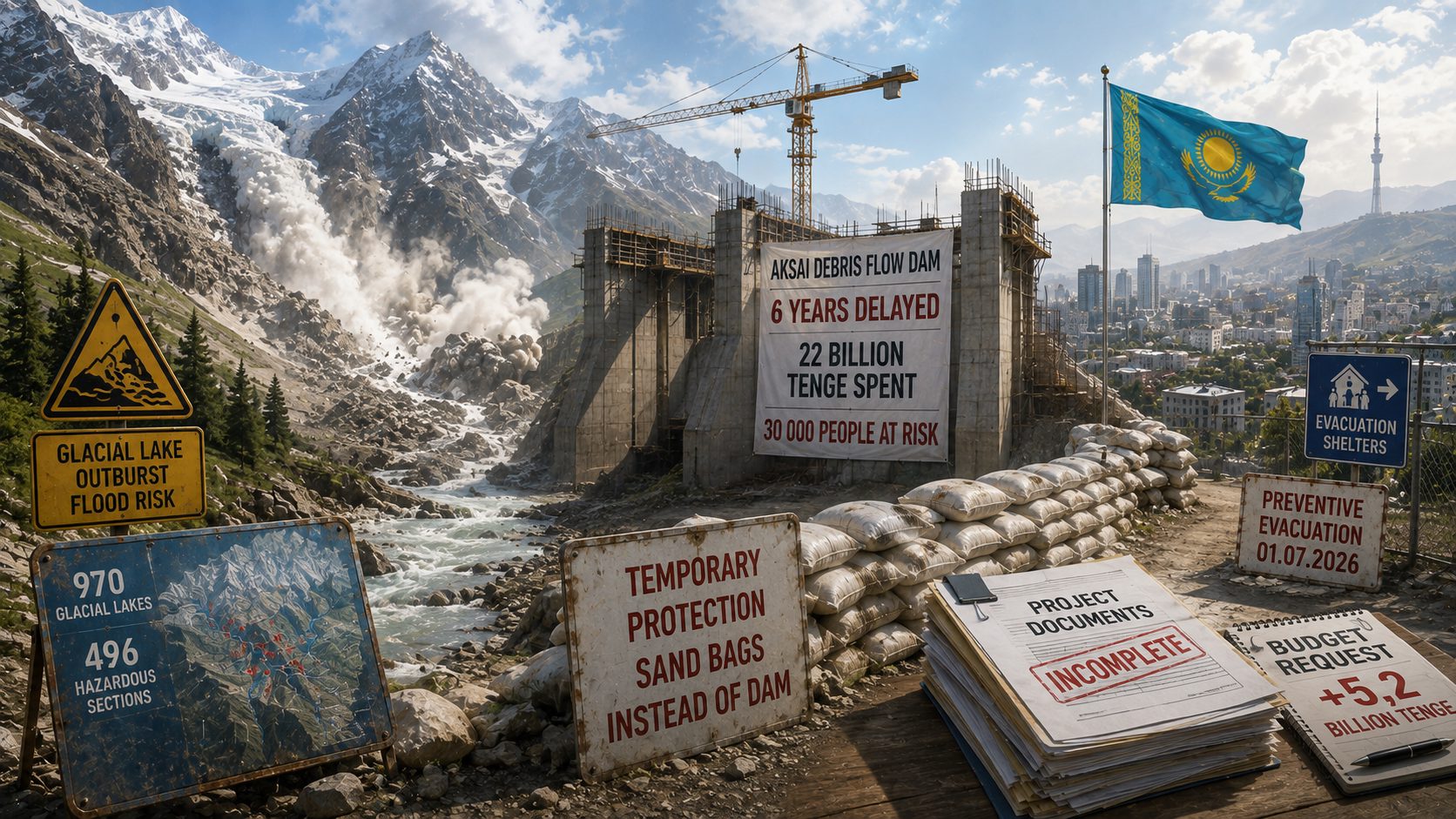
Mudflow over Almaty: the 22-billion Aksai dam and the sandbags
A glacier collapse in Nepal killed more than 350 people, with almost no warning possible. The mudflow dam above Almaty is the opposite: its danger is known in advance. It should shield thirty thousand people, and has stood unfinished for six years. 22 billion tenge spent, the site mothballed, its bank reinforced with sandbags.
Let me say this at the outset: this is an opinion, not a verdict. Everything that can be checked carries a source link at the end — the figures, dates and documents can be verified without taking my word for any of it. The rest is my assessment, and it is open to argument.
The glacier that warned no one
On 26 August the tongue of a glacier collapsed on the Nepal–Tibet border. A mass of ice, rock and debris fell from roughly 5,200 metres, blocked the valley, and a wave then travelled more than a kilometre below. An earthquake was suspected at first. It turned out to be something else.
By 27 August the agency figures diverged and kept rising: reports ranged from 270 to more than 350 dead, with over a thousand missing, most of them tourists. The search continues, and by the time you read this the numbers will have changed again.
Now the part that matters more than any of those figures. There was no rain before the disaster. One of the specialists who examined the event put it plainly: almost no operational flood warning system anywhere in the world would have caught this.
Nepal, in other words, is the case where there was almost nothing to warn with.
Hold on to that. Because what follows is a different kind of danger — the kind that can be measured in advance, and a city that measures it.
Nine hundred and seventy lakes
Kazakhstan has catalogued 970 moraine lakes and 496 mudflow-prone sites.
This is a different hazard from Nepal’s, and the difference deserves to be stated honestly. In the Himalayas a glacier gave way — a sudden event. A moraine lake behaves otherwise: it fills over years. It can be measured, pumped down, released by controlled blasting, walled off by a dam. The two stories share one thing only — retreating ice, which feeds both.
An uncomfortable conclusion follows. Nepal had almost nothing to warn with. Almaty does.
The most dangerous lakes are watched by name. Since July, round-the-clock high-altitude posts have operated on lake No. 13-bis and lake No. 10 in the Ulken Almaty basin, on lakes No. 1, No. 2 and No. 5 in the Turgen basin, on No. 8 and No. 19 in the Talgar basin, on No. 15 in the Kaskelen basin — and on lake No. 8 and lakes No. 9–10 in the basin of the Aksai river. Remember that last address; we will come back to it.
The danger is not holding still. It is growing, and it has been measured. Kazakhstan’s glaciated area shrank from 1744.8 to 1032.1 km² over sixty years: a loss of 712.7 km², or 40.8%. The heaviest losses were on the northern slopes of the Ile and Zhetysu Alatau — precisely the slopes above Almaty. Melting ice does not vanish without trace. It fills those same lakes.
Almaty has been through this before. On 15 July 1973 a mudflow down the Malaya Almatinka was stopped by the dam at Medeu. It held. The defence system — more than sixty structures, twenty-one of them mudflow dams — was built by a state that no longer exists.
Since then the mountains hold forty per cent less ice, and the lakes hold more water. The question is simple: has the defence grown as well.
The dam that isn’t there
There is an answer, and it is documented — not by me, but by the state itself.
In Almaty’s Nauryzbai district, along the Aksai river, a mudflow-retention dam was meant to stand. In 2020 Kazselezashchita signed a contract with Tolagai-2050 LLP worth 17.1 billion tenge. The completion date was 2023.
From the documents:
Ten supplementary agreements were signed during construction, and the cost rose to 22.1 billion tenge. In 2023 work stopped: there had been departures from the design that had passed state expert review. In September 2023 the contract was terminated unilaterally. In court, the company’s representatives argued that it was the client who had altered the design.
In 2024 the Minister for Emergency Situations, Chingis Arinov, said that an inspection of the dam had found violations tied to the contractor’s failure to perform, and that these had created a threat to the lives of around 30,000 Almaty residents.
A criminal case was opened against the contractor over the alleged embezzlement of 775 million tenge in budget funds. The anti-corruption service reported a further case — the embezzlement of 3.4 billion tenge on this dam’s construction; during the pre-trial investigation the company returned 1.5 billion, and the file went to Almaty’s special prosecutor. The same agency reported that the head of Kazselezashchita was under investigation in a bribery case in which the same company appeared as the bribe-giver.
The MP Aidos Sarym stated that until 3 February 2022 the founders of Tolagai-2050 included Akbota Nazarbayeva, daughter of the late Bolat Nazarbayev, younger brother of Nursultan Nazarbayev.
Precision is required here, and I insist on it. Appearing among a company’s founders is not in itself an accusation, I am aware of no charges brought against her personally, and an investigation is not a verdict. I report this exactly as the MP and the anti-corruption body stated it, and not one step further.
What is known for certain: as of 20 July 2026 the site remains mothballed. Completing it requires a further 5.2 billion tenge. Permission to revise the design was granted on 26 May this year, and a budget request has been filed.
And on 1 July 2026 Nauryzbai district announced a precautionary evacuation of residents along the Aksai channel because of the mudflow threat — among the reasons cited was seepage through the dam. People were housed in schools, an operational headquarters was set up, a hotline opened.
Two days later, on 3 July, Kazselezashchita reported that emergency works were complete. The wording deserves to be quoted exactly: in the area of the protective dam on the Aksai river, emergency mechanised brigades completed works to reinforce the bank with inert materials and sacking.
Sacking means sandbags.
Twenty-two billion tenge, ten supplementary agreements, six years — and sandbags.
Six years. Twenty-two billion. An unfinished structure. An evacuation — in the very district the dam was meant to protect.
Why you haven’t read this
Moraine lakes are covered regularly. The genre is settled: a helicopter flight, footage from above, a specialist on camera, and the conclusion — “the situation is assessed as stable”, “no signs of a breach threat have been identified”. All of it is true and all of it is verified. It is simply that the second curve is never laid beside it — the one with 22 billion, the mothballing and the evacuation.
Why that happens we examined in “A Newspaper by Quota”. The state information order absorbs roughly 67 billion tenge a year, while schools, hospitals and local administrations are still handed subscription quotas. Circulation survives for reasons other than a reader’s choice.
Let me mark a boundary, because it matters. I do not claim, and cannot claim, that any newsroom stayed silent on Aksai at anyone’s instruction: I have no evidence of that, and without evidence such an accusation is not permissible. The flight took place. The specialist told the truth.
My objection is to the structure, not to people, and it is simpler than that. When a substantial part of the market lives on state money, the public acquires a legitimate question: how freely do these outlets place the convenient and the inconvenient fact side by side in one piece?
Because both facts are true at the same time.
“No signs of a breach threat have been identified” is true.
“The dam meant to shield thirty thousand people has stood unfinished for six years, and a month ago people were evacuated” is also true.
Journalism begins where the reader sees both sentences at once.
Why prosecutions don’t work — we’ve been here before
The natural reaction to all of the above is to jail someone. Cases were opened, money was partly returned, a minister publicly named the number of people at risk. The state acted.
The dam is still not there.
We have written about what the world’s history of fighting corruption teaches, and the central conclusion was this: corruption is not the sum of personal sins but an equilibrium. A stable state of affairs in which being honest is unprofitable and even foolish if everyone around you is not. Until the equilibrium is shifted, prosecutions and campaigns are theatre.
Now I want to take that thought to its end, because it has a precise name outside sociology.
Three environments
Consider any biology laboratory. Bacterial growth is governed by three things: temperature, acidity (pH) and oxygen. Every organism has its range and its optimum. Some live only in warmth, others in cold. Some in acid, others in alkali. Some need oxygen; to others it is a poison.
From this follows the rule on which the entire food industry rests: microbes are not defeated one by one — their conditions are changed.
Salting and drying remove available water. Fermenting and pickling lower the pH. Refrigeration lowers the temperature. Vacuum packing removes oxygen. None of these methods “fights” bacteria. Each makes the environment unsuitable, and the colony stops growing on its own.
Now pasteurisation — and precision matters here, because everything rests on it.
Pasteurisation does not sterilise. It sharply reduces the number of microorganisms, but some survive the heat, and an opened container takes in new ones from outside. While the milk is cold this does not matter: conditions deny the survivors the chance to multiply. Leave the container in the warmth and it will sour, because the survivors and the new arrivals have been given a favourable environment.
That is the point. Pasteurisation reduces the population without touching the conditions. The conditions remain what they were — and the population rebuilds from those that survived and those that arrived.
A show prosecution is built exactly the same way. It reduces the population. It leaves the conditions.
And those conditions have three parameters of their own — they appeared in our article on corruption, in Klitgaard’s formula:
Monopoly plus discretion minus accountability.
These are the temperature, pH and oxygen of Kazakhstan’s public procurement. Monopoly: the decision on who builds the dam is taken by a narrow circle. Discretion: ten supplementary agreements that raised the price by five billion, and a design that, by the contractor’s account, the client itself altered. Accountability: six years, mothballing, and nobody resigned over thirty thousand people being left without protection.
While those three parameters hold their present values, the environment is favourable. And it will be colonised again — by anyone, under any surname, regardless of who is in prison.
Resetting the terms and the names
There is a manoeuvre that substitutes for changing the environment and looks like it from the outside.
The ruling party was called Otan. Then Nur Otan. After January 2022, Amanat. In June 2026 Amanat joined Ädilet, a party created two months earlier. Ädilet means justice. By the Central Election Commission’s official results it took 71.17% of the vote and 110 of the 145 seats.
The same with the capital. Astana became Nur-Sultan in 2019. In 2022 the old name was restored. The Constitutional Court found the law on the First President void, and the title Elbasy was abolished. In 2025 the name was removed from the National Defence University. In August 2026, from the Foreign Policy Concept.
A small note in the margin. The Ministry of Justice’s legal database, where that law now sits marked void, is called Ädilet. Since June the same word has named the party holding 110 seats. Justice in Kazakhstan is, for now, largely a name.
And here is what matters most. The name was taken off the capital, off the law, off the university, off a foreign policy document — and the environment stayed exactly as it was. The dam stood unfinished and stands unfinished. The central streets of regional capitals, named in 2019, still carry the name. So do streets named for his associates: Astana has a street named after Nurlan Balgimbayev, prime minister from 1997 to 1999, whose name featured in the Kazakhgate case.
This is proof by contradiction, and it is stronger than any denunciation. If you can take the name off an entire capital and nothing changes, then the name was never the cause. It was a label on a jar. The label was replaced; the temperature inside was not touched.
We have called this the tradition of resetting — terms are reset, names, signboards, party lists. The substance stays unchanged, because the substance is the environment, and an environment cannot be reset by renaming.
Why the architects of that environment remain free, and why a departing ruler nowhere in the world can leave safely, is a separate and longer conversation, and we have it: “The Kurultai: why Nazarbayev is not in prison and Tokayev cannot leave”.
What can be measured here
This article has an inconvenient property: its conclusion is testable.
The Aksai dam is not a metaphor. It is a physical object with coordinates, a budget and a deadline. It will either be finished or it will not. Thirty thousand people live downstream of it regardless of what the ruling party is called or whose name a street carries.
So I propose a simple check that anyone can run without trusting anybody. A budget request for 5.2 billion was filed in May 2026. Look again in a year: is the dam finished? And if not — what does the project cost by then, how many supplementary agreements have been added, and has another evacuation been declared?
That is the thermometer. Not for the dam — for the environment.
Questions that remain unanswered
They are worth asking directly, because no one has answered them publicly.
To the Ministry for Emergency Situations: in 2024 the minister named a figure — thirty thousand people at risk because a contractor failed to perform. Which officials were held responsible for that risk persisting into its third year?
To Kazselezashchita: the site is mothballed and needs a further 5.2 billion on top of the 22.1 already spent. What completion date does the filed budget request state, and what makes it better secured than the 2023 date?
To the Almaty city administration: on 1 July this year a precautionary evacuation was declared along the Aksai. How many such evacuations are anticipated before the dam is finished, and at whose expense do the evacuated live?
To the anti-corruption service: how did the 3.4 billion embezzlement case and the bribery case concerning the head of Kazselezashchita end?
These are not rhetorical questions. Answers to them will be published on this site unedited and unconditionally — the offer stands.
What I don’t know
I don’t know whether the dam will be finished: the request is filed, the revision approved, and this may well end with the structure delivered on schedule.
I don’t know how the cases mentioned will end in court. An investigation is not a verdict, and nowhere do I claim otherwise.
I don’t know how dangerous each of the lakes above Almaty is today: the assessment shifts through the season, and the last word belongs to hydrologists, glaciologists and the emergency service’s specialists, not to me.
And I know where my own analogy is weak. A society is not a Petri dish. A bacterium has no choice; a person does, and the whole difference between people and a colony rests on a person’s capacity to act against the environment. That is precisely why the analogy describes mass behaviour rather than excusing any individual. It explains why the statistics do not move when people are jailed. It does not explain or excuse a single decision by a single person.
My opinion
The glacier in Nepal was nobody’s fault. An ice collapse is physics; you cannot file a claim against it.
Everything else in this article was somebody’s fault.
The difference between Almaty in 1973 and Almaty in 2026 is not the quantity of ice. In 1973 a finished structure stood between the city and the mudflow. In 2026 what stands between thirty thousand people and the mudflow is a mothballed site, ten supplementary agreements and a criminal case.
And I do not expect that to change with the next prosecution, the next renaming or the next election. Not because I distrust people, but because this is a question of conditions rather than of faith. Milk in the warmth does not sour out of malice.
While monopoly over the decision, discretion in altering it, and the absence of accountability hold their present values, the environment is favourable, and it will be colonised again. The signboards change, and the surnames, and the deadlines. The temperature holds.
Environments are changed slowly and unglamorously: by independent courts, by open procurement, by a free press that does not live on state quotas. None of those phrases sounds like a victory, and none of them makes a television report. That is exactly why they are so readily replaced with a renaming.
And the dam is still not there.
Sources
Nepal and glaciers
- BBC, 27.08.2026: scientists point to a glacier collapse as the likely cause
- Al Jazeera: what a glacial collapse is and how common it is
- Guardian, 27.08.2026: nearly 1,400 missing, at least 356 dead
Moraine lakes and Kazakhstan’s glaciers
- Tengrinews: an aerial survey of the Ile Alatau moraine lakes
- Time.kz, 03.07.2026: “The moraine under control” — emergency works at the Aksai dam
- 24.kz: round-the-clock posts on breach-prone lakes, listed by name
- Vilesov. Changes in the size and state of Kazakhstan’s glaciers over 60 years (1955–2015), Ice and Snow journal
- Informburo: the 1973 mudflow and the Medeu dam
The Aksai dam
- Vlast, 20.07.2026: completing the Aksai dam requires a further 5.2 billion tenge
- Kazakhstan Today: the unfinished Aksai dam — is there a risk to Almaty
- Zakon.kz, 01.07.2026: evacuation of Nauryzbai district residents over the mudflow threat
- Orda: the precautionary evacuation in Almaty
Elections, the party, renamings
- Kursiv, 25.08.2026: the Kurultai election results
- The Ädilet party (2026): its creation and Amanat’s accession
- The 2026 Kurultai election: results and the distribution of seats
- Tengrinews: the Central Election Commission announced the final results — 71.17% and 110 seats
- 24.kz: how the seats were divided among five parties
- Akorda: the decree renaming Nur-Sultan back to Astana
- The law “On the First President of the Republic of Kazakhstan — Elbasy” in the Ministry of Justice’s Ädilet database
- Kursiv, 08.07.2025: Nazarbayev’s name removed from the Defence University’s title
- Ulysmedia, 29.08.2025: why streets in Kazakhstan were named after Nazarbayev and his associates
Our earlier articles
If you have found a mistake or a typo in this article, tell us about it
Comments (0)
Log in to leave a comment →
No comments yet. Be the first.