

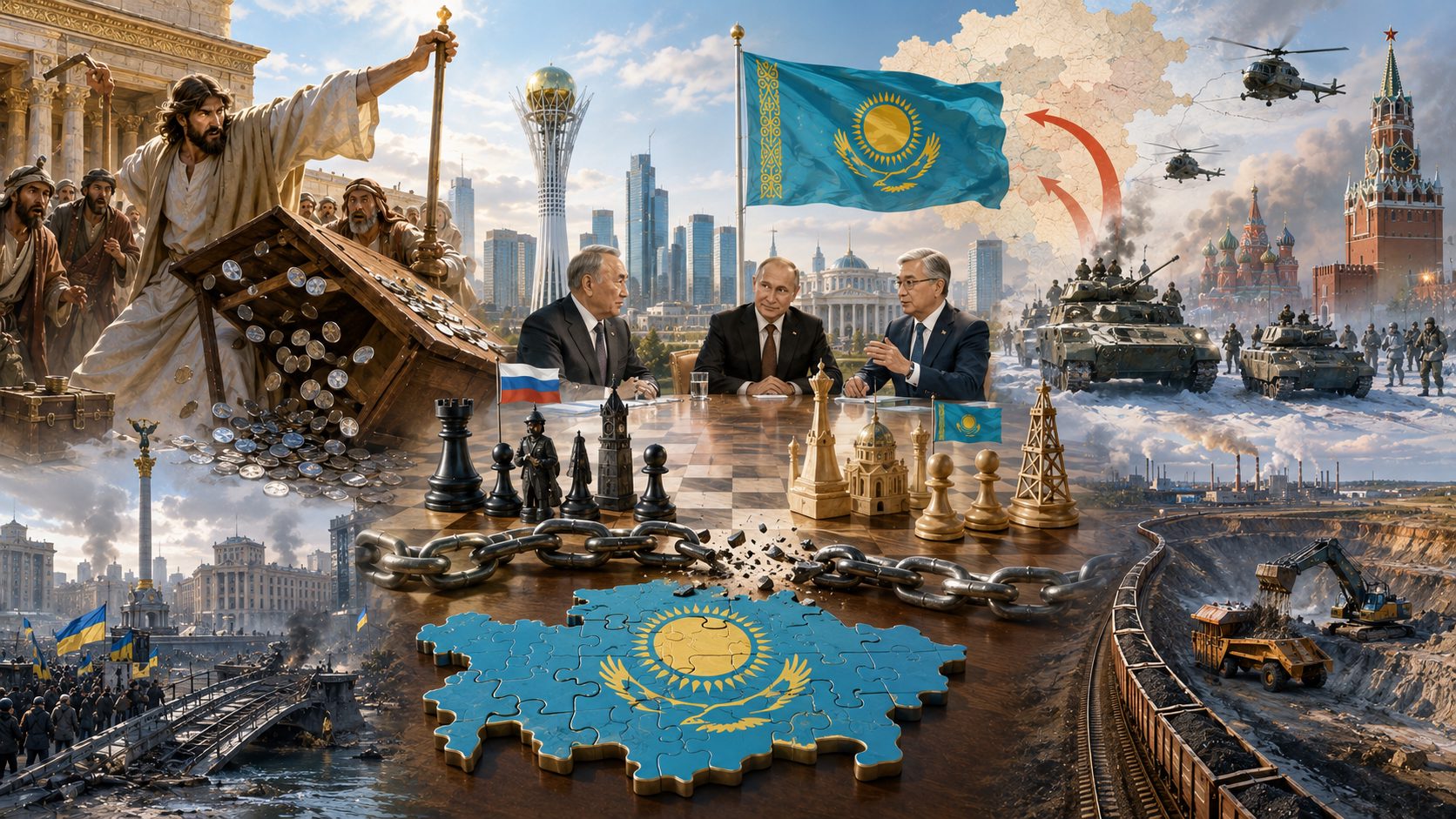
Why Russia did not attack Kazakhstan: Crimea, Kyiv and our north and east
Crimea in 2014, January 2022 in Kazakhstan and Russia's blitzkrieg against Kyiv are usually examined separately. They are links in one chain, and our regions from Kostanay to East Kazakhstan stood next in it. The chain did not break in talks or under sanctions. It broke outside Kyiv.
| Link | Date | What was being tested |
|---|---|---|
| “There was never a state here” | 2008 about Ukraine, 2014 about us | Can a country be cancelled with words |
| Crimea | March 2014 | Will the world accept borders redrawn by force |
| The NATO ultimatum | 17 December 2021 | Will the region be conceded, Central Asia included |
| Two centres in Astana | 28 December 2021 | Who decides in Kazakhstan |
| January in Kazakhstan | 5–19 January 2022 | Can troops be sent into a neighbour |
| Blitzkrieg on Kyiv | February 2022 | Does a capital fall in three days |
Following Adolf Hitler’s road
Putin is usually written about as a man holding on to power: his terms are counted, his successors listed, his health guessed at. From that altitude the main thing is invisible.
Climb higher, to where you see not a man but a method. The method turns out not to be new. It has been described, analysed and carried through to its end, and it has an author: Adolf Hitler.
We have examined the mechanics of such wars before — how a people is told it is chosen and sent to die for someone else’s purpose. This is about something else: not the justification, but the sequence.
The sequence runs like this. Hitler moves troops into the Rhineland, 1936 — a test of whether anyone will answer. No one did. The annexation of Austria, March 1938 — a test of whether it will be tolerated. It was. The Sudetenland that autumn, and Munich, where it was handed over voluntarily to avoid a war. Six months later, all of Czechoslovakia, which under the Munich agreement was supposed to be safe. Six months after that, Poland, and a world war.
Five steps, and each one taken because the previous one went unpunished.
The pretext never changed: compatriots abroad, oppressed. The preparation never changed either: the country being marched on was declared unreal — stitched together from other people’s pieces at Versailles, and therefore in no position to object.
Read that paragraph again and substitute different dates. Nothing changes but the names.
At this point people usually ask: surely everyone can see how it ended last time? The bunker, the jerrycan of petrol, seven million German dead and a country cut in half for forty-five years — this is hardly hidden knowledge.
It is visible. Knowledge simply has nothing to do with it.
Hunters have a way of catching monkeys. Something tasty is placed inside a hollow with a narrow opening. The animal reaches in, grabs it, and cannot pull its fist back out. It never occurs to it to open its fingers. That is how it is taken: bare-handed, alive. What holds the monkey is not the trap. It holds itself.
This is the architecture of autocracy. The problem is not that an autocrat does not know history. The problem is that opening your fingers means giving up the very thing you have been burning bridges for.
And the bridges burn at every step, which is not a figure of speech. After Crimea there was no returning to the position before Crimea. After February 2022, none to the position before February. Each step forward cut off the road back and made the next step the only movement available.
So Crimea, the NATO ultimatum, January in Almaty and the columns heading for Kyiv are not five separate stories. They are one sequence, and it had a queue.
We were standing in that queue.
Russia’s plan was never about land. It was about the code
It is a mistake to think this was about territory. Territory is the consequence. The design was larger: to restore an order in which sovereignty in this space does not belong to a country by right but is issued from Moscow and can be withdrawn.
That order has a precise name, and it does not come from the language of diplomacy. It is not law. It is ponyatiya — the code of the criminal world.
Anyone who lived through the nineties knows the difference. Law is written in advance and is the same for the strong and the weak. The code is written as you go and always in favour of whoever is stronger. It contains no rights, only a place in the hierarchy. Disputes are settled not by a court but by the smotryashchy — the man whose right to decide has been acknowledged. And under the code you do not conquer a neighbour. You explain to him who is senior here, after which he brings you his tribute himself.
The man at the head of Russia made his career in government in exactly that place at exactly that time: from June 1991 as chairman of the committee for external relations at the St Petersburg mayor’s office, then deputy and first deputy to Sobchak, until Sobchak lost the 1996 election. The city of those years acquired a name that became the title of a book and a television series: Gangster Petersburg. I assert nothing about his contacts or acquaintances. I am talking about a school: how you settle matters is absorbed from a place and a time, not from a diploma.
Transfer that code onto a map and the foreign policy reads without remainder. Moscow’s grievance against its neighbours is not territorial at all. It is that the neighbours carry themselves as equals, and under the code they are not equals.
Once such an order is acknowledged, borders move afterwards almost without war. It is enough that everyone understands who decides here.
This is not putting thoughts into the author’s head. On 17 December 2021 the Russian foreign ministry published draft treaties with the United States and NATO — the document that entered history as the ultimatum. The demand: return the military and political configuration to its 1997 state and abandon military activity “in Ukraine, in Eastern Europe, in the South Caucasus and in Central Asia”.
Read those last two words again. In December 2021, two months before the invasion, Central Asia is named in the demands in plain text. Not Ukraine alone. The whole region, ours included, treated as a space whose status Moscow discusses with Washington — over the heads of the people who live in it.
The document was published officially. Its intentions are arguable. Its contents are not.
How a state is cancelled with words: Ukraine in 2008, Kazakhstan in 2014
This design has a preparatory stage, and it is verbal. Before you enter a territory, you must establish that there is not, strictly speaking, a state there.
The template was worked out on Ukraine. In April 2008 in Bucharest, Putin said to George Bush a sentence that sounded at the time like emotion: Ukraine is “not even a state”. For years it survived only in second-hand accounts; now the transcripts of Putin’s conversations with Bush have been declassified following a lawsuit by the National Security Archive. The logic in them is the same one that would be heard from television screens fourteen years later: the country was assembled from other people’s pieces, therefore it is not a real country.
From “not a state” to “protecting compatriots” is a single step, and it is taken quickly.
Now the part we in Kazakhstan prefer not to remember.
On 29 August 2014, five months after Crimea, at the Seliger forum, the same man said of us: “The Kazakhs never had statehood. He [Nazarbayev] created it. In that sense he is a unique man in the post-Soviet space.” In the Russian telling this ran as a compliment to Nazarbayev.
The compliment is built like this: your statehood is not your own, it was a gift from one man. Therefore it is neither permanent nor unconditional. Therefore the question of it can, in principle, be raised.
This is precisely the construction of “Ukraine is not a state”. The only difference is the politeness of the tone. And it was spoken in the very year the construction was first applied in practice.
Afterwards it was repeated without the politeness. In December 2020 the State Duma deputy Vyacheslav Nikonov declared on Channel One that Kazakhstan’s territory was “a large gift from Russia and the Soviet Union”, and then explained that he had been misunderstood. His colleague Yevgeny Fyodorov went further still, to Russia’s right to raise the question of returning the transferred lands. Kazakhstan’s foreign minister called it nonsense, the ministry demanded that such statements be prevented in future, and by then the list of them was already long.
We decided it was noise from individual deputies. In Ukraine in 2008 they decided it was emotion.
Words of this kind are not noise. They are a legal pretext kept ready and produced when an opportunity appears.
Crimea 2014: testing whether the world accepts borders redrawn
Crimea was not an acquisition. Crimea was an experiment with a clear question: will the world accept a revision of borders by force, and at what price?
The answer was encouraging for the man asking. Sanctions were imposed, Russia was expelled from the G8, and the peninsula stayed. The price was high but payable, and above all it was finite.
From this followed a conclusion, and the conclusion was wrong although it looked ironclad: the code works, the world will swallow it, and it can be repeated on a larger scale.
The eight years between Crimea and the invasion were not a pause. They were the time needed to prepare the next stage.
Eight weeks: from the NATO ultimatum to the invasion of Ukraine
Now the calendar. Just the dates, in order.
| Date | Event |
|---|---|
| 17 December 2021 | Demands to NATO, naming Central Asia |
| 28 December 2021 | Putin receives Nazarbayev and Tokayev in St Petersburg, separately |
| 2 January 2022 | Protests begin in Zhanaozen |
| 5 January 2022 | Tokayev requests help from the CSTO |
| 6 January 2022 | CSTO troops enter Kazakhstan |
| 8 January 2022 | Karim Massimov, head of the security service, is detained |
| 19 January 2022 | Withdrawal of CSTO troops completed |
| 21 February 2022 | Recognition of the Donetsk and Luhansk “republics” |
| 24 February 2022 | Invasion of Ukraine |
Eight weeks from ultimatum to war, and exactly in the middle: Kazakhstan, where Russian troops entered legally for the first time in history.
I cannot prove that all of this was directed from one office. I have no such information and will not pretend that I do.
But a calendar is a calendar. And a coincidence of that density deserves at the very least to be said out loud.
28 December 2021: Putin, Nazarbayev and Tokayev in St Petersburg
One date in this sequence usually slips by unnoticed. It explains January better than any of the others.
On 28 December 2021, at the Constantine Palace outside St Petersburg, an informal CIS summit took place. Putin received Lukashenko and the rest — and held two separate conversations with Kazakhstan that day: one with Nazarbayev and, separately, one with Tokayev. Both transcripts sit on the Kremlin’s website.
That fact alone is an admission: there are two centres in Astana, and each has to be spoken to.
Read how Nazarbayev speaks: “Our President Kassym-Jomart Tokayev will come on behalf of Kazakhstan to settle all the questions. But as honorary chairman, as the most experienced, as a witness of history, I will take part in this.” And further: “We have built special relations with you. I hope they will continue under the new President as well.”
This is a patron speaking about his protégé. The sitting head of state is called “the new President”, under whom arrangements made with somebody else ought to be preserved. That day the Kremlin still titles the guest “Leader of the Nation”.
Putin answers in a different frame of reference. He attributes the economic results to “our joint work with the current leadership of Kazakhstan — with the President, with the government.” Not with the man across the table.
And then came the footage at the exit. The Kremlin press pool of RIA Novosti itself published the shots of the leaders arriving, and in them Lukashenko can be seen helping Nazarbayev down the steps and into a car. An eighty-one-year-old man who had just explained that the special relationship between two countries rested on him could not descend a staircase without someone else’s arm.
I will draw no medical diagnosis from this — none was ever published, and every theory about the cause remains a theory. But the clip spread instantly, and it was read one way only: the second centre of power in Kazakhstan was running out of physical resource.
Three years later this was confirmed by the one man who knew from the inside. On 3 January 2025 Tokayev said in an interview with the newspaper Ana tili that the decisive events which predetermined the crisis were Nazarbayev’s statements about the possibility of returning to the Akorda — citing Malaysia’s Mahathir Mohamad — and his participation in that same St Petersburg summit.
And he gave a picture he had not previously drawn so plainly: “After resigning, while remaining chairman of the Security Council, he was, frankly speaking, not distinguished by political delicacy; he regularly held meetings at his own office with the prime minister, the chairman of the National Bank, ministers and akims. Even foreign leaders and diplomats looked on in astonishment.” And he added the joke that circulated at the time: “After resigning, Nazarbayev was promoted: he got the President put under him.”
So nine days before the January events the country had two centres of power, foreign diplomats knew about it, and the elder of the two was visibly failing.
January 2022 in Kazakhstan: who got what
What follows divides into what can be shown and what cannot. I separate them deliberately.
What can be shown is the outcome.
After January, Nazarbayev lost everything: the Security Council, his status, his title, his constitutional guarantees, the capital named after him. Karim Massimov, the man he had installed at the head of the security service, received 18 years for treason and the violent seizure of power. Nazarbayev’s own nephew Samat Abish, first deputy chairman of the same service, received eight years suspended, having admitted guilt and repented, and is under probation supervision. Both trials were held behind closed doors.
After January, Tokayev received the fullness of power — and entered it owing his survival to the entry of foreign troops.
Both centres that stood in St Petersburg on 28 December came out of January weaker than they went in. One destroyed, the other in debt.
Now what cannot be shown.
Was this an operation rather than an eruption, using men who were reaching for power anyway? The motive is visible: behind the northern enterprises stood an ownership structure formed under Nazarbayev and tied to him. The Sokolov-Sarbai association belongs to Eurasian Resources Group, in which the state holds 40 per cent and the rest belongs to the “Eurasian trio” who rose in his era. No direct stake of Nazarbayev’s in these assets has been publicly recorded, and I will not ascribe one to him. But he was master of the situation in the north, and any arrangement made over his head ran into him.
I have no proof that January was directed from outside. A coincidence of dates is not evidence, and reliable knowledge of such things belongs to intelligence services, not to columnists.
There is, however, a third thing, and it is ours rather than anyone else’s. The verdicts were delivered in closed proceedings and the case files are classified. A citizen of Kazakhstan cannot verify who tried to seize power in his own country or who stood behind it. He is invited to take it on faith. We will return to why this was done — the secrecy here does not work in the country’s favour. A country that cannot check who betrayed it is exactly as defenceless from within as it is from without, and that hole was not drilled in Moscow.
What would have happened to Kazakhstan’s north and east if Kyiv had fallen
What follows is a supposition. I say so plainly: it cannot be proved, because it did not happen.
The design of Russia’s February 2022 invasion is known from the way it was executed: seizing the airfield at Hostomel on the first day, an airborne landing, columns from the north, a change of government in Kyiv within days. The plan was built for speed, not for war.
Imagine that it had worked.
The point is not that tanks would have rolled straight on eastwards. The point is that the very possibility of refusal would have vanished. A neighbour’s refusal is possible only while an example exists that refusal is possible. If the capital of the region’s second-largest country falls in three days and the world merely spreads its hands, that example disappears — and every conversation between Astana and Russia stops being a conversation.
The pretext would have been ready in advance, and it is an old one: protection of compatriots. It was exactly what Crimea was explained with, and the verbal groundwork had been laid for a decade — about gifted territories and about a statehood that supposedly never existed.
And it is worth understanding what, in our case, would have been at stake.
This is a belt along the Russian border — our north and our east. Four regions: Kostanay, North Kazakhstan with Petropavlovsk, Pavlodar, and, already in the east, East Kazakhstan with Ust-Kamenogorsk. Not simply regions with many Russian speakers. This is the country’s metallurgical spine. Kostanay region holds 93 per cent of Kazakhstan’s iron ore reserves, and its enterprises produce about 90 per cent of national output. In Rudny sits the Sokolov-Sarbai combine with the Sokolovskoye, Sarbaiskoye and Kacharskoye deposits — a raw ore capacity of about 25 million tonnes a year. Alongside it: the Ekibastuz coal of Pavlodar region, the polymetals and rare metals of East Kazakhstan, the grain belt of North Kazakhstan.
The north gives ore and coal; the east gives polymetals, titanium and uranium. Detach that belt and what remains of Kazakhstan is a country without metallurgy, without a significant part of its power generation and without half its industrial capacity. This is not the taking of land. It is the amputation of an economy.
And for the man who carried it out, the prize would not have been a raw-materials one. Someone who gathered Ukraine, our north and our east into one hand would have become, for the chauvinist part of his audience, not a president but a figure from a textbook: the man who brought the empire back. You do not step down with a reputation like that. You rule with it to the end.
Why Russia went no further: Kyiv did not fall in three days
Because Kyiv fell neither in three days nor in thirty.
Hostomel did not become a bridgehead. The column from the north stretched out and stopped. By the end of March 2022 Russian forces had left Kyiv region, and the “special operation” had turned into a long war for which neither the army nor the budget nor the design had prepared.
The code was not established. The demonstration did not take place. And with it, nothing that was meant to follow took place either.
How much this concerns us can be seen in a single scene.
On 17 June 2022, at the St Petersburg economic forum, sitting on the same stage as Putin, Tokayev said that the right of nations to self-determination “would also be applied to the quasi-state territories which, in our view, Luhansk and Donetsk are”. Kazakhstan does not recognise the Donetsk and Luhansk “republics” — said in St Petersburg, to his face, in public.
Five months after January, when Russian troops had stood in Almaty.
That sentence was not a matter of personal courage. It became physically possible because four months earlier it had turned out that capitals do not fall in three days and that the army everything had been staked on was not all-powerful. Tokayev said no within room for manoeuvre that had been won somewhere other than Astana.
We owe the integrity of our borders neither to our own diplomacy nor to the guarantees of the CSTO. We owe it to the resistance of another people who, in February 2022, simply did not run.
This is an uncomfortable thought, and it is not customary here to say it aloud. But it is, I think, the right one.
What is left of Putin’s plan
And here we return to the man we began with — but now from the right altitude.
The design failed and its author stayed inside it. In 2020 he reset his own term limits, and this was read as a strengthening. I read it differently: a term sets a date, a date is prepared for, and that is how a system produces a replacement. By removing the date, the reset removed not a limit but an exit.
There is no exit for a second reason as well, and it is not technical but simple.
Safety for a departing ruler is not given by his successor. It is given by how he ruled. A ruler who took nothing that was not his and did not step over the law leaves and lives: there is nothing to try him for, and he needs no special guarantees. A ruler who spent decades appropriating knows everything about himself — and knows that the files will open the day he stops being the power.
This shows what the common consolation is worth: hand power, they say, to someone who has already taken his share and therefore will not covet yours. This is naivety. Greed knows no point of satiety — appetite does not disappear in the well-fed, and to his predecessor’s assets he is closer than anyone else alive. A paper guarantee is therefore worth exactly what the next man’s signature is worth, and the next man has every interest in withdrawing it.
The experience next door demonstrated this. Nazarbayev had the most complete set of guarantees imaginable, and it held for three years. Thirty years in power closed his exit more reliably than any constitution.
There is a second half to the same problem: anyone who could in principle be trusted does not survive in such a system. The only man in Russia with an armed force of his own, not derived from an office, died two months after he used it. So there is no one to make the promise and nothing with which to secure it, and both sides understand this.
The same thing is taking shape here. Tokayev, generally considered a cultivated man, on 7 January 2022 gave the order to “open fire to kill without warning”. Officially 238 people died in January, 19 of them law enforcement officers; the violence against protesters was never investigated. He understands as well as anyone what he will be asked about first on the day he stops being president.
That is why January is classified. Closed trials, sealed files, uninvestigated violence — this is not bureaucratic habit or care for state secrets. This is what an attempt looks like to remove from public reach the thing you will have to answer for.
The method is a weak one. Secrecy protects not from a court but only from a conversation: it stops citizens discussing January, but cancels nothing in the cases themselves, which lie there and wait. And it works exactly until the day the signature that imposed it stops carrying force.
The trap, then, is not the absence of a suitable heir. It is what has accumulated over the years in power. And it is closed not by the successor but by the ruler himself, with every decision he will later have to answer for.
In the Russian constitution, incidentally, there is no line of succession at all. Article 92 knows only the prime minister temporarily performing the duties, and that is all. Twenty-seven years in power, and not one line about how that power passes to the next man.
Add the cost of the war. The 2026 budget was drawn up with a deficit of 1.6 per cent of GDP, while in January–April the deficit reached 2.5 per cent; energy revenues are expected 18 per cent below plan, and from 1 January VAT was raised from 20 to 22 per cent. On 23 August 2026 he announced his readiness for talks — but only “on the basis of the realities on the ground”.
A man who staked everything on a design and received nothing can neither play it back nor walk away. He closed both exits himself: one by the reset, the other by what he did while resetting.
The hand is in the hollow, the fist is closed, and there is nothing left in the fist — the fruit turned out to be inedible back in 2022. The fingers still cannot open: then he would have to explain what four years were paid for.
How stories like this end is known from the previous time. I will not claim it will repeat exactly — history rhymes, it is not recopied. Let me put it more carefully: not one of the ways out of this trap that I know of has ever suited an autocrat. It is not they who open the fingers.
The bill Kazakhstan was never sent
We have grown used to thinking that 2022 was about Ukraine and merely brushed against us: logistics, relocators, the tenge exchange rate, awkward questions at forums.
It did not brush against us. We were standing in the queue, and we left it only because the queue stopped at the one before us.
Two things follow, and both are unpleasant.
First: sovereignty is not secured by treaties, by membership of organisations, or by the personal relations of heads of state. All of it existed — the CSTO, the “exemplary relations” said to his face nine days before the crisis, and the signatures on the Budapest Memorandum, under which Ukraine surrendered 1,900 warheads and we surrendered 1,410 in exchange for guarantees from those very same states. In January 2022 we were protected by exactly what protected everyone else: someone else’s readiness not to give in.
Second: it is the stage that failed, not the design. The code it was meant to establish has not been cancelled, and the words that prepared it have not gone anywhere. They were spoken in 2014 at Seliger, repeated in 2020 on Channel One, and will be spoken again the moment a sense of opportunity returns. That, incidentally, is how everything written above can be tested: if I am right, talk of “gifted territories” will come back whenever Moscow feels strong and subside whenever it feels weak. If it falls silent for good while Moscow is strong, then I built an elegant scheme and got it wrong.
As for the answer, it does not lie in rhetoric.
Our own metallurgy and our own processing instead of exporting ore — because whoever ships raw material bargains from weakness. Our own routes, not running through a single country. Our own language, our own education and our own history — not as a grievance against a neighbour, but as something that cannot be disputed by someone else’s broadcast. And the right of citizens to examine verdicts in treason cases, because a closed trial protects not the country but the people named in it.
Above all — understanding what we owe to the Ukrainian people, who took the entire blow upon themselves.
Kazakhstan’s borders are intact not because we defended them and not because anyone vouched for us. They are intact because in February 2022 the Ukrainian people, whom we helped in no way at all, simply did not run. No bill for that was sent to us, and none will be.
Debts like that are not repaid. They are remembered.
Sources
Our earlier articles
- Tokayev is not leaving: a reset term and the division of Nazarbayev’s legacy
- Kurultai: why Nazarbayev is not in prison and Tokayev cannot leave
- Trump is not a dictator. And that is not to his credit
- God with us: the anatomy of war from an altitude where flags are invisible
- Ukraine refused to be a herd. We have not yet
- Not a turn but a warning: what Tokayev told Putin in Omsk
The words that prepare a pretext (sources in Russian)
- Putin at Seliger, 29 August 2014: “The Kazakhs never had statehood”
- Voice of America: how the statement sounded and what was said about it
- Declassified transcript of Putin’s conversation with Bush (National Security Archive)
- RIA Novosti: Nikonov explains his words about territory “gifted” to Kazakhstan
- Interfax: Kazakhstan’s foreign minister calls deputy Fyodorov’s statement nonsense
- Forbes.kz: “Take your suitcases, give back the territory” — what is said about Kazakhstan in Russia
The ultimatum of December 2021
- RIA Novosti, 17.12.2021: the foreign ministry publishes draft treaties with the US and NATO
- Izvestia: the full set of published demands
St Petersburg, 28 December 2021
- Kremlin: Putin’s meeting with Nursultan Nazarbayev, transcript
- Kremlin: Putin’s meeting with President Kassym-Jomart Tokayev the same day
- Kremlin: informal meeting of the CIS heads of state
- Kaktus.media: Lukashenko helps Nazarbayev down the steps and into a car. Video
- Parlamentskaya Gazeta: Tokayev on Nazarbayev’s participation in the CIS summit and the crisis in Kazakhstan
- Forbes.kz: Tokayev on Nazarbayev and on the dual power, interview with Ana tili
January 2022 in Kazakhstan
- CSTO: the peacekeeping operation in Kazakhstan, 6–19 January 2022
- RIA Novosti, 07.01.2022: Tokayev orders fire to kill without warning
- Prosecutor General’s Office: the number of deaths in the January tragedy
- Human Rights Watch: no justice for the victims of the January protests
- Vedomosti: Massimov sentenced to 18 years for treason
- RIA Novosti: the verdict delivered in a closed trial
- Kursiv: Samat Abish sentenced to eight years suspended
- Mediazona: Nazarbayev’s nephew given a suspended sentence in the January events case
- Eurasian Resources Group: ownership structure
Tokayev’s refusal at the St Petersburg forum
- Vedomosti, 17.06.2022: Kazakhstan does not recognise the independence of the Donetsk and Luhansk “republics”
- Fontanka: Tokayev’s direct words about “quasi-state territories”
What is at stake: Kazakhstan’s north and east
- Inform.kz: 93 per cent of Kazakhstan’s iron ore reserves are in Kostanay region
- Inbusiness.kz: the region leading in iron ore extraction
- Kursiv: how much iron ore the Sokolov-Sarbai combine and Kachary Ruda produce
What is left of the plan
- The reset of presidential terms: how the amendment was framed
- RBC: forensic examination confirms Prigozhin’s death
- RBC, 11.01.2023: the Constitutional Court strips Nazarbayev of the title of Elbasy
- Reuters: the budget deficit may nearly triple on falling oil revenues
- The budget deficit reached 2.5 per cent of GDP in four months
- The State Duma approves raising VAT to 22 per cent from 2026
- 23.08.2026: the announcement of readiness for talks with Ukraine
If you have found a mistake or a typo in this article, tell us about it
Comments (0)
Log in to leave a comment →
No comments yet. Be the first.