

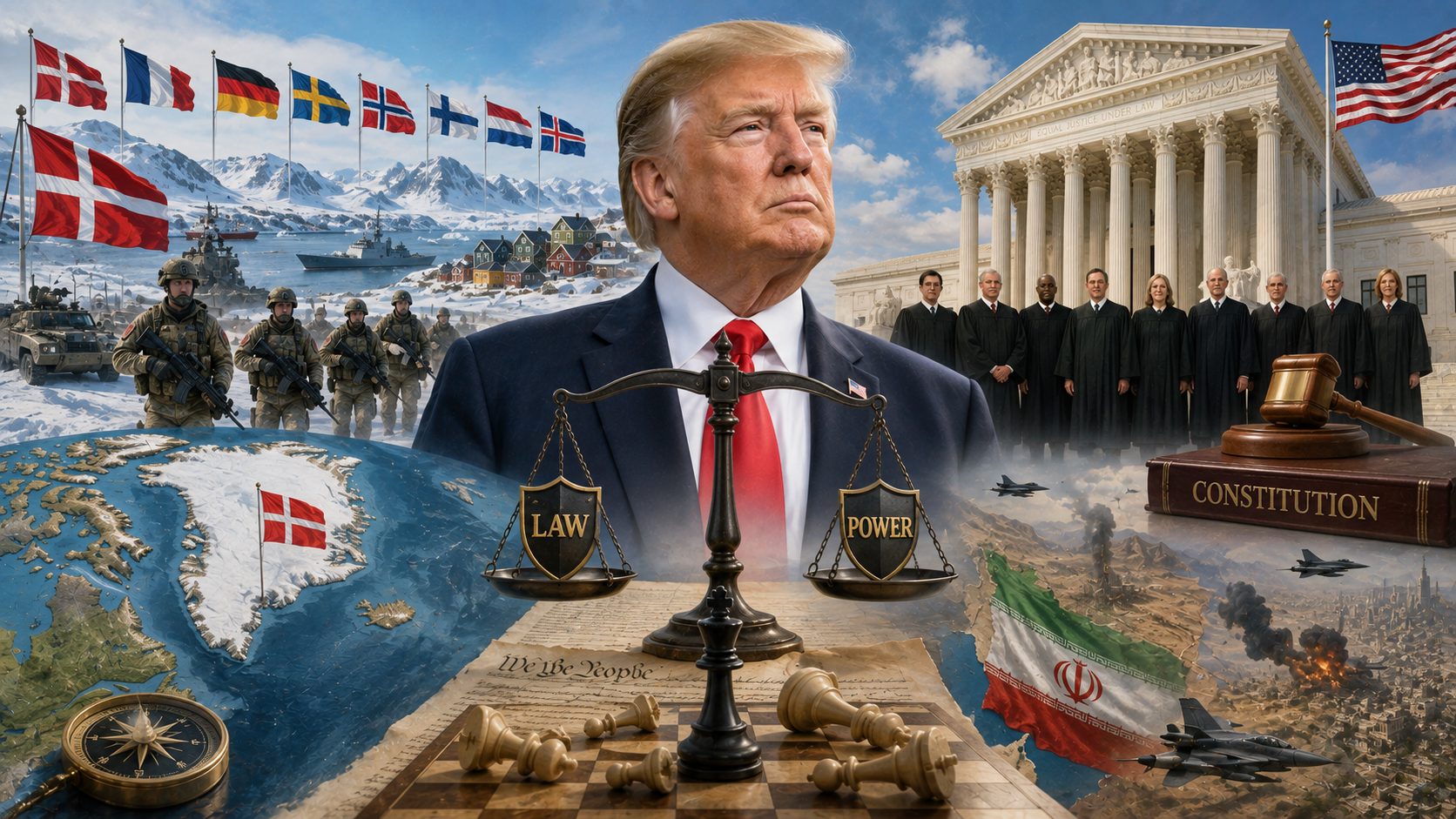
Trump is not a dictator. That is not his doing
For weeks he refused to rule out military force against Greenland. European troops arrived and eight governments publicly backed Denmark. On 21 January he ruled force out. Greenland, tariffs, Iran, a third term — four times he reached a wall, and not once did he stop himself.
This is the author’s opinion. Everything checkable carries a link to its source. The rest is judgement, and it can be argued with.
| What he wanted | What stopped him |
|---|---|
| To annex Greenland | Eight European armies, the NATO Secretary General, a joint statement on Danish sovereignty |
| Tariffs under emergency powers | The US Supreme Court, six votes to three |
| A ground operation in Iran | His own advisers, the cost of the war, 31% support |
| A third term | The Twenty-Second Amendment |
January 2026, Nuuk
Danish engineers and dragoons deploy to Nuuk and Kangerlussuaq. Troops from France, Germany, Sweden, Norway, Finland, the Netherlands, Iceland and Belgium follow. The operation is called Arctic Endurance. On 11 February NATO launches a second one, Arctic Sentry.
Officially these are Danish exercises with allies, strengthening Arctic security. That is what they should be called: nobody declared that the troops were coming against the United States.
But there is a sequence, and it speaks for itself.
In an NBC interview the US president refused to rule out the use of military force to acquire Greenland. On Canada he was softer — “economic force”, the fifty-first state. On 17 January he threatened Denmark and other European countries with tariffs: 10% from February, 25% from June, until an agreement to hand over the island.
On 18 January eight European governments issued a joint statement on the sovereignty and territorial integrity of Denmark. The troops were already arriving by then.
On 21 January, in Davos, after meeting NATO Secretary General Mark Rutte, Trump ruled out the use of force and dropped the tariffs. His wording on Truth Social: “Based on this understanding, I will not be imposing the tariffs scheduled for February 1st.”
I cannot and will not claim that European soldiers made him change his mind. Something else is visible: for weeks he did not rule out force, the allies stood as a wall and offered a deal, and after that he ruled force out.
Danish Foreign Minister Lars Løkke Rasmussen put it most precisely: force being off the table is good, “but the problem has not gone away. The president’s ambition is intact.”
What he says
His words are well known and have been repeated for years.
On Xi Jinping, March 2018, a closed-door gathering at Mar-a-Lago: “He’s now president for life. President for life. No, he’s great. And look, he was able to do that. I think it’s great. Maybe we’ll have to give that a shot someday.”
On Kim Jong Un, June 2018: “He speaks and his people sit up at attention. I want my people to do the same.” Pressed on it, he answered: “I’m kidding. You don’t understand sarcasm.”
To Putin, in front of journalists, about the press: “Get rid of them. Fake news is a great term, isn’t it? You don’t have this problem in Russia, but we do.”
December 2023, Sean Hannity asks whether he promises not to abuse power. “Except for day one.”
In all four cases the praise is for the same thing: these men do not have to explain themselves. Not a word about the one-party system, the planned economy, the ideology. Dictatorship as a system of government does not interest him. The absence of friction does.
What he does
Words are confirmation. Deeds are proof, and the deeds form a single pattern.
Sanctions against Russia. July 2025: a hundred per cent in secondary tariffs unless there is peace within 50 days. The deadline is then cut to 10–12 days. The regime is created in August by an emergency-powers order.
It was applied against exactly one country — India, with a 25% surcharge. In February 2026 the surcharge was lifted: India signed a trade agreement. Nothing was ever taken from Russia.
An instrument announced as pressure on Moscow worked as leverage in negotiations with Delhi.
In August 2026 the Senate passed the Graham bill 86 votes to 11 — Congress produced this itself, almost unanimously. And even there the president was left room for discretion.
Weapons for Ukraine. They are not given, they are sold. The PURL mechanism: allies put up the money, the United States supplies. Trump’s own wording: “We’re sending weapons to NATO, and NATO is paying for those weapons, 100%.” Around ten billion dollars for American industry.
None of these actions cost Putin much. None of them cost Trump anything.
Iran. On 28 February 2026 “major combat operations” are announced, joint strikes with Israel against military, government and infrastructure targets. Six months later the war is being fought from the air and the sea. There is no ground invasion.
It did not happen, but not for want of wanting it. Massed strikes were repeatedly paused after meetings with advisers.
And the price kept rising. By late August 2026 the war was supported by 31% of Americans, against 37% in March. Even among Republicans support fell from 77% to 69%. The president’s approval rating is at a historic low.
The pattern
Put all four cases together and one thing is visible.
Greenland was not taken — eight armies arrived, and the NATO Secretary General. The emergency-powers tariffs were struck down — the Supreme Court, six votes to three. There is no ground war in Iran — advisers and the cost talked him out of it. There will be no third term — “the law is very strong.”
Not one of these stops came from inside.
In no case did he say he had changed his mind, that it would have been wrong, that it must not be done. In each he ran into something outside himself and retreated exactly as far as he had to.
That is the definition. Not temperament, not style, not coarse manners. A man whose every brake is located outside himself.
Where it comes from
For forty years he ran a private family company. No public shareholders. No board that had to be persuaded. No electorate. No press that did not answer to him.
The presidency is the first job of his life in which the building is not his.
That biography is easy to mistake for an excuse: not a dictator, just an owner caught in someone else’s rules. That reading is wrong, and it is wrong in an important place.
Forty years without a single “no” is not a mitigating circumstance. It is the origin of the instinct. A man who has never had an authority above him has not developed the thing that only develops underneath one: an internal limit. He had nowhere to get it from.
Everything else follows, literally. A threat, to him, is not an instrument but an asset: once used it is spent, which is why the sanctions regime is held rather than applied. Aid is an expense, a sale is revenue, which is why Europe pays for the weapons. You do not destroy a counterparty in an unclosed deal — which is why Putin is never squeezed to the end.
And this is why the bull in the china shop is not a malfunction. He described unpredictability as a technique back in The Art of the Deal: never let the other side work out your limit. In real estate, the shop is an obstacle on the way to the construction site. In constitutional government the shop is the point: courts, Congress, the press, the states are not obstacles on the way to the result — they are the result, and the president is obliged to preserve them.
The person able to tell the difference is one who has, at least once, worked under somebody else’s rules.
What holds, and what is already being cut
Constraints work unevenly, and that is measurable.
Holding. On 20 February 2026 the Supreme Court decided Learning Resources, Inc. v. Trump: by six votes to three, through Chief Justice Roberts, the emergency economic powers act does not give the president the authority to impose tariffs. Four days later every tariff imposed under that act ceased to have effect. Of 552 tracked lawsuits, 153 blocked administration actions. Eight armies in Greenland. Seventy per cent of Americans against a war with Iran.
Being cut. January 2026: federal judge Schiltz listed 96 court orders violated by the immigration service across 74 cases in a single month, and wrote that the agency had “probably violated more court orders in January 2026 than some federal agencies have in their entire existence.” Since August, judges have issued at least 35 orders to show cause why the administration should not be held in contempt. Nine new states of emergency in the first year.
Steven Levitsky, Lucan Way and Daniel Ziblatt — who coined the term — classify today’s United States as competitive authoritarianism: elections continue, but the machinery of the state works against the opposition. Levitsky: “When we invented this term twenty-five years ago, we never imagined applying it to the United States.”
He is not Putin, and that needs saying
The temptation to put an equals sign between them is strong, and it should be resisted — not out of caution, but because the equation is false and easily refuted.
Putin is waging a full-scale war. Political competition in Russia has been destroyed, television belongs to the state, parliament is not an independent centre of power, term limits have been rewritten. Trump operates in a country where courts strike down his orders, states sue him and win, newspapers write what they like about him, and Congress passes laws against his will by eighty-six votes.
These are not the same thing, and today they are not close.
What is related is something else: the conception of what a limit on power is. For both men an independent institution is not part of the structure but an obstruction inside it. The difference between them is not in that conception, but in how many such institutions have survived around each of them.
That is why the comparison should not be between the men, and not between the constitutions. The comparison should be at the point of collision: the ruler wants one thing, the law says another — who won.
Renaming what he could not take
On 27 August 2026 an executive order was signed, “Honoring the American History of the Great Lakes and Renaming Lake Ontario as Lake America.” Interior Secretary Doug Burgum is directed to carry out the renaming within thirty days, and the Board on Geographic Names to “remove all references to Lake Ontario” from the federal register of names and to ensure the new name appears on all federal maps, in contracts and in documents.
The justification inside the order itself: the United States is “the greatest protector of the Great Lakes.” Nine of eleven icebreakers are supplied by the American coast guard; some four billion dollars have gone into the lakes’ ecology over ten years.
The lake is half Canadian. It is managed jointly under the Boundary Waters Treaty of 1909. The order changes nothing beyond American federal paperwork: neither Canada, nor international organisations, nor cartographers, nor newspapers are obliged to comply.
Mark Carney answered the same day: his country will call it Lake Ontario “forever”. The name comes from the Wendat Ontari’io — “the lake is beautiful, the lake is big.” It is more than four hundred years old. It is older than both the Canadian Confederation and the US Declaration of Independence.
This is the same will in its cheapest available form. Greenland was not handed over. The tariffs were struck down by the court. Advisers and the cost kept him out of Iran. A third term is closed off by the amendment. But renaming a lake on your own maps is something nobody can prevent — no one’s consent is required.
Renaming is what is left when everything else has run into a wall.
The invention is not American. In March 2019, the day after Nazarbayev resigned, Astana became Nur-Sultan — the ruler’s name on the capital while he was alive. It was proposed by Tokayev in his very first speech as president. In September 2022 the same man gave Astana back. One city, two rewritings, three and a half years.
In China, on 11 March 2018, “Xi Jinping Thought” was written into the constitution — before him only Mao had been granted that. The same package of amendments removed the term limit on the presidency.
The difference shows in the result. Nur-Sultan was renamed. Ontario was not.
The will is identical. What differed is what the signature runs into. In Kazakhstan the president’s signature is the last word. In America it holds as far as the Canadian shore, and not a metre further.
Remove the Boundary Waters Treaty. Remove Canada on the other side of the lake. Remove the court that struck down the tariffs, and the allies who came to Nuuk. Then the order of 27 August stops being a gesture on paper and becomes a renaming.
The same impulse, a different structure
We recently examined how Kazakhstan reset the presidential term. The rule of “one term with no right of re-election” remained in the text of the constitution. The Constitutional Court explained that it does not apply to the sitting president.
On 20 February 2026 the US Supreme Court read the law and refused the president — six votes to three.
The will in both cases was the same: that the rule should not apply to me. What differed was the structure that the will ran into. In Kazakhstan the court read the constitution the way it had been asked to. In the United States it did not.
From this follows a conclusion that is uncomfortable for anyone looking to America for an example. The example it sets is not the one expected. It shows that limits work not because a good man is in charge, but because there is nobody who can lift them alone.
That is the only guarantee that has ever worked. Humanity has not invented another.
What I do not know
I do not know what he believes about Russia. All that can be shown is that he has done nothing to undermine Putin’s position. Why, cannot be shown.
I do not know how the confrontation with the courts will end. Ninety-six violated orders in a month is a lot. Thirty-five demands to explain contempt is also a lot, on the other side of the ledger.
I do not know whether he would have taken Greenland if the Europeans had not come. I know only that he refused to use force after European troops moved in.
And I know the weak point of my own explanation. A biography is a model, not a diagnosis, and models like this are easy to fit after the fact. It is tested by prediction: if the brakes are only external, he will try again everywhere the constraint has weakened, and retreat where it is firm. If he pushes straight through somewhere he has already retreated, the model is wrong.
My view
It will be objected that calling this authoritarianism is an exaggeration. Elections are held, courts work, the press writes. All true.
But the year produced a rare thing — an almost clean experiment. Normally a ruler’s intentions are argued over, because only what was done is visible. Here we can see what he set out to do, what stopped him, and in what order.
He did not rule out force against Greenland. Eight armies arrived. He ruled out force.
Between “does not want to” and “cannot” the difference is enormous. Everything we observed was “cannot.”
And so the argument about whether or not he is a dictator loses its meaning as currently posed. The right question is a different one: what will be left when the counterweights are removed. That question has already been answered four times running, and the answer was the same every time.
To judge a man by what he did not do under pressure is to judge a river by its banks.
Sources
Our earlier articles
- Tokayev is not leaving: the reset term and the division of Nazarbayev’s legacy
- Kurultai: why Nazarbayev is not in prison and Tokayev cannot leave
Greenland: the January 2026 chronicle
- ABC News, 21.01.2026: Trump rules out military force at Davos
- Al Jazeera, 21.01.2026: tariffs dropped after talks with the NATO chief
- NBC News, 21.01.2026: live coverage from Davos
- Fortune, 21.01.2026: did Trump change his mind on Greenland
- France 24, 21.01.2026: Copenhagen’s reaction, Rasmussen’s words
Greenland and Canada
- CNN, 04.05.2025: Trump again refuses to rule out force to annex Greenland
- NBC News: military force for Panama and Greenland, “economic” force for Canada
- The Greenland crisis: chronology
- House of Commons Library: briefing for the UK parliament
Operation Arctic Endurance
- CNBC, 15.01.2026: NATO countries send troops to Greenland after tense White House talks
- CNN, 15.01.2026: European countries send additional troops amid annexation threats
- Danish Ministry of Defence: Arctic Endurance continues throughout 2026
- Operation Arctic Endurance: participants and outcome
- NATO Arctic Sentry, launched 11.02.2026
- Chicago Council: how European allies pushed back against the pressure
Iran
- The 2026 war: chronology
- The 2026 US military buildup in the Middle East
- ABC News: Trump conferred with advisers on the options
- The Hill: how to avoid a ground war in Iran
- Forbes, 25.08.2026: support for the war falls to 31%
- Al Jazeera, 24.08.2026: the Reuters/Ipsos poll on war support and approval
What he said
- CNN, 03.03.2018: on Xi — “maybe we’ll have to give that a shot”
- PBS NewsHour: on a president for life
- CBS News: “I want my people to sit at attention”
- PolitiFact, 07.12.2023: “except for day one” — transcript of the exchange
- NBC News, 06.12.2023: the same episode with Hannity
- CNN: fifteen occasions on which Trump praised authoritarian rulers
Sanctions and weapons
- Al Jazeera, 28.07.2025: Russia’s deadline cut to 10–12 days
- Steptoe: the 2026 Graham act and the discretion left to the president
- Atlantic Council: the Senate has handed over a tariff weapon — will he use it
- “NATO is paying for those weapons, 100%”
- FDD: the first delivery under the PURL mechanism
The Supreme Court decision on tariffs
- Learning Resources, Inc. v. Trump — the opinion of 20.02.2026
- Congressional Research Service: the court against IEEPA tariffs
- White & Case: IEEPA tariffs terminated on 24 February
Powers, courts, a third term
- Lawfare: one emergency after another
- Just Security: tracking suits against the administration and their outcomes
- Protect Democracy: the administration’s conflict with the courts
- LSE: how the 22nd Amendment might be circumvented
- “It’s pretty clear you cannot run a third time”
The renaming of Lake Ontario
- The White House, 27.08.2026: the text of the order
- Global News: “Lake Ontario, now and always” — Carney’s answer
- Al Jazeera: can Trump really rename the lake
- CNN: what the order changes and what it does not
- Akorda: the 2019 decree renaming Astana as Nur-Sultan
- Akorda: the decree restoring the name Astana, 17.09.2022
- NPR, 11.03.2018: China removes the term limit on the presidency
- BBC: “president for life” — the 2018 amendments in full
Political scientists’ assessment
If you have found a mistake or a typo in this article, tell us about it
Comments (0)
Log in to leave a comment →
No comments yet. Be the first.