

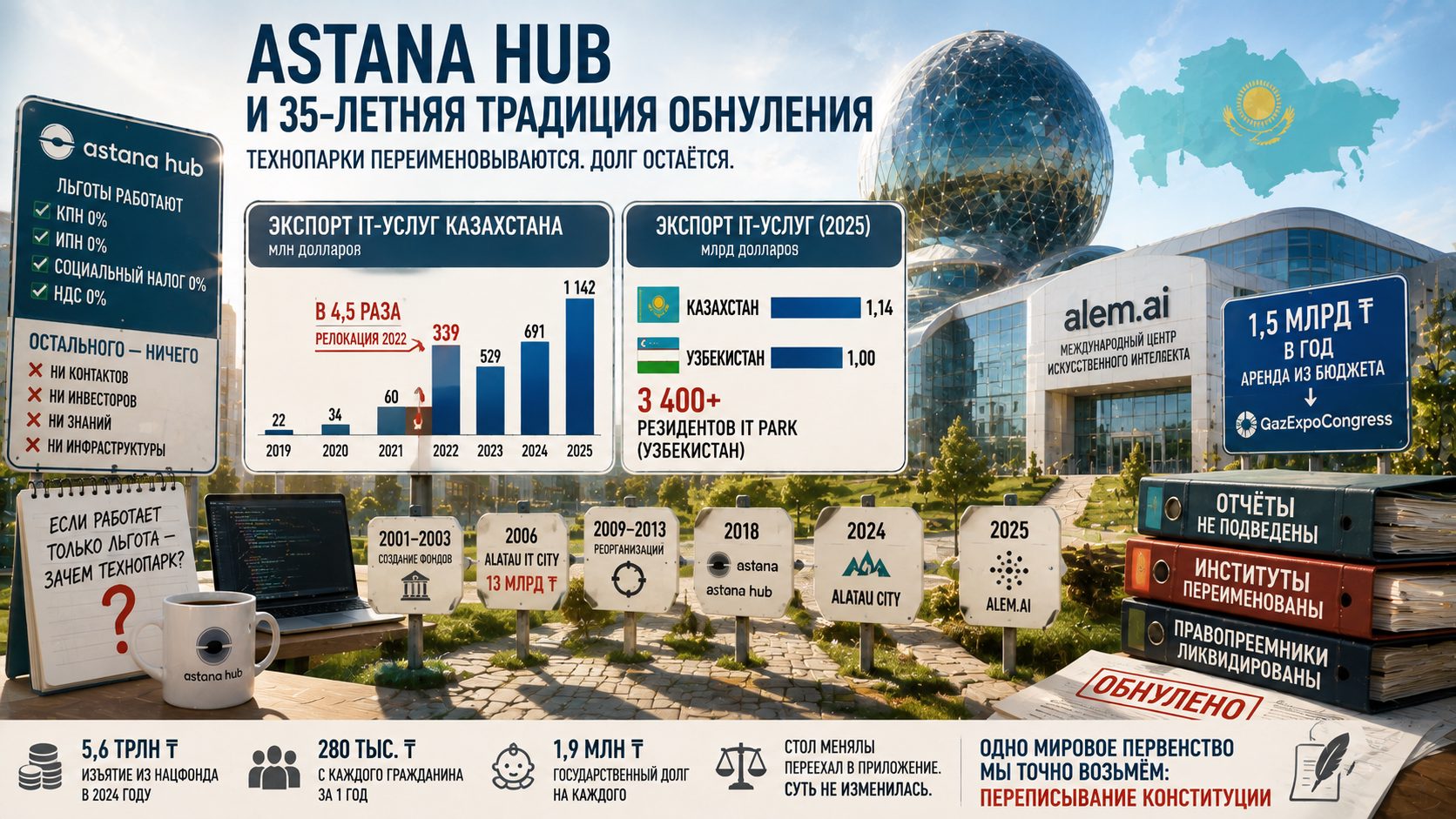
Astana Hub and the 35-year tradition of resetting
I am a member of Astana Hub, and I will say it plainly: the tax exemption works and a startup needs it — the rest gave me nothing. Hence the question: if only the exemption works, why does it need a technology park, a building and 1.5 billion tenge of rent a year? And why has no such project been audited in thirty-five years.
Exports did not rise when the hub opened. Both innovation centres sit inside EXPO pavilions. The state pays rent to itself. And above all: in thirty-five years not one project of this kind has ever been closed out with a final account — which is not carelessness but a working technology.
A note first: this is analysis and opinion, not a verdict. Every checkable claim is sourced at the end. Everything else is my assessment, and arguing with it is welcome.
Starting with myself
I am a participant of Astana Hub. I write this not to lend my words weight but so the reader knows where I am looking from.
What I actually received: a tax break. And that is no small thing. Exemption from corporate income tax, personal income tax, social tax and VAT — for a startup that has no profit yet but already has costs, this is the difference between “let’s try” and “let’s not begin.” There is nothing to argue about here and no other opinion is possible.
What I received besides that: nothing. Not one contact that led anywhere. Not one piece of knowledge I did not already have. Not one investor. My project advanced exactly as far as I sat down and worked on it myself.
I do not claim this is everyone’s experience. Perhaps others were luckier. But my observation raises a question the reporting has no answer to:
If the only working function is a tax exemption, why does it need a technopark?
An exemption can be granted by one line in the Tax Code — by type of activity, the way it is granted to agriculture. Without a building. Without a staff. Without 1.5 billion tenge a year of rent from the budget.
Everything standing between that line in the code and the entrepreneur is the subject of this piece.
And one more thing to grasp at the outset: in the reporting, my case is indistinguishable from a genuine success. I am counted as a resident. My income enters “total resident income.” If I sell something abroad, I enter “exports.” Meanwhile I went through no accelerator, received no investment, used no infrastructure. The statistics do not tell the difference.
What the technopark reports
Results for 2025, per Astana Hub itself: more than 2,000 residents, 490 of them with foreign participation. Total income of $1.7 billion. Resident IT-services exports of $633.8 million to 111 countries. More than 32,000 jobs. Over seven years, startups attracted $840 million of investment. An “ecosystem worth $4.3 billion.”
Impressive figures. One difficulty: they are published by the party they describe. I found no independent verification of them.
There is, however, another series that can be checked.
The hockey stick does not grow from where you think
Kazakhstan’s IT-services exports according to balance-of-payments data — the same National Bank statistics the ministry itself cites:
| Year | Exports | Growth |
|---|---|---|
| 2019 | $22.2 m | — |
| 2020 | $33.6 m | +51% |
| 2021 | $60.1 m | +79% |
| 2022 | $339 m | 4.5× |
| 2023 | $529 m | +56% |
| 2024 | $690.7 m | +30.5% |
| 2025 | $1,142 m | +65% |
Astana Hub has been operating since November 2018. Over its first three full years, exports grew from $22 million to $60 million — an increase of $38 million in three years.
Then, in 2022, a four-and-a-half-fold rise in twelve months.
Everyone remembers what happened in 2022. The industry press explains the jump without diplomacy: it was the consequence of Russian and Belarusian IT companies and specialists relocating to Kazakhstan. The same reporting adds that the effect is running out — by 2024 relocation had finished, and the growth rate fell from 345% to 30.5%.
Indirect confirmation that is hard to explain otherwise: in 2025, 90.3% of the country’s entire IT-services exports came from Astana — the city where the arrivals registered.
Does this mean Astana Hub had nothing to do with it? No. Those arriving had to arrive somewhere, and the tax regime may well have decided why they chose Kazakhstan over Georgia or Armenia. Being a functioning landing site is a real achievement.
But between “we received a flow well” and “we created the growth” lies a chasm. And the reporting jumps it in silence: no document anywhere separates “our own contribution” from “external shock.”
Testing against a neighbour
The best way to tell whose achievement this is: look at whoever caught the same wave with a different instrument.
| Kazakhstan, Astana Hub | Uzbekistan, IT Park | |
|---|---|---|
| Residents | 2,000+ | 3,400+ |
| With foreign capital | 490+ | 970+ |
| IT-services exports, 2025 | $1.14 bn | ~$1 bn |
Uzbekistan is poorer. Uzbekistan was not the main address of relocation. Uzbekistan has one and a half times more residents and twice as many foreign companies — at comparable exports. And its declared target is $5 billion by 2030.
This looks like a regional pattern rather than the effect of one Kazakh institution.
Whose “unicorns”?
Three companies it is customary to be proud of:
Kaspi.kz — founded in 1991 as Bank Kaspiyskiy; its transformation began in 2007. Twenty-seven years older than the technopark. It has no relation to Astana Hub.
inDrive — founded in 2013 in Yakutsk, Siberia. It arrived ready-made. Sources describe it outright as a unicorn “gifted” to Kazakhstan.
Higgsfield AI — the first “Kazakh unicorn,” valued at $1.3 billion, a participant in an Astana Hub programme. Headquartered in San Francisco.
Not one was grown here. This takes nothing away from the companies themselves — it takes something away from the formula “the technopark created unicorns.”
Now the money
In early 2026, deputies of the Mazhilis put direct questions to the technopark. Deputy Nurtay Sabilyanov gave figures for five years:
| Resident income | 864 bn ₸ |
|---|---|
| Transferred to the budget | 7 bn ₸ |
| Tax exemptions | 133 bn ₸ |
0.8% came back to the budget. That is not a violation — it is the design: instead of taxes, a resident pays a membership fee of 1% of income.
Deputy Anas Bakkozhayev asked about opacity: the technopark has run for about ten years, and the promises of self-sufficiency have not been met. “Where is this money?”
No answer on the substance followed. First Vice-Minister Kanysh Tuleushin proposed merging Astana Hub with the Park of Innovative Technologies.
Remember that answer. We will come back to it — it is the key to the whole piece.
Money that travels in a circle
Astana Hub occupies pavilion C4.6 of the EXPO complex in Astana.
About 1.5 billion tenge a year is allocated from the budget, and the entire sum goes on renting premises from QazExpoCongress, a quasi-state enterprise.
Follow the chain.
The state built the EXPO complex for 565 billion tenge — $2.1 billion over five years. The state placed Astana Hub inside it. The state pays rent out of the budget to its own quasi-state enterprise for a building erected with budget money.
Not one tenge leaves the state. But it passes through the accounts twice: as “state support for IT” on one side and as “QazExpoCongress revenue” on the other. Nothing was produced — both sides showed activity.
For scale: at that rent, the cost of building the complex is recouped in 377 years.
One building, three signboards
In October 2025 Alem.ai — the International Centre for Artificial Intelligence — opened in Astana. Its declared goal: to train 100,000 specialists and launch projects “without analogues not only in Central Asia but in the world.”
Alem.ai occupies the “Nur Alem” sphere — the central pavilion of the same EXPO-2017.
So both flagships of Kazakh innovation live inside the carcass of the previous flagship of Kazakh innovation. The one that cost 565 billion tenge and ended in an embezzlement case running to more than 500 volumes, with a conviction for the former head of the national company, Talgat Yermegiyayev.
The building does not change. The signboard on it does.
The ministry changes its signboard along with them. On 29 September 2025 the Ministry of Digital Development, Innovation and Aerospace Industry was reorganised into the Ministry of Artificial Intelligence and Digital Development. The buzzwords of the previous cycle left the name; the buzzword of the present one arrived.
The budget of Alem.ai, as one might guess, is not published.
Thirty-five years: how accountability disappears
Now step away from IT and look at the whole class of such structures. The chronology runs like this.
2001–2003. The Development Bank of Kazakhstan, the Investment Fund of Kazakhstan, the National Innovation Fund and the Small Business Development Fund are created.
2006. Alatau IT City launches — the “Kazakh Silicon Valley,” 13 billion tenge from the republican budget. The park barely functioned; companies wound down.
2006–2007. The Kazyna fund merges eight structures. Seven regional corporations appear, plus Kazyna Capital Management and Kaznex.
2009–2013. Kaznex is renamed Kazakh Invest. The National Innovation Fund is renamed NATD. The Investment Fund is converted into a manager of distressed assets. And in 2011 “Kazinvest,” in the words of the source, vanished from the reporting without trace.
2018. Astana Hub opens.
2019–2021. NATD hands the “Alatau” technopark to the Almaty city administration and renames itself QazTech Ventures. In 2021 QazTech Ventures is effectively liquidated and its functions passed to Kazyna Capital Management. The Investment Fund is sold to a private company.
2024. A presidential decree creates Alatau City — “the first digital city in Central Asia.” Up to $20 billion is announced.
2025. Alem.ai opens.
Of the eight institutions once merged into Kazyna, four remain in the Baiterek holding.
Now look at the chain NIF → NATD → QazTech Ventures → liquidation and try to ask: what did the National Innovation Fund accomplish with the money it received from 2003 onward?
There is nobody to ask. The legal entity is gone. Its successor was renamed. Its successor’s successor was liquidated.
Now go back to the vice-minister’s answer to the deputies. To the question “where is Astana Hub’s money,” the proposal was a merger with the Park of Innovative Technologies — that is, with the successor to Alatau IT City, the very project that failed in 2006. To a question about accounting, another reorganisation was offered.
That is not evasion. That is the answer — it is simply an answer about something else.
The state auditor confirms the mechanism
So that this does not look like my own invention, here is the conclusion of the Court of Audit, delivered by its chair Natalya Godunova following an audit of special economic zones.
The country has 15 SEZs and 55 industrial zones. For every tenge of state investment, only 1.1 tenge of private investment is attracted. And 65% of all “attracted” investment comes from the quasi-state sector — that is, from money previously received from the republican budget or the National Fund.
The audit’s conclusion: the activity of a number of SEZs does not have the proper effect on the socio-economic development of the regions.
In plain language: two thirds of “attracted investment” is the same budget money returning under a different name. Exactly what we saw with the pavilion rent — the state moves money from one pocket to another and records the movement as an achievement.
And this is not me saying so. A state auditor established it.
And the documented losses
So as not to be unsubstantiated, here is what is confirmed by figures and by verdicts.
| What | How much |
|---|---|
| Investment Fund: stakes in 35 companies bought for 28.7 bn ₸ at a fair value of 11.6 bn | difference ~17 bn ₸ |
| Write-down of the KazSat satellite investment | 5.3 bn ₸ |
| Alatau IT City | 13 bn ₸ |
| EXPO-2017 | 565 bn ₸; a case running to 500+ volumes; the former head of the national company convicted |
| Kyzylorda glass plant: former economy minister Kuandyk Bishimbayev — bribery and embezzlement | 10 years in prison |
| Astana Hub exemptions against 7 bn returned | 133 bn ₸ |
These lines alone come to about 760 billion tenge. The list is knowingly incomplete.
Who pays for all of this
The money does not come from nowhere. Here is the state of the source.
In 2024, 5.6 trillion tenge was withdrawn from the National Fund — roughly one sixth of all its net assets in a single year. The 2026 budget deficit is 4.6 trillion, and without oil revenues 9.1 trillion. State debt as of 1 July 2026 stood at 38.5 trillion tenge, up 2.1 trillion since the start of the year. External debt is $181.8 billion. Withdrawals from the National Fund once again exceed inflows.
Divide by twenty million people.
The single year 2024’s withdrawal from the National Fund comes to 280,000 tenge from every citizen. Against a poverty line of 35,596 tenge a month, that is nearly eight months of living. Each.
State debt comes to 1.9 million tenge per person, newborns included.
Where the tradition comes from: thirty years of personal resets
Before drawing the conclusion, we must say who this was learned from. Because resetting institutions is not a bureaucrat’s invention. It is an adopted habit, and its pedigree is documented.
April 1995. Instead of an election, a referendum extends Nazarbayev’s powers to 1 December 2000.
August 1995. A new Constitution is adopted. It contains a limit: the same person may not be elected president more than twice in a row.
1998. The presidential term is extended from five years to seven.
2007. The limit on the number of terms is removed from the Constitution — but removed in a particular way. The provision applied only to Nursultan Nazarbayev personally and did not extend to successors.
2010. The title “Elbasy — Leader of the Nation” appears, with lifetime guarantees.
2011 and 2015. Early presidential elections.
2019. Departure from office while retaining the lifetime chairmanship of the Security Council.
2023. The “Elbasy” title is abolished — but, as we have examined, the personal guarantees of immunity are retained.
Thirty years of one job: a counter reset every time it approaches its end. First by referendum, then by lengthening the term, then by a personal exemption written into the Constitution, then by early elections.
And here is the detail that makes the listing worthwhile. The 2007 exemption was written personally and did not extend to successors. So in 2026, when the counter approached its end for the next president, the construction had to be built again from scratch — through a new Constitution and a ruling of the Constitutional Court.
The instrument turned out to be non-transferable. The habit transferred perfectly.
The main conclusion: resetting is a craft
Now everything converges, and the conclusion turns out not to be about Astana Hub.
In thirty-five years of independence, Kazakhstan has mastered and perfected one management technology. It is called resetting. And it is not a consequence of muddle — it is a working instrument that does exactly one thing:
Resetting severs the link between a decision and its consequences for whoever made it.
It operates on three floors.
Resetting the institution. NIF → NATD → QazTech Ventures → liquidation. Kazinvest vanished from the reporting without trace. Alatau IT City → Astana Hub → Alatau City. Ministry of Innovation → Ministry of Artificial Intelligence.
Resetting the reporting period. Not one of the listed projects has ever been closed out. Not once. There is no account of Alatau IT City’s 13 billion in the documents about Astana Hub. There is no account of Astana Hub in the documents about Alatau City. Until an account is drawn, every next attempt begins as the first — a clean sheet and a new budget.
Resetting the term. Thirty years of Nazarbayev’s personal resets, and then, on 7 July 2026, a ruling of the Constitutional Court at the president’s own request: terms served under the previous Constitution do not count. We examined this in detail in our piece on the Kurultai. It is now clear that this is not a separate story: the same operation, performed on the top floor of the same building.
The tradition did not disappear when the first person changed. It acquired new shades — and, worse, new pupils. People who joined the service yesterday and saw from day one that this is allowed.
Why no villains are required
And here is the most unpleasant part. There is no conspiracy. There is an incentive.
Picture a young official who joined the service yesterday. Here is what he sees.
A loud declaration — “digitalisation,” “innovation,” “artificial intelligence” — opens access to the budget.
The louder the noise, the more money falls out of the budget.
He will report on indicators he himself counts. In a few years the structure will be renamed or merged, and there will be nobody left to ask. And above all: not one predecessor has ever answered for a result — not on a single project in thirty-five years.
What will a rational person do in that situation?
Exactly what is being done. For this you do not need to be dishonest — it is enough to be consistent. And that is the worst news in the whole analysis: the system does not rest on bad people. It will reproduce the same behaviour with anyone.
The lessons were absorbed excellently. And so was the budget. In Russian it is the same verb, and it works here literally: to absorb means to process into oneself without remainder.
What cannot be reset
An institution can be reset. A reporting period can be reset. Even the constitutional counter of presidential terms can be reset, as July showed.
A debt cannot be reset.
38.5 trillion tenge of state debt and $181.8 billion of external debt are the only figures in this entire analysis that are not renamed, not merged into other structures and do not disappear from the reporting. They simply grow. And they will be paid by the people living today on 35,596 tenge a month, and by their children.
That is the whole difference. What gets reset is accountability. The debt stays with the poor.
I do not know whether anyone steals at Astana Hub. Neither do you. Nor does the deputy of the Mazhilis who asked — he was not answered. That is precisely the result of thirty-five years: a system has been built in which the question “where did the money go” has no addressee. Not because the answer is frightening, but because there is nobody to answer — the structure was renamed, the successor liquidated, the account never drawn. Somebody designed such a system. And did not fix it in thirty-five years. We have written before about what the world’s history of fighting corruption teaches: nowhere did it begin with imprisonments — everywhere it began with money acquiring an addressee.
It has been said earlier and more briefly than I can say it:
“Inflation is not a law of nature; it is the work of fools who govern the state.”
— Ludwig Erhard
And it is worth remembering who he was when he said it. The economics minister of a country that had just lost a war and lay in ruins. The man who abolished rationing and freed prices against the direct prohibition of the American occupation administration — and personally risked his post, in his own name, for doing so.
The German miracle did not begin with a development institution. Not with a technopark, not with a digital city, not with a centre for artificial intelligence. It began with a man who answered for the result himself.
For thirty-five years, Kazakhstan’s development institutions have been built so that there is nobody answering on any floor.
That is not a failure of execution. That is the Nazarbayev legacy.
We will take one world championship after all
And finally, a promise that will be kept.
Alem.ai declared its goal to be projects “without analogues not only in Central Asia but in the world.” Such formulations accompany every new institution here: overtake, enter the top, be first. So far it has not worked once.
But on one measure Kazakhstan really will lead the world, and here nobody will catch up.
In rewriting the Constitution.
Let us count. The first Constitution of independent Kazakhstan — 1993. The second — 1995, by referendum. It was amended six times: 1998, 2007, 2011, 2017, 2019, 2022. The third — March 2026, replacing 84% of the text.
That makes, in thirty-three years: three Constitutions and six rounds of amendments. The fundamental law is rewritten on average once every three and a half years — more often than some countries change governments.
And it will not stop. Because we have worked out why it happens: every incumbent has to reset the counter, and the instrument, as the personal exemption of 2007 showed, is not inheritable. So each next one will build his own — that is, rewrite the Constitution again, to fit himself.
Nobody will take that championship from us. It requires no budget, no technopark, no centre for artificial intelligence in a former EXPO pavilion. It arrives by itself, out of the way the system is built.
The only pity is that, of all the world records promised, this is the one that turned out to be achievable.
Sources
- Astana Hub in figures: an ecosystem of $4.3 bn in 7 years — the technopark’s declared indicators
- Astana Hub residents earned over $1.7 bn in a year — Digital Business — 2025 results
- Astana Hub income was 864 bn tenge, only 7 bn transferred to the budget — Astana TV — statements by deputies Sabilyanov and Bakkozhayev
- Opacity of income and expenditure: Astana Hub questioned — Ulysmedia — deputies’ criticism, funding, exports by year
- Astana Hub office rent costs 1.5 bn: why does the state pay the bills of a profitable technopark? — CMN.kz — rent, QazExpoCongress, pavilion C4.6
- Astana Hub to receive over a billion tenge from the budget in 2026 — Ulysmedia — the 2026 budget line
- Astana Hub to reach self-sufficiency by 2029 — Vlast.kz — the ministry’s position
- Kazakh IT-services exports exceeded $1.1 bn in 2025 — Profit.kz — 2025 data
- Technology exports from Kazakhstan — TAdviser — the year-by-year export series
- Kazakhstan’s IT exports grew in 2024 but the pace slowed — Digital Business — the relocation effect and its exhaustion
- IT Park Uzbekistan: 2025 results — residents of the Uzbek technopark
- Uzbekistan’s IT-services exports reached a billion dollars — Anhor.uz — Uzbekistan’s exports
- Higgsfield AI becomes Kazakhstan’s first unicorn — The Astana Times — valuation and headquarters
- inDrive — Wikipedia — founded in Yakutsk in 2013
- How Kazakhstan “diversified” its economy through development institutions — Kursiv — chronology, renamings, liquidations, Investment Fund and KazSat losses
- Alatau IT Park: a new name — a new life? — Profit.kz — the fate of Alatau IT City
- How much was spent preparing EXPO-2017 — Forbes.kz — 565 billion tenge
- Over 500 volumes in the Astana EXPO-2017 embezzlement case — Kapital.kz — the criminal case
- Special economic zones: an effectiveness audit — Uchet.kz — Court of Audit findings, 1.1 tenge and 65% quasi-state
- Alem.ai — Kazakhstan’s national AI ecosystem — The Tech — the centre’s opening, the “Nur Alem” sphere, its tasks
- A Ministry of Artificial Intelligence to be formed on the base of the digital ministry — Forbes.kz — the ministry’s reorganisation
- Kazakhstan’s 2026 budget: revenues, spending, deficit, National Fund transfers — Tengrinews — deficit and transfers
- Kazakhstan’s state debt passed 38 trillion tenge in the quarter — Kursiv — state debt
- Kazakhstan’s external debt grew to $182.8 bn — Kursiv — external debt
- MCI, minimum wage and subsistence minimum for 2026 — Prg.kz — poverty line, minimum wage
- Constitution of Kazakhstan — Wikipedia (ru) — the 1993, 1995 and 2026 Constitutions, six rounds of amendments
- Referendum on extending the Kazakh president’s powers — Wikipedia (ru) — the 1995 referendum
- The presidency of Nursultan Nazarbayev — Wikipedia (ru) — the 2007 amendment applying only to the First President
If you have found a mistake or a typo in this article, tell us about it
Comments (3)
Log in to leave a comment →
Мы впереди планеты всей "По переписыванию Конституции!"
Sign in to vote. 0 Sign in to vote.We are ahead of the rest of the world in "Rewriting the Constitution!"
Sign in to vote. 0 Sign in to vote.Біз «Конституцияны қайта жазуда!» әлемнің қалған бөлігінен алда келеміз.
Sign in to vote. 0 Sign in to vote.