

Python: from data to your own digest Lesson 54 of 56
Type annotations and mypy: fail before running
Lesson fifty-three of the Python course. Describe data shapes in signatures, narrow `None` with a check, and run `mypy` so incompatible values are found before the program executes.
Why this matters
Python remains dynamic: an annotation does not stop a caller passing text instead of a number at runtime. An editor and mypy can trace that value beforehand. Types are most valuable at module boundaries: parameters, return values, and record structures.
The whole thing first
from dataclasses import dataclass

@dataclass(frozen=True)
class Observation:
    source_id: str
    year: int
    value: float

def latest(rows: list[Observation]) -> Observation | None:
    if not rows:
        return None
    return max(rows, key=lambda row: row.year)

def label(row: Observation | None) -> str:
    if row is None:
        return "no data"
    return f"{row.year}: {row.value:.1f}%"

print(label(latest([Observation("cpi-kz", 2025, 11.4)])))
Output:
2025: 11.4%
The -> Observation | None signature admits an empty list honestly. After if row is None, the checker narrows the type: below it, row is an Observation.
Run mypy
Install the course version and check the file:
python -m pip install mypy==2.3.1
python -m mypy --strict digest.py
With Observation("cpi-kz", "2025", 11.4), the checker reports that argument two must be int. Python may still run that code; static analysis and runtime validation are different layers.
Start with your modules rather than every dependency. A useful minimal pyproject.toml is:
[tool.mypy]
python_version = "3.12"
strict = true
files = ["sholu", "main.py"]
This is the oldest Python version promised by the project, not whichever version happens to be on the author’s machine.
Collections and readable aliases
SourceID = str
Evidence = dict[SourceID, float]

def missing(required: set[SourceID], known: Evidence) -> set[SourceID]:
    return required - known.keys()
An alias communicates intent, but SourceID = str does not create a distinct type. If confusing two strings is dangerous, introduce NewType later.
Do not hide uncertainty in Any
Any disables checking for a value and spreads downstream. A JSON response is genuinely unknown at the boundary: accept it as object, validate its structure, and then construct a typed record. Do not label the whole application dict[str, Any] merely to silence errors.
An annotation does not validate a range, unit, or existing source_id. Tests and runtime validation still own those promises. Types complement lesson 52; they do not replace it.
Lesson map
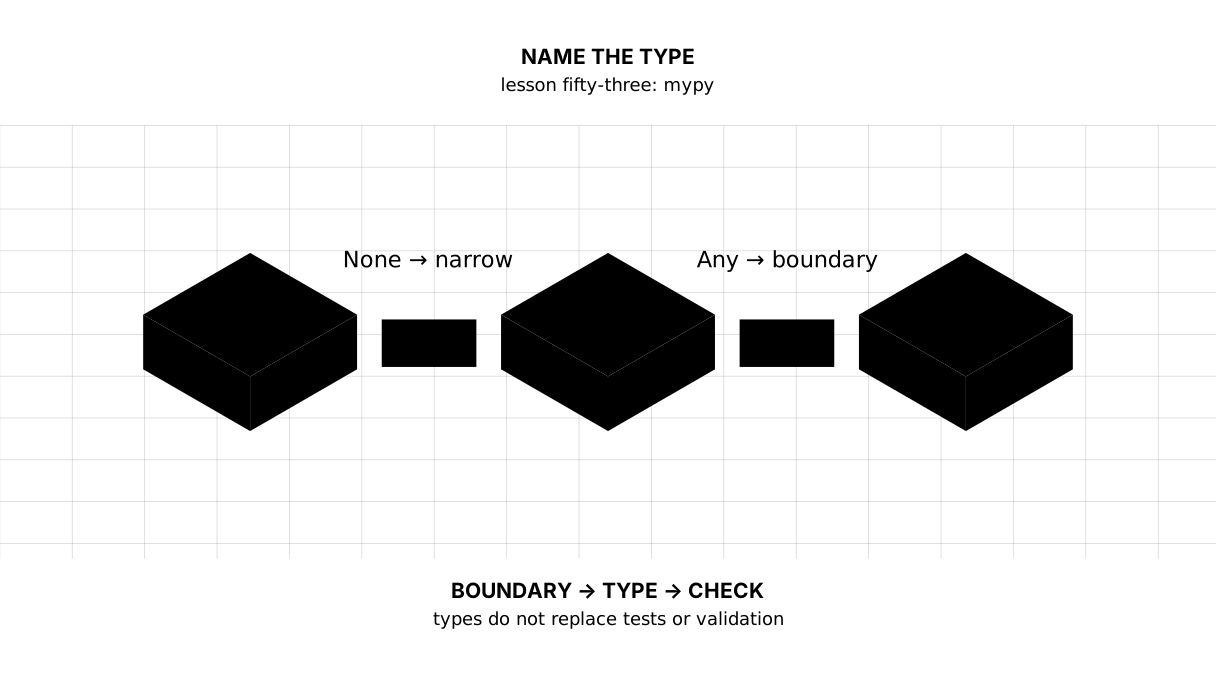
Recall cue: boundary → precise type → narrowing → mypy → runtime test.
Say it in your own words
- Why is an annotation not runtime validation?
- What does
Observation | Nonemean? - Why check
Nonebefore accessing fields? - Why confine
Anyto a system boundary?
Warm-up
1. Predict the output.
def size(values: list[int]) -> int:
    return len(values)

print(size([3, 5]))
2. Fill the return annotation.
def title(year: int) ... str:
    return f"Report {year}"
3. Fix it. row may be None:
def show(row: Observation | None) -> str:
    return str(row.year)
Assignment
Required. Type latest and label, then check a populated and an empty list. Run python -m mypy --strict solution.py, followed by the file itself.
2025: 11.4%
no data
With your data. Annotate three public digest functions and fix errors without # type: ignore.
Optional. Introduce NewType("SourceID", str) and find a swapped identifier.
Where this fits in the project
Step 28 adds types at the model boundary and strict mypy configuration. The next lesson pins Python and dependencies so the same analysis and tests can run on another machine.
Answers
- Python normally does not enforce annotations; a checker reads them.
- The function returns a record or no result.
- The check narrows the type and prevents field access on no object.
Anydisables useful checks and propagates uncertainty.
2
- Use
->.
def title(year: int) -> str:
    return f"Report {year}"

print(title(2025))
Report 2025
- Handle
Nonefirst.
def show(row: Observation | None) -> str:
    if row is None:
        return "no data"
    return str(row.year)
Sources
- Python: typing — standard annotations.
- mypy: Getting started — static checking.
- mypy: The
Anytype — dynamic typing boundaries.
If you have found a mistake or a typo in this article, tell us about it
Comments (0)
Log in to leave a comment →
No comments yet. Be the first.