

Python: from data to your own digest Lesson 52 of 56
What a model cannot be trusted with: fact, inference, cause
Lesson fifty-one of the Python course. Separate an observation, a computed result, and a causal explanation. Code can verify a value and reproduce a calculation, but plausible causal prose remains a hypothesis until it has independent evidence and human review.
Why this matters
In lesson 50 the model could no longer replace a number: the program compared it with a source_id. A correct number can still acquire a false story:
Inflation was 11.4% because the money supply grew.
The first part may be in a table. “Because” adds a causal relationship that one row does not establish. A language model can choose a convincing explanation; conviction is not evidence.
We need three kinds of claim:
- an observation appears directly in a source;
- a calculation is produced by reproducible code, such as a difference;
- a cause explains why something changed and needs separate evidence.
The whole thing first
The file trust.py applies an admission policy. The model may classify a sentence, but code owns the final decision.
"""Lesson 51: a causal story does not pass as an observation."""

EVIDENCE = {"inflation-kz-2025", "inflation-kz-2024"}


def decide(candidate):
    """Route a claim without guessing whether polished prose is true."""
    missing = set(candidate["evidence_ids"]) - EVIDENCE
    if missing:
        return "reject", "unknown source"
    if candidate["claim_type"] == "cause":
        return "review", "a cause needs independent evidence"
    if candidate["claim_type"] == "calculation":
        return "review", "a reproducible formula is required"
    if candidate["claim_type"] == "observation":
        return "accept", "the value can be checked against its source"
    return "reject", "unknown claim type"


candidates = [
    {
        "text": "Inflation in Kazakhstan has a published value.",
        "claim_type": "observation",
        "evidence_ids": ["inflation-kz-2025"],
    },
    {
        "text": "Inflation rose because the money supply grew.",
        "claim_type": "cause",
        "evidence_ids": ["inflation-kz-2025"],
    },
]

for candidate in candidates:
    decision, reason = decide(candidate)
    print(candidate["claim_type"], "->", decision, "—", reason)
Output:
observation -> accept — the value can be checked against its source
cause -> review — a cause needs independent evidence
Claim type is data
Constrain claim_type in the schema:
"claim_type": {
    "type": "string",
    "enum": ["observation", "calculation", "cause"],
}
The model may still label a cause as an observation. Its label helps routing; it is not proof. For automatic publication, use a narrow observation template assembled from verified fields. Send free-form prose to review.
Correlation does not answer why
Two series may move together because of a direct effect, reverse causation, a third factor, a shared trend, or chance. Even strong correlation does not choose among them.
An experiment, natural experiment, considered causal design, or reliable domain source may support a causal claim. One chart and one language model cannot.
Causal words such as “because”, “caused”, “led to”, and “thanks to” are useful warning signals, but a word list is not a safety boundary: the same meaning can be phrased differently. The safe policy is not to auto-publish free-form causal prose.
Treat uncertainty as a state
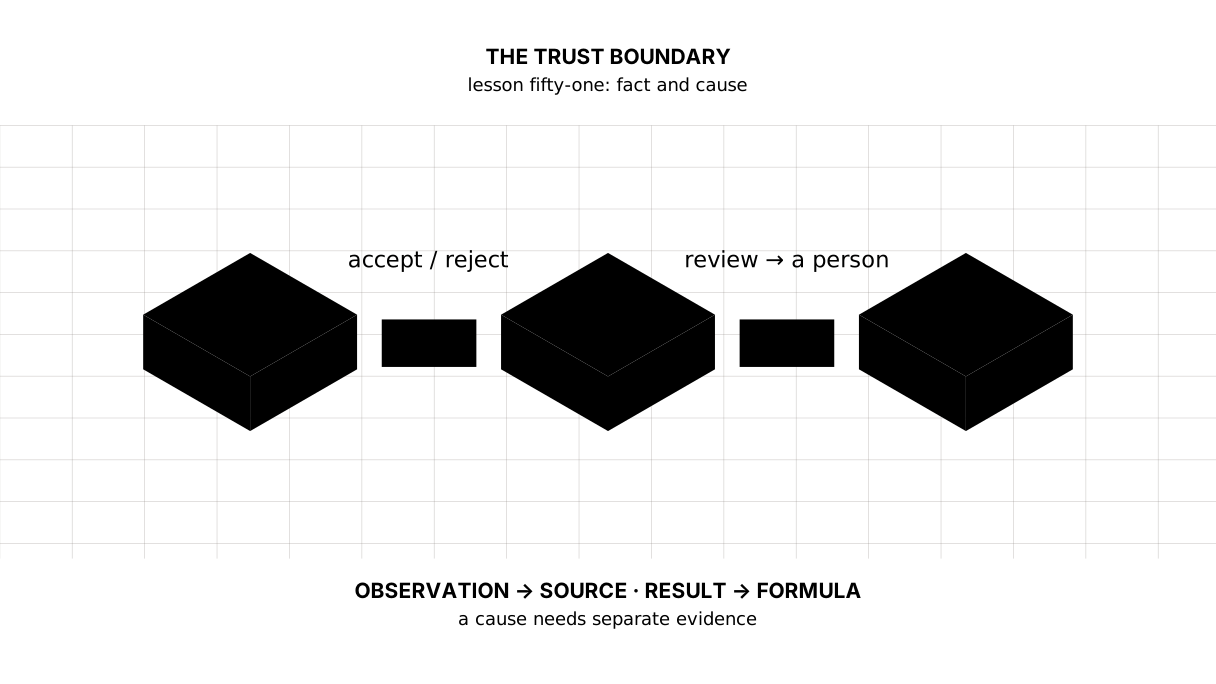
A useful system needs at least three outcomes:
accept: a narrow observation is rendered from verified data;review: the claim may be useful but needs a person or another source;reject: its structure, type, or evidence reference is invalid.
review is not disguised approval. The text remains unpublished until a person decides.
Do not ask the model to certify itself
A second prompt—“check whether you invented anything”—may catch some errors, but it remains model output. Use it as an extra signal, never as independent verification.
Independent checks rely on something else: a source record, executable calculation, external document, or accountable human reviewer.
Lesson map
Reconstruct the cue: observation → source; calculation → formula; cause → independent evidence and a person.
Say it in your own words
- Why does a correct number not make its causal explanation correct?
- How does a calculation differ from an observation?
- Why can we not trust the model’s own
claim_typeunconditionally? - What does
reviewmean for publication?
Warm-up
1. Predict. What type is “the value rose because of demand”?
text = "the value rose because of demand"
print("cause" if "because" in text else "observation")
2. Fill the gap. Permit only three known types.
schema = {"type": "string", ...: ["observation", "calculation", "cause"]}
3. Mend it. A causal claim is currently published automatically.
if candidate["evidence_ids"]:
    publish(candidate["text"])
Exercise
Required. Write route(candidates, known_ids). An observation with known evidence receives accept; a cause receives review; a calculation without formula_id receives review; an unknown source or type receives reject. Count each outcome.
accept: 1
review: 2
reject: 2
published: ['obs-1']
With your own data. Write one observation, one calculation, and one causal hypothesis about the digest. State the evidence each requires.
Optional. Add a review queue containing the text, routing reason, evidence identifiers, and editor’s decision. Never publish an item in review.
Where it enters the project
The AI module is now closed: requests are reproducible, JSON is validated, numbers are checked, and causal prose cannot pass automatically. Lesson 52 begins engineering reliability and turns these rules into pytest tests.
Answers
Show the answers
- A number supports an observation, not the mechanism that produced it.
- An observation lives in a source; a calculation must be reproducible from a named formula.
- Classification is itself unverified model output.
- The text stays outside publication pending a separate decision.
cause
- The key is
"enum".
schema = {"type": "string", "enum": ["observation", "calculation", "cause"]}
print("cause" in schema["enum"])
True
- Route the cause to review.
candidate = {"claim_type": "cause", "text": "Demand caused growth."}
decision = "review" if candidate["claim_type"] == "cause" else "accept"
print(decision)
review
Sources
- NIST AI Risk Management Framework — managing validity and AI risk.
- OWASP: misinformation — plausible false output and independent verification.
- The Book of Why — the distinction between observation and causal inference.
If you have found a mistake or a typo in this article, tell us about it
Comments (0)
Log in to leave a comment →
No comments yet. Be the first.