

Python: from data to your own digest Lesson 51 of 56
A model on our data: verify every number
Lesson fifty of the Python course. Give the model a small table with stable source identifiers, accept structured claims, and compare every number with its source row. The model proposes wording; our code inserts the verified value, unit, and year into the final text.
Why this matters
Lesson 49 checked JSON structure. A response containing {"value": 17.9} may satisfy the schema perfectly and still be invented. A schema knows the number’s type, not our table.
Each fact therefore gets a stable source_id. The model returns that identifier with its value. Code locates the source row and compares its value, year, and unit. One mismatch rejects the claim.
An even safer boundary keeps digits out of model-written prose. The model supplies a verbal label; the program formats trusted numbers.
The whole thing first
The file grounded.py extends the previous lesson’s contract.
"""Lesson 50: verify a model response against source data."""

import json
from decimal import Decimal

from jsonschema import Draft202012Validator

SOURCES = {
    "inflation-kz-2025": {
        "year": 2025,
        "value": Decimal("11.4"),
        "unit": "percent",
    }
}

CLAIM_SCHEMA = {
    "type": "object",
    "properties": {
        "source_id": {"type": "string"},
        "year": {"type": "integer"},
        "value": {"type": "number"},
        "unit": {"type": "string"},
        "label": {"type": "string", "minLength": 1},
    },
    "required": ["source_id", "year", "value", "unit", "label"],
    "additionalProperties": False,
}
VALIDATOR = Draft202012Validator(CLAIM_SCHEMA)


def verify_claim(raw):
    """Check shape, provenance, and every numeric field."""
    claim = json.loads(raw, parse_float=Decimal)
    VALIDATOR.validate(claim)
    source = SOURCES.get(claim["source_id"])
    if source is None:
        raise ValueError("unknown source")
    for field in ("year", "value", "unit"):
        if claim[field] != source[field]:
            raise ValueError(f"{field} does not match the source")
    if any(char.isdigit() for char in claim["label"]):
        raise ValueError("the model put a number in the label")
    return claim, source


raw = json.dumps({
    "source_id": "inflation-kz-2025",
    "year": 2025,
    "value": 11.4,
    "unit": "percent",
    "label": "Inflation in Kazakhstan",
})
claim, source = verify_claim(raw)
text = f'{claim["label"]}: {source["value"]} % ({source["year"]}).'

print("source:", claim["source_id"])
print("value verified:", claim["value"] == source["value"])
print("unit verified:", claim["unit"] == source["unit"])
print("result:", text)
Output:
source: inflation-kz-2025
value verified: True
unit verified: True
result: Inflation in Kazakhstan: 11.4 % (2025).
Give data an address
A source_id is neither a link to an entire website nor a row number that changes after sorting. It is a stable identifier for one record. It should lead to the dataset version, observation date, and unit.
Send the model only rows required for the task. This reduces noise, memory use, and opportunities to choose the wrong value. Preserve the dataset version or fingerprint beside the request.
Why Decimal
JSON normally turns a fraction into float. Binary fractions are awkward for money and exact comparisons. json.loads(..., parse_float=Decimal) reads 11.4 as a decimal value that compares exactly with Decimal("11.4").
That does not make the value true. It only removes an accidental representation error; agreement with the chosen source establishes provenance.
Words and numbers have different jobs
If the model returns label="Inflation rose by 15 percent", it has hidden a new number in prose. The deliberately strict isdigit() rule rejects it. The model names the measure; code prints its value.
Checking digits is not enough for editorial prose: “inflation fell” may be false without containing a number. This lesson therefore permits a neutral label. A later program can calculate “rose” from two verified values.
Reject; do not silently repair
Do not silently replace the model’s wrong value with the right one. Record the rejection and request another response or send it to a person. Otherwise the audit record and publication describe different outputs.
Useful rejection reasons are an unknown source, a mismatched value/year/unit, a digit inside the label, and invalid JSON structure.
Lesson map
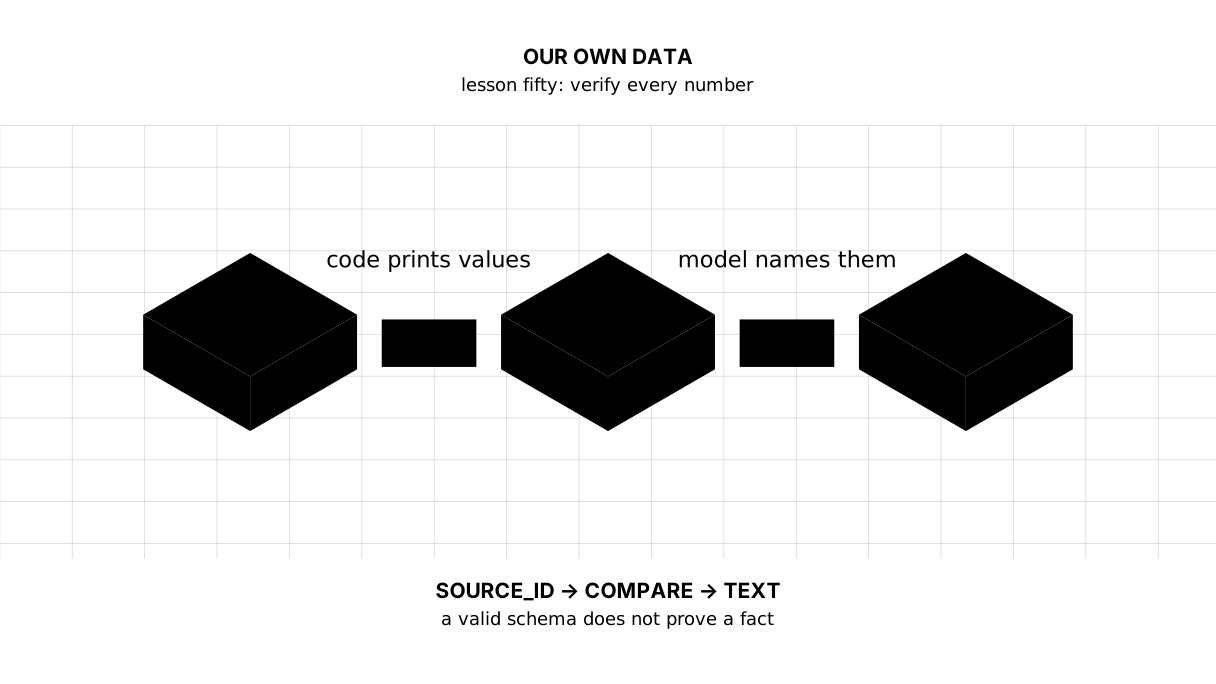
Reconstruct the cue: source → source_id → schema → compare fields → code inserts the number.
Say it in your own words
- Why is a valid JSON Schema insufficient to verify a fact?
- Why keep
source_idwhen the response already contains a value? - Why does code, rather than the model, print the final number?
- What happens to a response whose value does not match?
Warm-up
1. Predict. Are these ordinary float values equal?
print(0.1 + 0.2 == 0.3)
2. Fill the gap. Parse JSON fractions as Decimal.
claim = json.loads(raw, ...=Decimal)
3. Mend it. This code trusts the model’s number without finding its source.
claim = json.loads(raw)
text = f'Inflation: {claim["value"]} %'
Exercise
Required. Write accept_many(raw_items, sources). Accept a claim only when its source_id exists and its year, value, and unit all match; its label must contain no digits. Return accepted identifiers and rejection counts by reason.
accepted: ['inflation-kz-2025']
unknown source: 1
value mismatch: 1
number in label: 1
With your own data. Give two digest rows stable identifiers and ask the model for neutral labels. Include one deliberately wrong response and demonstrate its rejection.
Optional. Add a dataset_version and file SHA-256 to each source. Reject claims that name another version.
Where it enters the project
The model may now suggest a label, but it cannot silently replace the number. Lesson 51 examines a harder boundary: plausible causal explanations absent from the data.
Answers
Show the answers
- A schema checks shape and types, not agreement with our table.
- It identifies the exact record and version used for comparison.
- The publication then receives the trusted source value, not a model-typed copy.
- Reject it, record the precise reason, and do not pass it onward.
False
- The argument is
parse_float.
import json
from decimal import Decimal

raw = '{"value": 11.4}'
claim = json.loads(raw, parse_float=Decimal)
print(claim["value"] == Decimal("11.4"))
True
- Look up the source, compare fields, and print the source value.
claim = {"source_id": "cpi-2025", "value": 11.4}
sources = {"cpi-2025": {"value": 11.4}}
source = sources[claim["source_id"]]
assert claim["value"] == source["value"]
print(f'Inflation: {source["value"]} %')
Inflation: 11.4 %
Sources
- Python
json—parse_floatand JSON parsing. - Python
decimal— exact decimal arithmetic. - OWASP: validating LLM output — validating output before passing it to another component.
If you have found a mistake or a typo in this article, tell us about it
Comments (0)
Log in to leave a comment →
No comments yet. Be the first.