

Physics Nobel honours neutrinos caught in Antarctic ice
Francis Halzen won the 2026 Nobel Prize in Physics for decisive contributions to IceCube and the discovery of high-energy neutrinos from space. How did South Pole ice become a way to study the universe?
On 6 October, the Royal Swedish Academy of Sciences awarded the Nobel Prize in Physics to Francis Halzen. Its citation recognises decisive contributions to the IceCube Neutrino Observatory and the discovery of high-energy neutrinos of astrophysical origin. The prize honours a new way of observing the universe, not merely the construction of an unusual instrument.
Why so much ice is needed
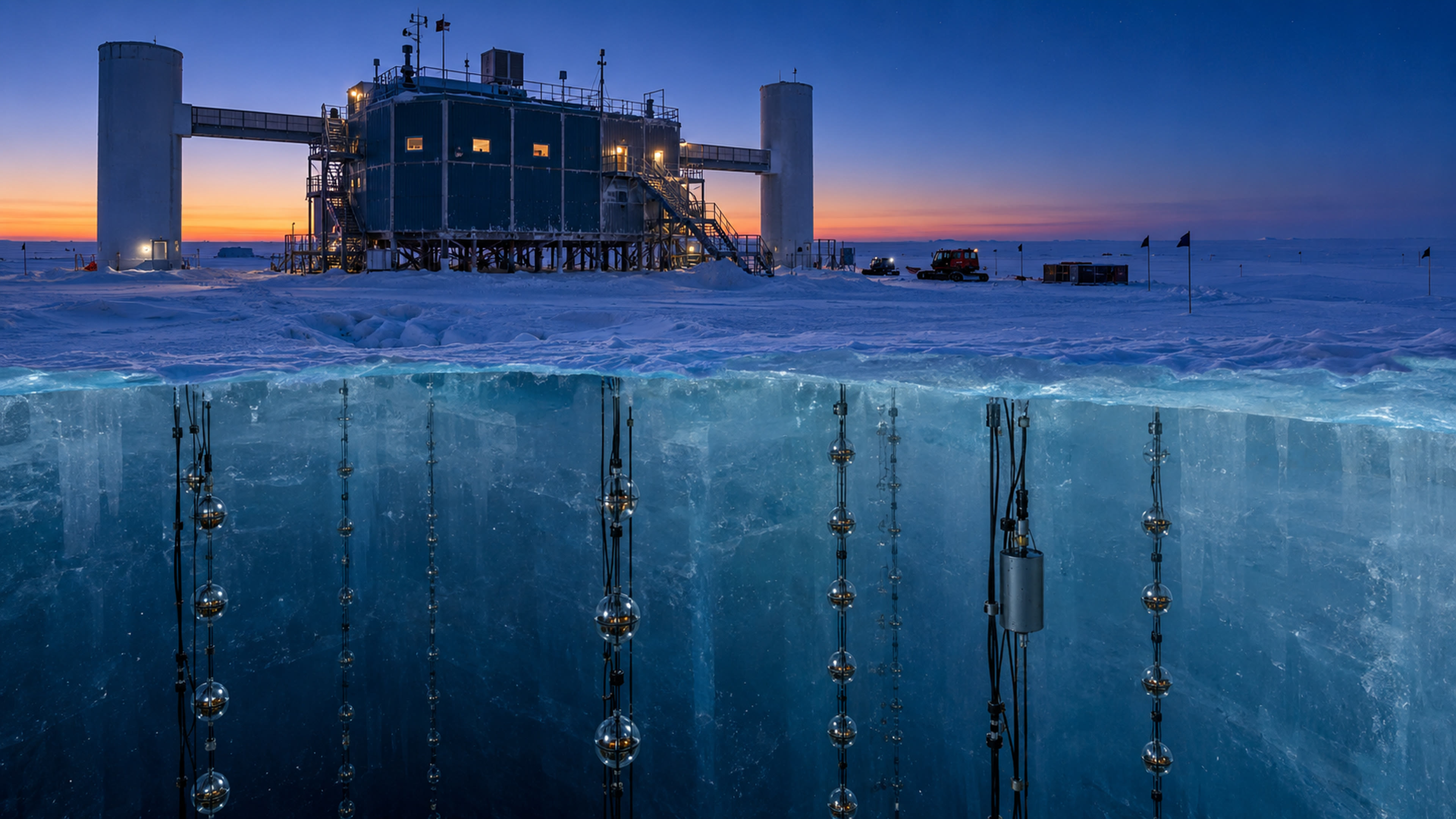
Neutrinos interact with matter only rarely. They pass through Earth and people, leaving a trace only in an occasional collision. IceCube uses transparent ice at the South Pole as an enormous detection medium: sensors deep below the surface register faint flashes associated with particles produced in those collisions.
A cubic-kilometre scale improves the odds of capturing rare events, while thick ice helps separate a signal from background noise. The direction and energy of detected particles can point scientists towards some of the universe’s most powerful processes.
What the prize recognises
The Academy highlights Halzen’s role in establishing IceCube and discovering cosmic neutrinos. The observatory is also the work of a large international collaboration, which the IceCube organisation itself stresses. The prize names one scientist; the achievement was not a solo experiment.
The wider discovery is that astronomy need not depend only on light. Particles that have crossed immense distances almost undisturbed can carry information about events ordinary telescopes struggle to see.
Primary source: https://www.kva.se/nyheter/nobelpriset-i-fysik-2026/.
If you have found a mistake or a typo in this article, tell us about it
Comments (0)
Log in to leave a comment →
No comments yet. Be the first.