

The Bill Comes Due: Why the Gulf War, Inflation, and the AI Crash Are One Story
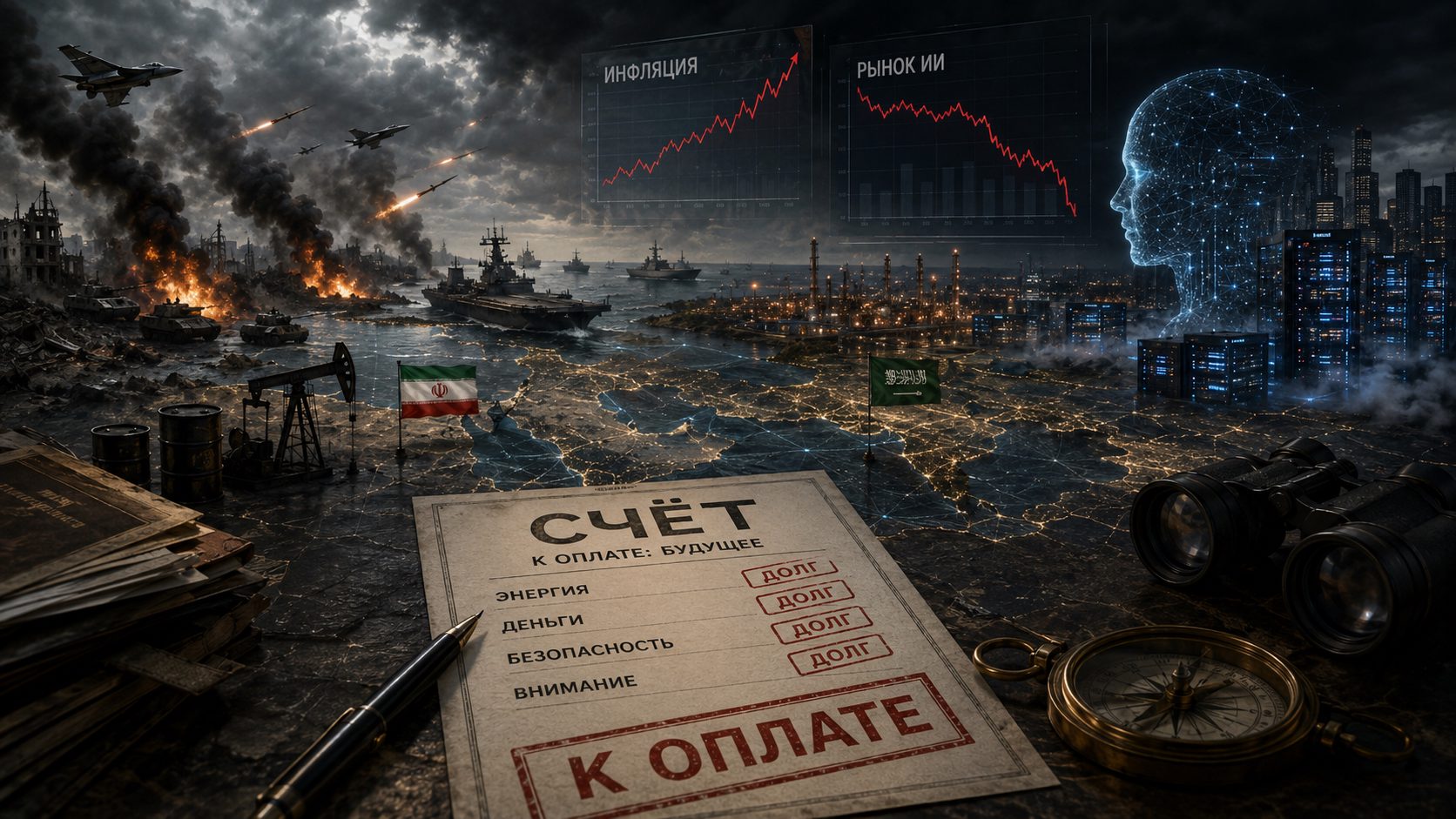
The Gulf war, resurgent inflation and the crash in AI stocks are three July 2026 stories with one cause. On 8 July the IMF cut its global growth forecast to 3.0% and raised inflation to 4.7%, naming both. The condition has a name: stagflation. Thirty years of cheap money were borrowed from the future, and the margin call has arrived.
The worm’s world is a clod of damp earth. To the beetle, the grass is impassable jungle. To the elephant, the same grass is a soft carpet underfoot. And the eagle above the field sees rivers, roads, the edges of forests, and where the smoke is really coming from. Each is right within the limits of its sight — and each is wrong to mistake those limits for the limits of the world. Today’s commentators are beetles for whom their blade of grass is the whole universe.
What it looks like from below
Down below everything breaks into separate dramas, each with its own chorus.
Some argue about the Gulf war: Iran strikes US forces in Jordan with ballistic missiles, the US and Saudi Arabia answer with strikes in Iraq, drones fly at Saudi refineries, and Washington imposes a naval blockade on Iranian ships. The chorus divides the world into “aggressors” and “victims” — depending on which steeple it watches from.
Others argue about money: oil has jumped, inflation is breathing down our necks again, the Fed is caught between the fear of rising prices and the fear of strangling the economy. Their chorus: “hawks” against “doves.”
Others argue about artificial intelligence: after two years of euphoria the market flinched, money fled the tech giants for “boring” defensive assets. Again a chorus — “it’s a bubble” versus “it’s a revolution, buy the dip.”
Each camp is sure that its own blade of grass is the center of events. And each is right in its own way. But none of them looks up.
What it looks like from above
From above you can see that all three fires burn on the same fuel. On July 8 the IMF cut its 2026 global growth forecast to 3.0% and at the same time raised its inflation forecast to 4.7%, naming as causes both the Middle East war and the risk of a correction in the AI market. Growth down, prices up — this condition has an old, ugly name: stagflation. It is the symptom of several of our core assumptions colliding at once.
For the last thirty years civilization lived on four “eternal cheapnesses” it took for granted:
- cheap energy — oil and gas that always flow somewhere, at a reasonable price;
- cheap money — credit at near zero, with which any dream can be financed;
- cheap security — peace under someone else’s umbrella, paid for by someone else;
- cheap attention — the faith that technology, on its own, without us, will carry the future.
Each of these cheapnesses was not a gift but a loan. We borrowed energy, stability, money, and trust from the future and filed them under “forever.” July 2026 is the month several of those loans got margin-called at once.
The Strait of Hormuz is a reminder that cheap energy was borrowed from geopolitics. The inflation spike — that cheap money was borrowed from time. The blockades and strikes — that cheap security was borrowed from someone else’s strength. And the AI crash is the purest example: it is not the collapse of a technology, it is the repricing of a promise the market had for years treated as an accomplished fact.
Why every steeple lies
It lies not from stupidity but from convenience. To admit the trouble is structural is to admit there is no villain to blame, only a shared bill everyone pays. That is unbearable. So each camp offers its own painkiller fairy tale: “the enemy is to blame,” “the Fed is to blame,” “the bubble is to blame.” The tale is comforting because it leaves you right and innocent.
But structure does not argue with opinions — it simply presents the bill. It does not care which team you are on. Inflation does not read your posts. The strait does not pick a side. Herein lies the cruel honesty of the view from above: it robs you of the pleasure of being right at your enemy’s expense.
What the altitude demands
Here one must not overplay it. The eagle, too, is not all-seeing: it reads the terrain but does not feel the hunger of the mouse in its burrow. The view from above is not “one more, truer opinion.” It is not an opinion at all — it is a different altitude. It will not tell you who wins the war or where oil goes on Friday. It says one thing, but an important one: stop mistaking the borrowed for the owned.
For a small open economy — like ours, wedged between great centers of power and living off the export of that very energy — this is not an abstraction. An oil shock adds to revenue today and hits everything we buy from abroad tomorrow. Whoever reads only the “good” half of the news is the beetle for whom the blade of grass is a jungle. Learning to read the structural weather, not the chorus of opinions, is the only real insurance when several “eternal cheapnesses” turn out at once to have been loans.
And this must be said plainly
None of the camps of July 2026 will see the whole until it lifts its head from its blade of grass. War, inflation, and the AI crash are not three stories but three cracks in one foundation too long mistaken for solid rock. The world is not collapsing — it is being settled with. The difference between panic and sobriety is where you look from: from below it is the end of the world, from above it is a bill presented for thirty years lived on credit from the future.
And the future, unlike us, is very good at counting.
Sources: IMF — World Economic Outlook Update, July 2026 · NPR World News · Just Security — Early Edition, July 29, 2026 · Euronews — news bulletin, July 29, 2026 · InteractiveCrypto — markets between geopolitics and AI doubts, July 2026
If you have found a mistake or a typo in this article, tell us about it
Comments (0)
Log in to leave a comment →
No comments yet. Be the first.