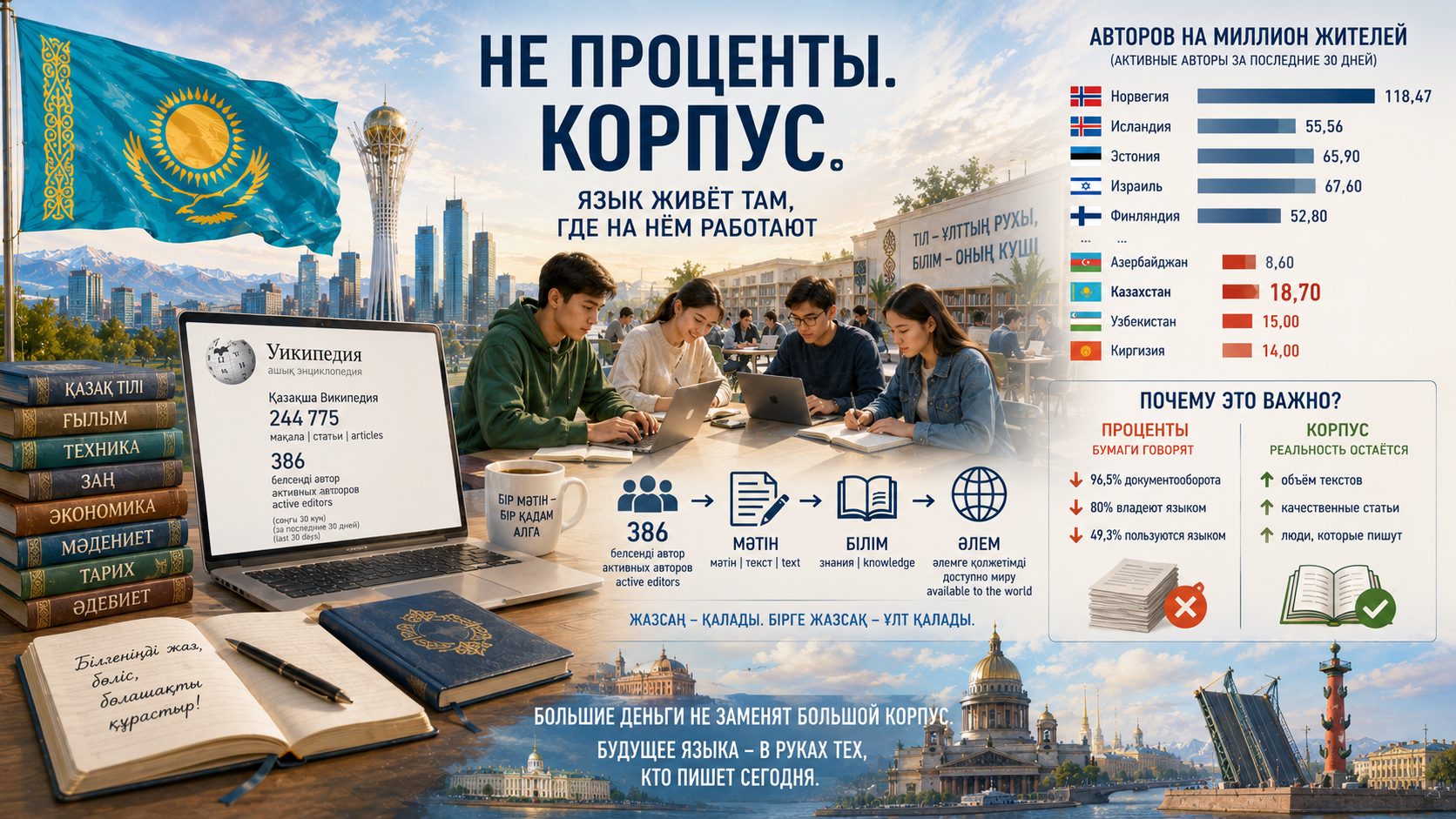
A language was safe as long as enough people spoke it. That rule has stopped working: machines learn from text, and a machine's ability to speak a language depends on how much has been written in it. Iceland, with 386,000 people, has 215 active encyclopedia editors; Kazakhstan, with twenty million, has just 386.
A language does not merely convey a thought — in part it forms it. Every language has turns of phrase another lacks, and with them shades of meaning visible in one and lost in another. Multilingualism is sold as a competitive advantage, but that is the dull half of the truth: the point is protection from a single version of events.
A language is not only a means of communication but a way of thinking and of remembering who you are. Losing it means losing not a dictionary but part of your view of the world. Why the choice between the native and the useful is false: Kazakh does not stand in the way of Russian or English — each strengthens the other.


 Culture