

Four Countries Closed the Border — We Opened a Stadium
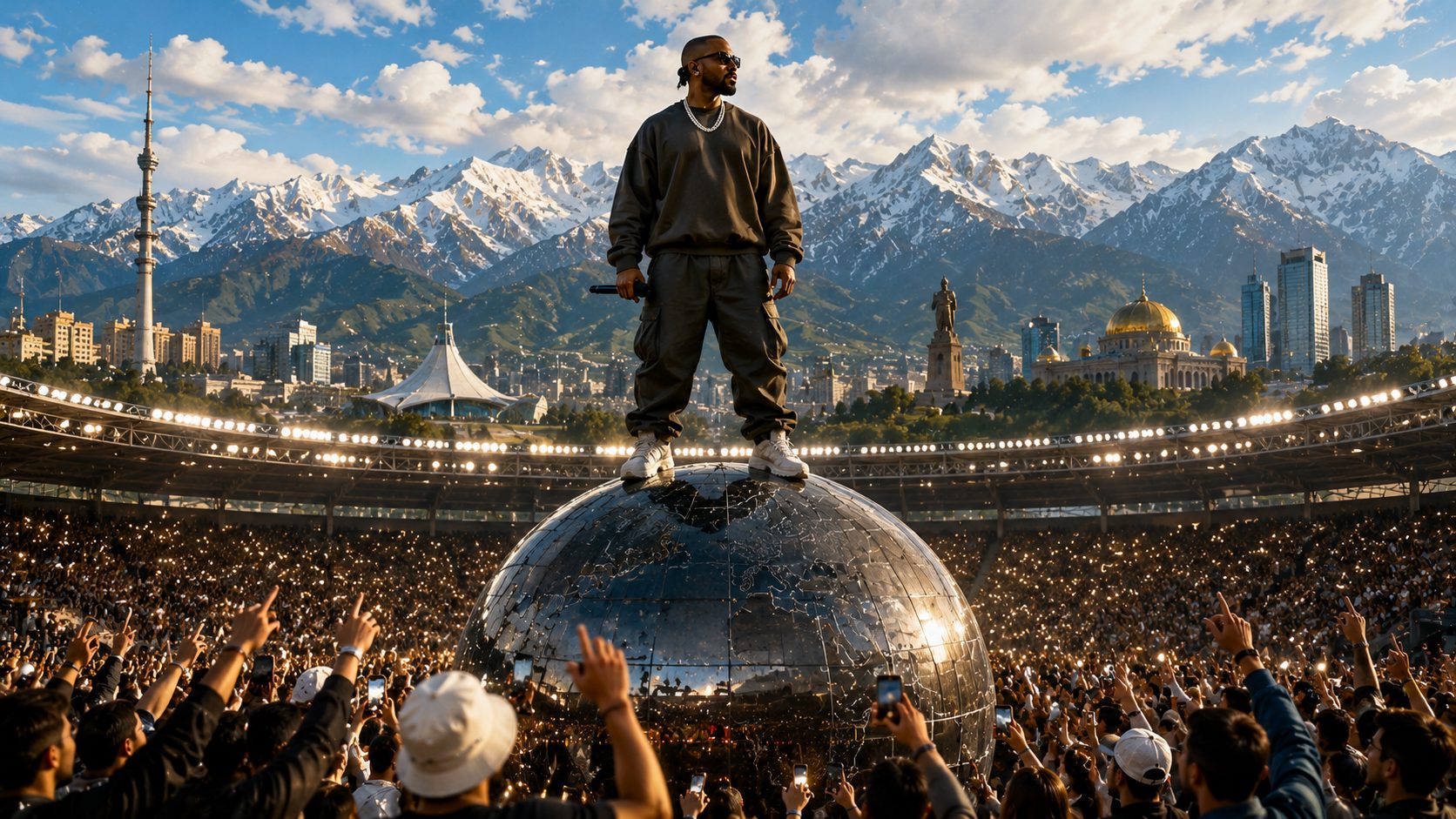
Britain, Australia, Poland and Switzerland each said publicly why they would not let Ye in. On 15 August he walked onto the Central Stadium in Almaty: 31,000 people, five billion tenge. He played the old hits — nothing he was barred for. What Kazakhstan argued about for a week was the grass.
What is established beyond dispute
Start with what is neither rumour nor interpretation. This is a record every major outlet in the world covered, and every line of it can be checked in a minute.
October 2022. A “White Lives Matter” shirt at the Paris show. An Instagram post saying Diddy is “controlled by the Jews”. On 8 October, a post announcing he was going “death con 3” on Jewish people.
November–December 2022. On Alex Jones’s InfoWars he calls himself a Nazi, says there was value in Hitler, and denies the Holocaust. In December he is banned from X for an image of a swastika set inside a Star of David.
February 2025. A Super Bowl spot points to his own website, where shirts bearing a swastika are on sale.
May 2025. He releases a track called “Heil Hitler”. The album being prepared also carried “Gas Chambers” and “Hitler Ye Jesus”.
All of it cost him Adidas, Gap, Balenciaga and JPMorgan — and, by most accounts, his billionaire status.
And this is established too
Now the part exposés usually leave out, and leaving it out is not an option.
On 26 January 2026 Ye bought a full page in The Wall Street Journal for a letter headed “To Those I’ve Hurt”. He wrote that he had lost touch with reality, that behind it lay a four-month manic episode, and that he has bipolar disorder which he attributes to a car crash twenty-five years ago. And he wrote it plainly: he is not a Nazi and not an antisemite.
The Anti-Defamation League’s response was measured. The apology was “long overdue”, it said, and does not undo the song, the hundreds of posts, the swastikas, the Holocaust references; “the truest apology would be for him to not engage in antisemitic behavior in the future.” And separately: “We wish him well on the road to recovery.”
We set this down not for balance for its own sake. We set it down because without it the next fact carries no weight.
The refusals came after the apology
April 2026 — two and a half months after the letter — Britain refuses Ye entry. The wording is official: his presence would “not be conducive to the public good”. The refusal collapses the Wireless Festival, where he was to headline.
Poland and Switzerland drop their shows next. France postpones the Orange Vélodrome date in Marseille. Australia had already cancelled his visa in May 2025, immediately after “Heil Hitler” appeared.
This matters. Four countries knew about the apology and still said no. Which means the argument “but he apologised” had already been put and had already failed. For those who brought him here, it is neither a new argument nor a strong one.
On 7 August 2026, eight days before Almaty, Israel’s ambassador publicly demanded the cancellation of Ye’s concert in the Algarve, calling it a shame for Portugal.
Now to us
17 July: the announcement — Ye will perform in Almaty. 15 August: he takes the Central Stadium. Thirty-one thousand in the stands. Seven thousand seven hundred arrivals from more than fifty countries. Organisers put the effect on the city at roughly five billion tenge — eleven million dollars.
He was brought by First Media Group together with Freedom Holding Corp. The ticketing operator was Freedom Afisha, formerly Freedom Ticketon; the presale ran exclusively through the Freedom SuperApp and went in minutes. The project was led by First Media Group’s head, Alfiya Nurgumarova.
There was an argument about this concert in Kazakhstan. It lasted a week.
On 17 July the football club Kairat stated that the date had not been agreed with them: the club plays its home matches at that stadium and was still in European competition, and assembling and dismantling the stage would ruin the pitch. On 20 July ticket sales were suspended over it. On 24 July the club gave way and petitioned UEFA to move a home match in the third qualifying round; it went to the Turkistan Arena.
For a week the country haggled publicly over a lawn.
About what the man sings — the man for whom a Champions League fixture was moved — not one word was said.
What he actually played in Almaty
Here we have to be exact, or nothing else we write is worth anything.
Thirty-seven numbers were played from that stage. KING, “Power”, “Black Skinhead”, “CARNIVAL”, “Jesus Walks”, “Gold Digger”, “All of the Lights”, “Stronger”, “Runaway”. The old catalogue — the one he has been loved for over twenty years.
Neither “Heil Hitler” nor “Gas Chambers” nor “Hitler Ye Jesus” was performed in Almaty. Nothing from the 2025 material at all.
So it cannot be said that Nazism was propagated from a stage in Kazakhstan. It was not. We are obliged to write that as plainly as we write everything else — otherwise our words are worth exactly what we accuse others of being worth.
But consider what it means.
The programme was assembled to be immaculately safe. Two hours of songs half the country grew up on, and not one line of what four states closed their borders over. Programmes like that do not fall together by accident: a show for thirty-one thousand people is planned for months, and what is left out of it is as much a decision as what is put in.
From which one simple thing follows. The risk was seen. You cannot strip out of a set what you do not consider dangerous. So the question — what about the things he said — was in fact asked inside the project. Only inwards rather than outwards, and the answer was not a cancellation. The answer was a setlist.
The question nobody asked
We looked. Alfiya Nurgumarova gave interviews before the concert and after: on technical solutions, on the complex stage structure, on international logistics, on having to prepare the site twice in twenty-four hours because of the blackout and the storm. These are professional, substantive answers — to professional questions.
Judging by everything published, nobody asked her about Hitler.
The contrast is visible next door. In Britain the Wireless promoter had to defend the booking publicly and urge critics to show forgiveness — because he was asked. In Portugal the ambassador spoke publicly, and it was reported. In Kazakhstan nobody asked: not journalists, not deputies, not the culture ministry, not the city administration that handed over the stadium.
We do not claim the organisers share the artist’s views. We have no grounds for that and we will not invent any. We claim only what is visible: the decision was not taken in secret or in ignorance. By August 2026 the whole world knew about this man — his words had cost him Adidas, a visa to Australia, entry to Britain and an entire British festival four months earlier. Working in the concert business and not knowing that is impossible.
What the law says, and what it does not
We took the primary sources from the Adilet legal database and read both codes through.
Article 174 of the Criminal Code is headed “Incitement of social, national, ethnic, racial or religious discord”. It covers deliberate acts aimed at inciting discord and at insulting national honour and dignity, and the propagation of the exclusivity, superiority or inferiority of citizens by their national, ethnic, racial or religious affiliation — where done publicly or through mass media, telecommunications networks and online platforms.
And now the part we did not expect.
The words “Nazi”, “swastika”, “fascist” and “Holocaust” appear nowhere in the Criminal Code of the Republic of Kazakhstan, nor in the Code of Administrative Offences. Not once.
In Germany, Austria, Ukraine and Russia, Nazi symbols and propaganda are banned by a provision that names them. We have no such provision. We have the general article on discord, and that is all.
This exonerates nobody and accuses nobody. It explains why the question was so easy not to ask: where a thing is not named in the law, it need not be noticed in life.
Who it was sold to
Thirty-one thousand people in the stands, most of them young. People still assembling a sense of what is permitted and what is not; of where provocation ends and where the thing begins that makes four states close a border.
They were sold a ticket. With the ticket they were sold a message, and the message is simple: nothing that was said counts for anything. You can say there was value in Hitler, deny the Holocaust, sell swastikas, name a song “Heil Hitler” — and a year later walk onto a stadium in a country that lost hundreds of thousands of its own in that war.
This is not about the artist. The artist said his piece and apologised, and his apology is a matter for his conscience and his doctors. This is about those who decided that thirty-one thousand tickets outweighed a question.
And the question is not “does Kazakhstan support Nazism”. No Nazism was sung from that stage, and we have written so. The question is a different and less comfortable one: do a man’s words stop meaning anything the moment he agrees not to repeat them in your city? Britain answered it in April: they do not. Here nobody answered, because nobody asked.
The questions
Since nobody put them, we put them — openly, each to its addressee.
To First Media Group and to Alfiya Nurgumarova personally. Was it discussed inside the company that the artist you were bringing had called himself a Nazi, denied the Holocaust and released a song called “Heil Hitler”? If it was — what outweighed it? If it was not — why not?
To Freedom Holding Corp. Your name stood in the announcement beside the artist’s, your ticketing operator sold the tickets, the presale ran in your app. Did this decision pass a reputational-risk assessment — the same procedure a NASDAQ-listed company ordinarily applies to its partnerships?
To the Almaty city administration. A municipal stadium was given over to a concert for which a football club had to move a European fixture. Did the city consider the content of the artist’s statements when it took that decision?
To the Ministry of Culture and Information. Britain put its position in a single line: his presence would not be conducive to the public good. Does Kazakhstan have a position on this — any position at all?
Whatever answers come, we will publish them in full and unedited. Silence we will publish too.
Sources
- The record of his statements: ADL · Rolling Stone · Billboard · AJC
- The InfoWars appearance, December 2022 — Variety · NBC News
- The Wall Street Journal apology, 26 January 2026, and the ADL response — Washington Post · Euronews · NBC News
- The UK entry refusal and the collapse of Wireless, April 2026 — Al Jazeera · NPR
- Cancellations in Poland and Switzerland, postponement in France — Euronews
- The Israeli ambassador’s call to cancel the Portugal concert, 7 August 2026 — Euronews
- The Wireless promoter defending the booking — Malay Mail
- The dispute with FC Kairat and the moved fixture — Orda · Tengrinews, 17 July · Tengrinews, 24 July
- Organisers, ticketing operator and the totals — Astana Times · Kursiv · Freedom Afisha
- The Almaty setlist, 15 August 2026 — setlist.fm
- The postponement over the blackout, 14 August — Tengrinews · Forbes Kazakhstan
- Legislation: Criminal Code of the Republic of Kazakhstan, Article 174, and the Code of Administrative Offences — Adilet
If you have found a mistake or a typo in this article, tell us about it
Comments (0)
Log in to leave a comment →
No comments yet. Be the first.