

Chemistry: investigate the world of substances Lesson 54 of 58
What does a percentage on a solution label mean?
Calculate mass fraction using total solution mass as denominator.
Support map
Model diagram
Use paper, a calculator and supplied data only. Do not heat, taste or smell samples, mix household chemicals or perform electrical experiments. Clarity and ordinary filtration do not establish drinking safety.
Situation and question
A card says “6%”. That is incomplete: a percentage may refer to mass, volume or another basis. All percentages here mean mass fraction of the specified component. These are supplied teaching calculations, not instructions for medicines or household chemicals.
New terms, fully explained
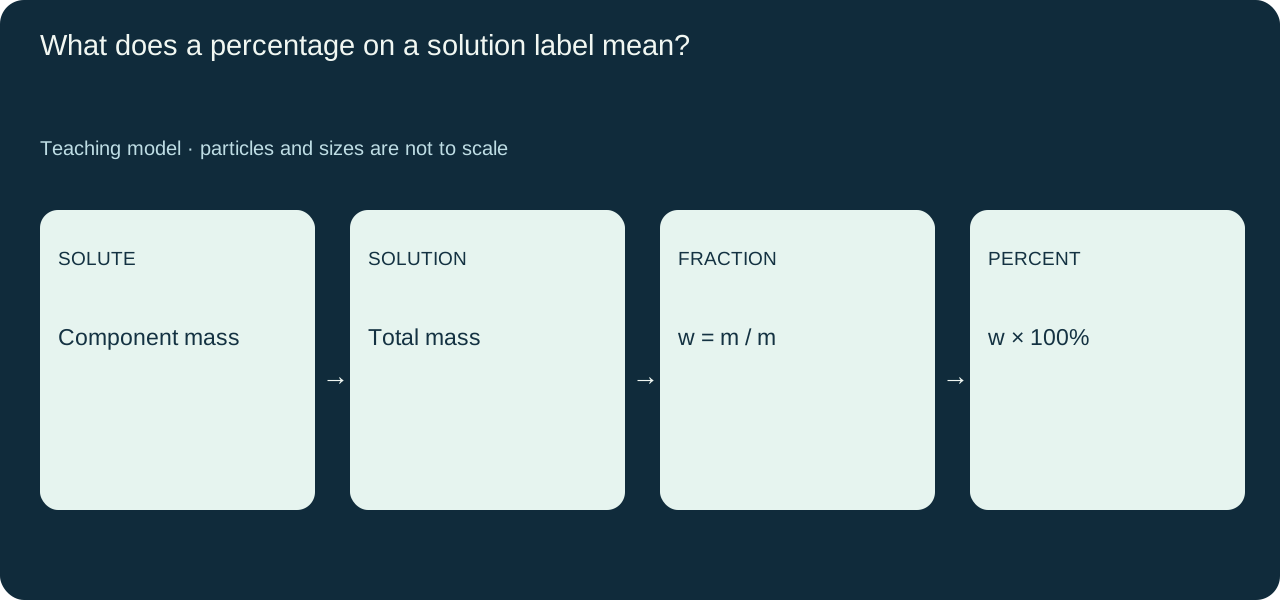
Mass fraction w is component mass divided by total mixture mass: w=m(solute)/m(solution). It is dimensionless and lies between 0 and 1. Mass percentage is w×100%. For a two-component solution without losses, solution mass equals solute plus water mass. Use the same units for both masses.
Predict first
Compare 12 g of solute in 188 g of water with 12 g in 88 g of water. Both dissolve completely. Which has the greater mass fraction? Predict the direction before calculating.
Investigate or analyse given data
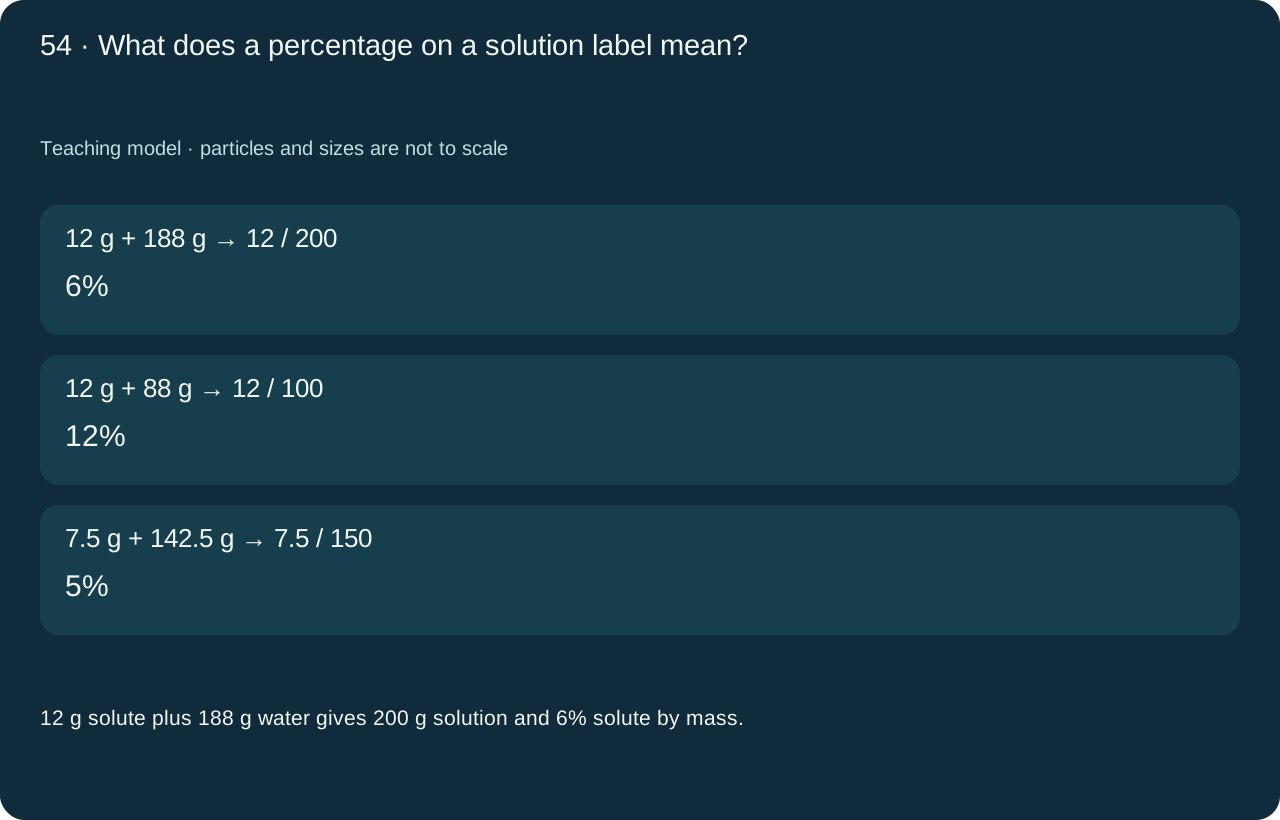
Use separate columns for solute mass, water mass, solution mass and w. Total masses are 200 g and 100 g. If dissolution is incomplete, determine the liquid solution mass separately, excluding undissolved solid.
| Object / step | Given / calculation | Result |
|---|---|---|
| 12 g + 188 g | 12 / 200 | 6% |
| 12 g + 88 g | 12 / 100 | 12% |
| 7.5 g + 142.5 g | 7.5 / 150 | 5% |
Worked example
The first gives w=12/200=0.06=6%. The second gives 12/100=0.12=12%. With the same solute mass, less water means a larger fraction. In a two-component model the fractions sum to 1, or their percentages to 100%.
A common mistake
Mistake: calling 12/188 the solution mass fraction. That is a ratio to solvent mass. Another mistake is replacing 6% with 6 rather than 0.06 when multiplying a mass. Always show conversion from percentage to fraction.
Transfer to a new case
Transfer: 7.5 g of sugar completely dissolves in 142.5 g of water. Find solution mass and both component fractions. Express both masses in milligrams and check that the dimensionless ratio remains unchanged.
Answer and recall
Check: solution mass is 150 g, sugar fraction 0.05=5%, water fraction 0.95=95%. Consistent unit conversion leaves a ratio unchanged. Explain why 5% by mass means 5 g per 100 g of solution rather than per 100 g of water.
Exercise
Find mass fraction for 9 g of solute plus 171 g of water. What is the denominator?
Answers
Show the answers
9/180=0.05=5%; total solution mass.
When to revisit
Close the page and, after 10 minutes, reconstruct the map, define the terms in your own words and solve the new case. Repeat without hints after a day and a week. If an error persists, return to the worked example and write down the missing step.
Sources and limits
If you have found a mistake or a typo in this article, tell us about it
Comments (0)
Log in to leave a comment →
No comments yet. Be the first.