

Chemistry: investigate the world of substances Lesson 27 of 40
How does structure help explain a substance’s properties?
Compare molecular, ionic, metallic and network structures using data rather than one label.
Support map
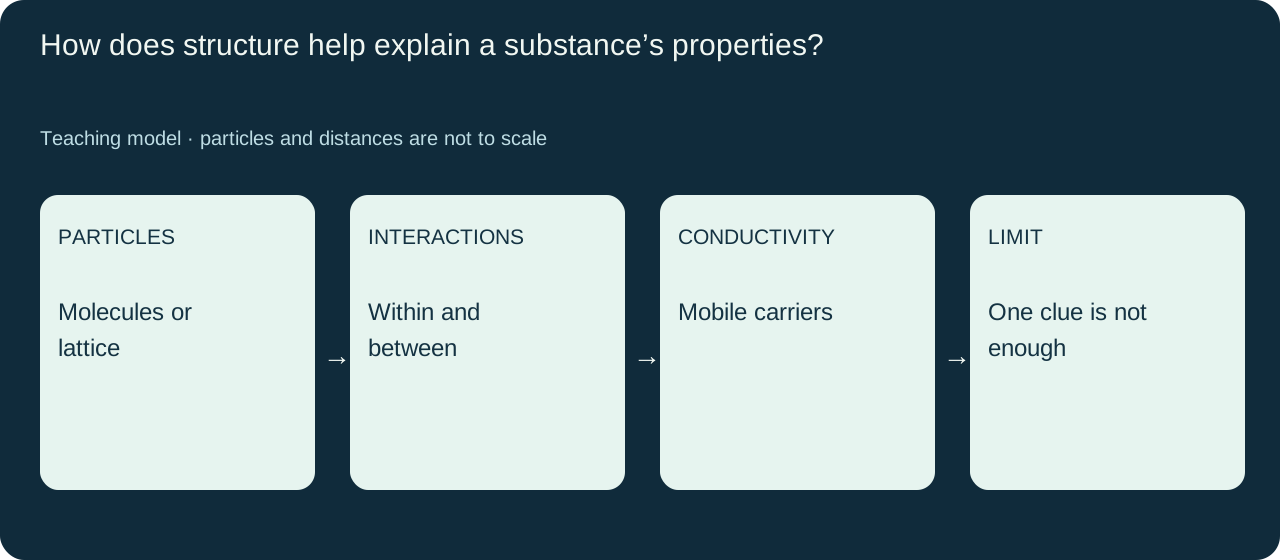
Model diagram
Teaching model · particles and distances are not to scale
Use paper and supplied data only. Do not produce gases, heat substances or use electrical equipment; do not touch, taste or smell unknown substances.
Situation and question
Four cards describe ice, salt, copper and diamond. All can be solids, but that does not give them the same structure. Why does ice melt more easily than salt, while copper conducts as a solid? Use supplied information: do not melt, heat or connect anything to an electrical supply.
New terms, fully explained
A molecular substance consists of molecules; interactions between molecules differ from bonds inside them. A covalent network is an extended structure of bonded atoms. A metallic model has positive atomic cores associated with shared mobile electrons. An ionic crystal contains repeating cations and anions. These are models, not four exception-free lists of properties.
Predict first
Predict whether melting ice breaks every O—H bond. Does the word “covalent” prove that any substance is soft and melts easily? Explain which particles you think move. Conductivity requires charges that can move through the sample, not merely the existence of charged particles.
Investigate or analyse given data
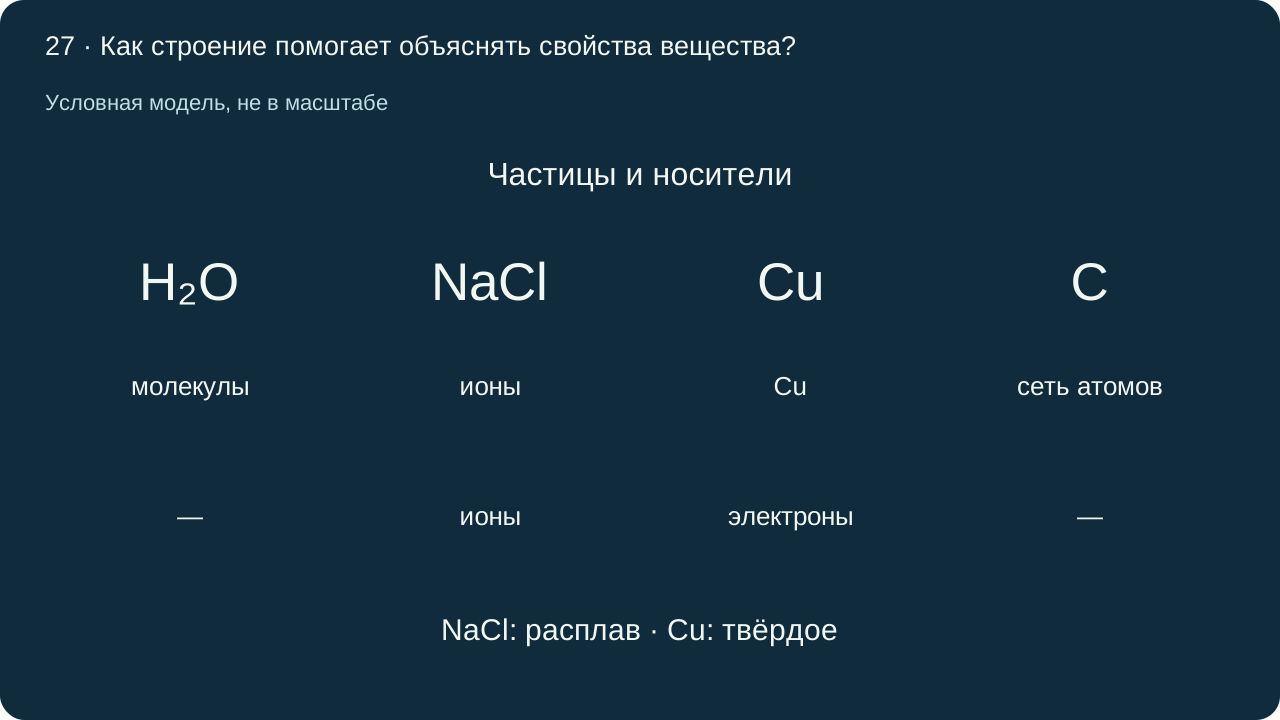
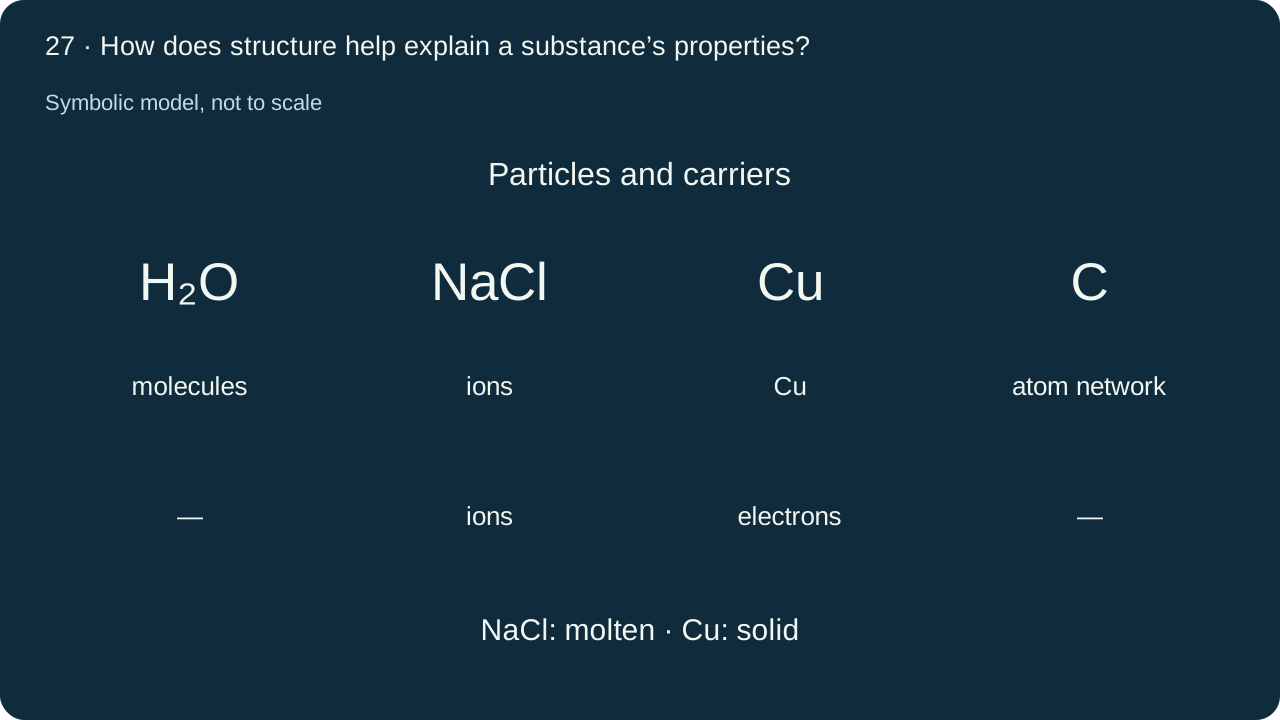
Use the supplied cards: melting ice retains H₂O molecules; solid NaCl conducts poorly but its melt conducts; copper conducts as a solid; diamond is very hard and conducts ordinary current extremely poorly. Molten salt is a problem condition, not an experiment instruction. Build a “particles — interactions — mobile carriers” table.
Worked example
In ice, interactions between molecules rearrange while molecules remain. In solid NaCl, ions are constrained to lattice sites; in its melt they are mobile. Copper has electrons able to move through the metal. Diamond has an extended C—C network, with no separate diamond molecules. Different carriers and interactions explain different properties even though all samples are solids.
A common mistake
Mistake: “a covalent substance always consists of molecules” or “only metals conduct”. Graphite is a nonmetallic form of carbon with mobile electrons and conductivity; it does not become a metal. Purity, temperature and measurement direction also matter. School classifications help interpret data but do not replace testing a particular sample.
Transfer to a new case
An unknown solid X does not conduct. Is this enough to choose between ice, salt and diamond? Suggest further safe reference information, such as melting temperature at a specified pressure. Do not propose heating an unknown substance yourself.
Answer and recall
Check: the evidence is insufficient: all three can conduct poorly under the stated conditions. Reference melting temperatures and composition could help distinguish them. Recall the four models, naming particles and mobile carriers. Dissolving and solution conductivity need separate analysis: substances differ in solubility and not every solution is ionic.
Exercise
- Do H₂O molecules disappear when ice melts?
- Which carriers are mobile in molten NaCl?
- Must a conductor be a metal?
Answers
Show the answers
No; ions; no, graphite is a counterexample. These answers apply to the specified states and conditions.
Investigator’s notebook
Record your first answer before reading the explanation. For each error, identify the step: particle model, electron count, charge balance, brackets or limits of inference. Correct the explanation, invent a new example and solve it without hints.
When to revisit
Close the page and, after 10 minutes, reconstruct the map, define the terms in your own words and solve the new case. Repeat without hints after a day and a week. If an error persists, return to the worked example and write down the missing step.
Sources and limits
If you have found a mistake or a typo in this article, tell us about it
Comments (0)
Log in to leave a comment →
No comments yet. Be the first.