

Chemistry: investigate the world of substances Lesson 20 of 22
Why can atomic weight be a decimal?
Calculate an isotope mixture’s mean mass and distinguish A, atomic mass and dimensionless relative atomic mass.
Support map
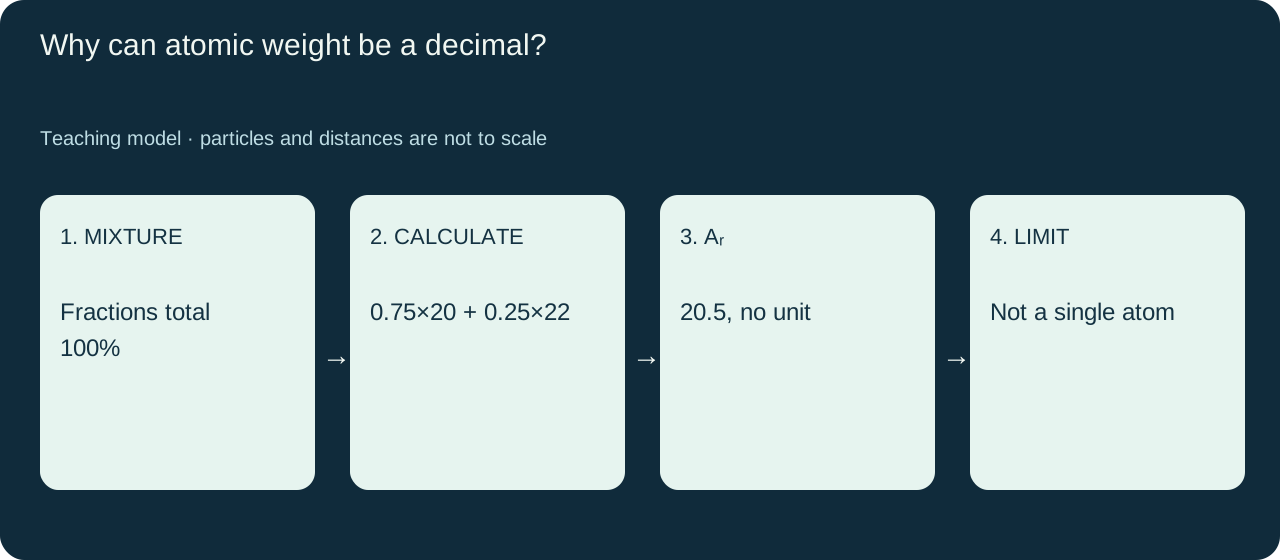
Teaching model · particles and distances are not to scale
Situation and question
A teaching table gives chlorine Aᵣ≈35.45. This does not mean 35.45 protons or a fractional neutron. Explore an invented mixture of X atoms to understand an average. Here X is a task placeholder, not the official symbol of a new element. Real atomic masses require reference data.
New terms, fully explained
Mass number A is the integer total of protons and neutrons in a particular atom. Atomic mass can be expressed in atomic mass units u: one u is one twelfth of the mass of a free neutral carbon-12 atom in its ground state. Relative atomic mass Aᵣ is the ratio of the mean atomic mass to u; the ratio has no unit. A fraction specifies part of a mixture. All component fractions must add to one, or 100%.
Predict first
In the invented mixture, 75% of atoms have the given mass 20 u and 25% have mass 22 u. Between which numbers must the average lie? Which end is it nearer? Predict before calculating. These masses are simplified teaching data, not exact masses of real isotopes.
Investigate or analyse given data
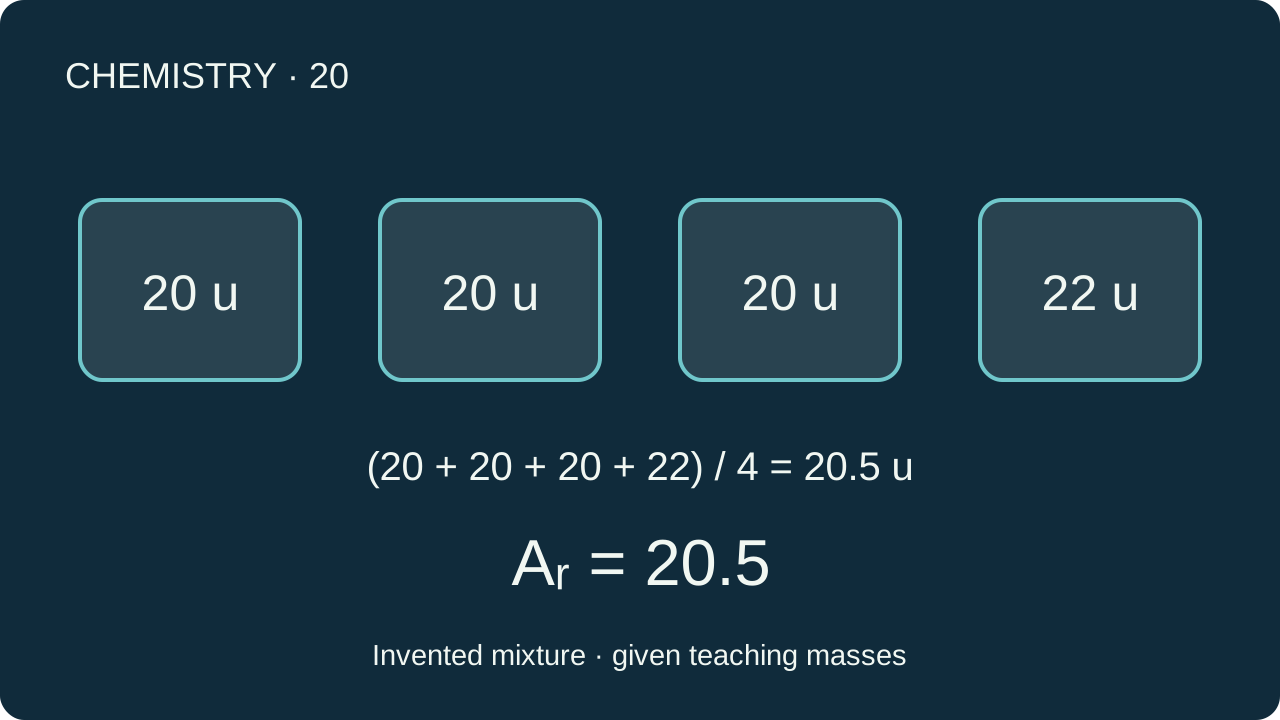
Draw four cards: three labelled 20 u and one labelled 22 u. Check that the fractions by atom count are 75% and 25%. Add their masses and divide by four. Replace this drawing with a weighted mean: multiply each kind’s mass by its fraction, then add the products. No isotope samples are needed.
Worked example
(3×20+1×22)/4=82/4=20.5 u. Equivalently, 0.75×20+0.25×22=20.5. The mean mass is 20.5 u and Aᵣ=20.5 without a unit. The average lies between 20 and 22, nearer the more abundant lighter kind. None of the four individual cards has thereby acquired mass 20.5 u.
A common mistake
Mistake: replacing real isotope masses with mass numbers and calling the result exact. A counts nucleons; it is not an exact atomic mass in u. Standard atomic weights account for isotope composition; references give intervals for some elements. Rounding a table’s Aᵣ therefore does not determine the neutron count of every atom of that element.
Transfer to a new case
Reverse the fractions: 25% with mass 20 u and 75% with mass 22 u. Predict the direction of change before calculating. Another record lists 75% and 40%. Can those values go straight into a two-component mixture calculation? Explain the input check you would make.
Answer and recall
Check: the new mean is 21.5 u and Aᵣ=21.5; it has moved towards 22. Fractions 75% and 40% total 115%, so correct or clarify the conditions before calculating. Label A, mass in u and Aᵣ separately in the notebook. Recall each meaning and explain why an average is not the description of one particular atom.
Exercise
- Find Aᵣ for 75% atoms at 20 u and 25% at 22 u. What unit does Aᵣ have?
- Are 75% and 40% valid fractions?
Answers
Show the answers
20.5; no unit; no, the total is 115%.
Notebook record
Record your initial answer, the evidence used, the corrected explanation and the limit of your conclusion. Close the example and explain a new case in your own words. If you made an error, identify the step: reading the card, counting particles, choosing a model or drawing a conclusion.
When to revisit
Close the page and, after 10 minutes, reconstruct the map, define the terms in your own words and solve the new case. Repeat without hints after a day and a week. If an error persists, return to the worked example and write down the missing step.
Sources and model limits
If you have found a mistake or a typo in this article, tell us about it
Comments (0)
Log in to leave a comment →
No comments yet. Be the first.