

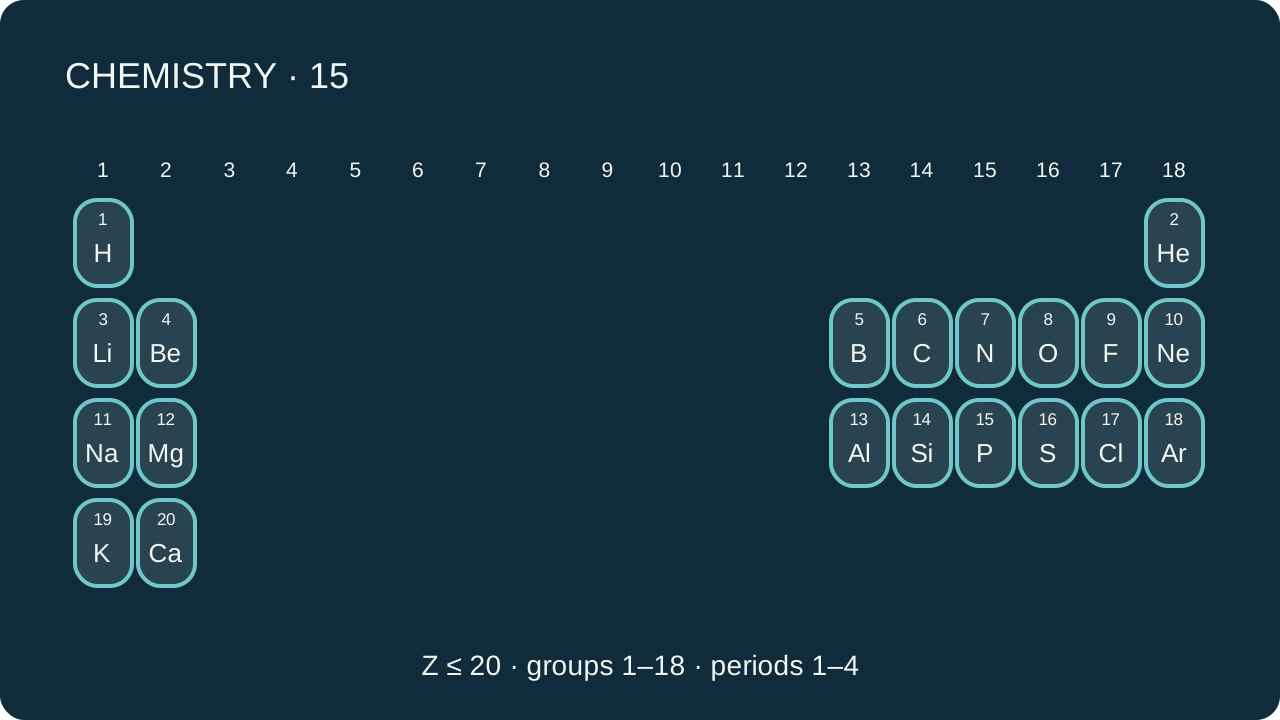
Chemistry: investigate the world of substances Lesson 15 of 22
How do we find an element’s address in the periodic table?
Read periods and groups in the long table while keeping helium and deliberate gaps in their correct places.
Support map
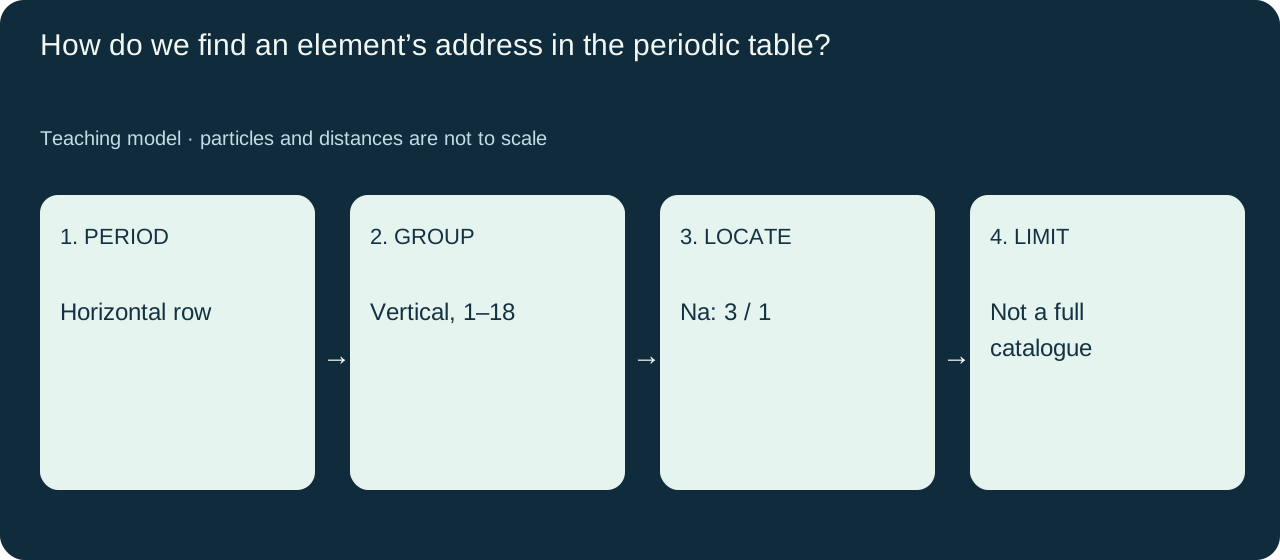
Teaching model · particles and distances are not to scale
Situation and question
Imagine the table as a map of addresses. Na and Mg are neighbours in a row, while Li and Na sit one above the other. Which pair shares a “floor” and which shares a “street”? This analogy is a starting point: the address describes patterns in atomic structure, not where a substance is found in nature.
New terms, fully explained
A period is a horizontal row; a group is a vertical column. The long table used here numbers groups from 1 to 18. Elements follow increasing Z, not a strictly increasing average atomic mass. Our reference shows only the first 20 elements. Gaps are deliberate: moving B beneath Li to fill space would give it the wrong address. An empty position in this limited reference does not mean no element occupies it in the full table.
Predict first
Before reading the example, predict the addresses of Na, Mg and Cl. Do Na and Cl share a period or a group? Should He belong to group 2 merely because it has two electrons? Mark which answers use an actual position in the table and which are guesses based on a single number.
Investigate or analyse given data
Use the included first-20-elements diagram to locate H, He, Li, Ne, Na, Cl, K and Ca. Record symbol, Z, period and group for each. Trace a row first and a column second. If the diagram appears small, open the SVG itself and zoom in. Do not fill its gaps with invented symbols or slide existing entries into them.
Worked example
Na has Z=11, period 3, group 1. Mg has Z=12, period 3, group 2. Cl has Z=17, period 3, group 17. Na and Cl therefore share a period but not a group. Li and Na share group 1 but occupy periods 2 and 3. Helium is in group 18, period 1: “group equals total electrons” is not a valid rule.
A common mistake
Mistake: reversing the directions, or describing group 17 as a seventh period. Older school tables may use different group labels; this course uses IUPAC numbers 1–18. Changing the table’s design does not change an element’s Z. Its position does not tell you a sample’s colour, price, availability or safety.
Transfer to a new case
Two new cards describe element X with Z=19 and element Y with Z=20. X and Y are placeholders in this problem, not actual element symbols. Find their real symbols and addresses. Compare X with Na: what stays the same, and what differs? Check the table rather than guessing from how a name sounds.
Answer and recall
Check: X is K, period 4, group 1; Y is Ca, period 4, group 2. K and Na share a group but have different periods and atomic numbers. Reconstruct the directions “period →” and “group ↓” from memory. Put He at the upper right and explain why two electrons do not move it to group 2.
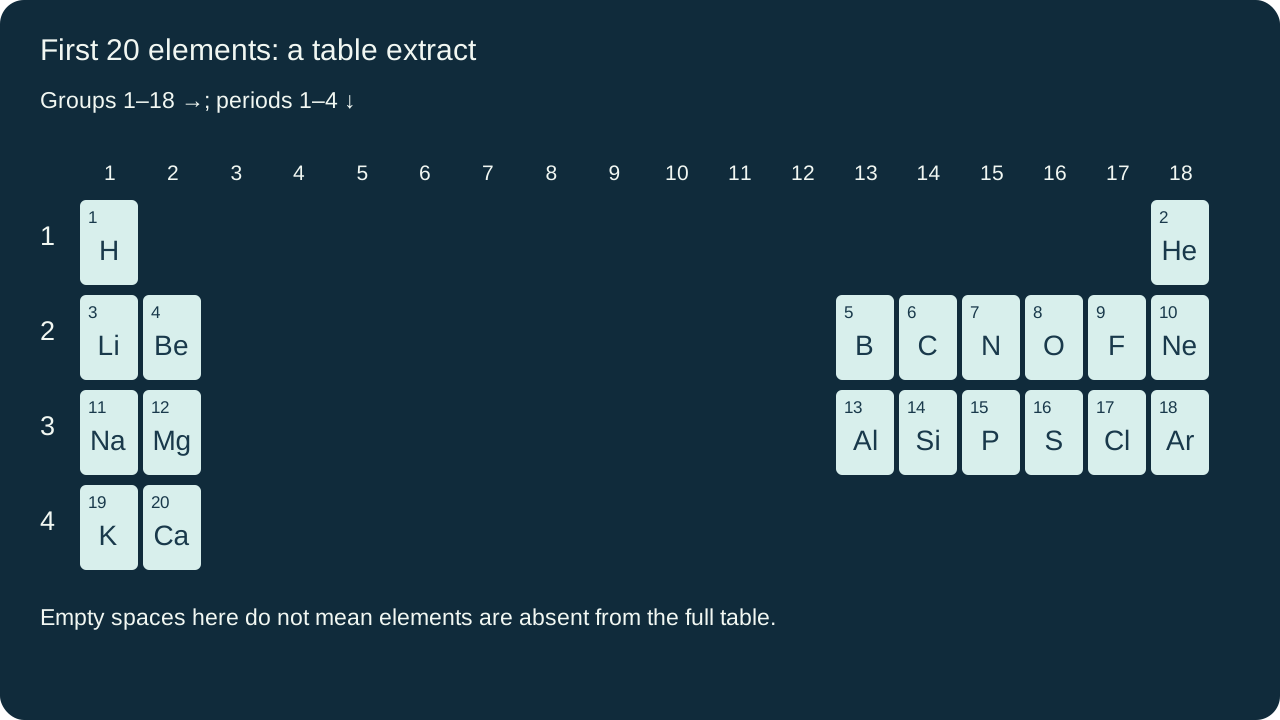
Empty spaces here do not mean elements are absent from the full table.
| Z | symbol | period | group | electrons by shell |
|---|---|---|---|---|
| 1 | H | 1 | 1 | 1 |
| 2 | He | 1 | 18 | 2 |
| 3 | Li | 2 | 1 | 2, 1 |
| 4 | Be | 2 | 2 | 2, 2 |
| 5 | B | 2 | 13 | 2, 3 |
| 6 | C | 2 | 14 | 2, 4 |
| 7 | N | 2 | 15 | 2, 5 |
| 8 | O | 2 | 16 | 2, 6 |
| 9 | F | 2 | 17 | 2, 7 |
| 10 | Ne | 2 | 18 | 2, 8 |
| 11 | Na | 3 | 1 | 2, 8, 1 |
| 12 | Mg | 3 | 2 | 2, 8, 2 |
| 13 | Al | 3 | 13 | 2, 8, 3 |
| 14 | Si | 3 | 14 | 2, 8, 4 |
| 15 | P | 3 | 15 | 2, 8, 5 |
| 16 | S | 3 | 16 | 2, 8, 6 |
| 17 | Cl | 3 | 17 | 2, 8, 7 |
| 18 | Ar | 3 | 18 | 2, 8, 8 |
| 19 | K | 4 | 1 | 2, 8, 8, 1 |
| 20 | Ca | 4 | 2 | 2, 8, 8, 2 |
Exercise
- Give Cl’s period and group. Where is He?
- Do groups 3–12 exist although our extract leaves them unfilled?
Answers
Show the answers
Cl: 3 and 17; He: 1 and 18; yes, in the full table.
Notebook record
Record your initial answer, the evidence used, the corrected explanation and the limit of your conclusion. Close the example and explain a new case in your own words. If you made an error, identify the step: reading the card, counting particles, choosing a model or drawing a conclusion.
When to revisit
Close the page and, after 10 minutes, reconstruct the map, define the terms in your own words and solve the new case. Repeat without hints after a day and a week. If an error persists, return to the worked example and write down the missing step.
Sources and model limits
If you have found a mistake or a typo in this article, tell us about it
Comments (0)
Log in to leave a comment →
No comments yet. Be the first.