

Chemistry: investigate the world of substances Lesson 22 of 22
The salt case: what can the periodic table explain?
Assemble element, shell and charge evidence while separating it from an unknown sample’s unconfirmed composition.
Support map
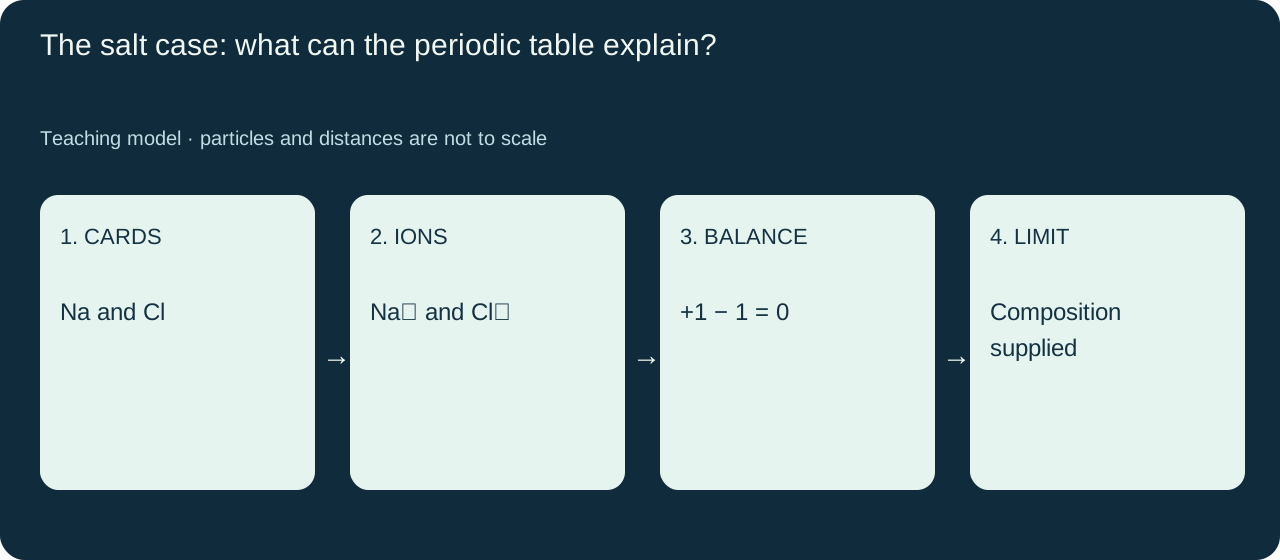
Teaching model · particles and distances are not to scale
Situation and question
Return to the clear liquid from block 1. The case confirms that pure NaCl was originally dissolved. Explain its composition through elements and ions. The table helps check notation but cannot identify every clear liquid. Do not taste the sample or start new experiments: use only the case data.
New terms, fully explained
Evidence here means data supporting a particular conclusion. An assumption still needs checking. An ion ratio compares counts of different kinds of particles. NaCl describes a one-to-one ratio of Na⁺ to Cl⁻ in an ordinary crystal. It is not a picture of a separate two-atom molecule or a promise of metallic sodium’s properties.
Predict first
Predict whether a model containing only two Na⁺ and one Cl⁻ can represent an electrically neutral formula portion of ordinary NaCl. Write the charge sum. Then decide whether a colourless solution independently confirms NaCl. State which evidence supports each answer.
Investigate or analyse given data
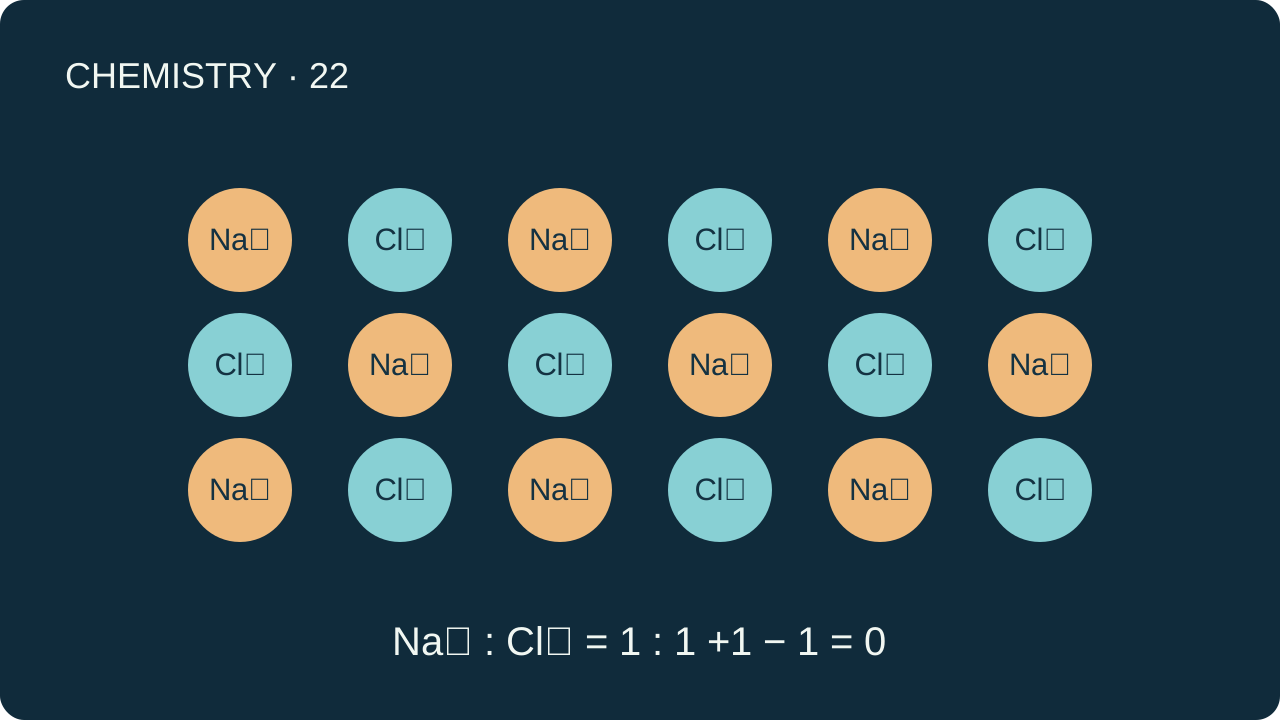
Build a four-row paper dossier. Na: Z=11, period 3, group 1, neutral arrangement 2,8,1. Cl: Z=17, period 3, group 17, arrangement 2,8,7. Na⁺: 11p, 10e. Cl⁻: 17p, 18e. Add columns “supported conclusion” and “not yet established”. Represent particles with symbolic cards only.
Worked example
The charges are 11−10=+1 and 17−18=−1. Equal ion counts give zero total: four Na⁺ and four Cl⁻ give +4−4=0. Two Na⁺ and one Cl⁻ give +1, so that set is not a neutral NaCl formula portion. Card sizes and colours do not represent actual ion sizes or colours.
A common mistake
Mistake: declaring an unknown liquid salty just because Na and Cl can be found in the table. Composition was supplied in the case; without it, suitable independent evidence is needed. Do not derive neutron counts from 35.45 or move Na⁺ into period 2. A compound and the simple substances of its elements have different properties.
Transfer to a new case
Another set contains Mg²⁺ and Cl⁻. How many singly charged anions are required per cation for zero total charge? Calculate first, then propose a ratio notation. This is a balance exercise, not a claim that neutrality alone proves the existence of any invented substance.
Answer and recall
Check: one Mg²⁺ and two Cl⁻ give +2−2=0; the 1:2 ratio corresponds to MgCl₂. Explain elements, positions, neutral atoms, ions, balance and limits in that order. The next block will develop bonds and formulas further. Keep the initial answer, correction and reason for change: the notebook should show the reasoning process rather than only a correct result.
Exercise
- Find the total charge of 2Na⁺ and Cl⁻. What ratio does NaCl need?
- How many Cl⁻ balance Mg²⁺?
- Does clarity establish composition?
Answers
Show the answers
+1; 1:1; two; no. Explain each using evidence and the limit of the conclusion.
Notebook record
Record your initial answer, the evidence used, the corrected explanation and the limit of your conclusion. Close the example and explain a new case in your own words. If you made an error, identify the step: reading the card, counting particles, choosing a model or drawing a conclusion.
When to revisit
Close the page and, after 10 minutes, reconstruct the map, define the terms in your own words and solve the new case. Repeat without hints after a day and a week. If an error persists, return to the worked example and write down the missing step.
Sources and model limits
If you have found a mistake or a typo in this article, tell us about it
Comments (0)
Log in to leave a comment →
No comments yet. Be the first.