

Chemistry: investigate the world of substances Lesson 1 of 5
Where did the salt go? Start a chemistry investigation
Begin with a testable question and rules that keep the investigation safe.
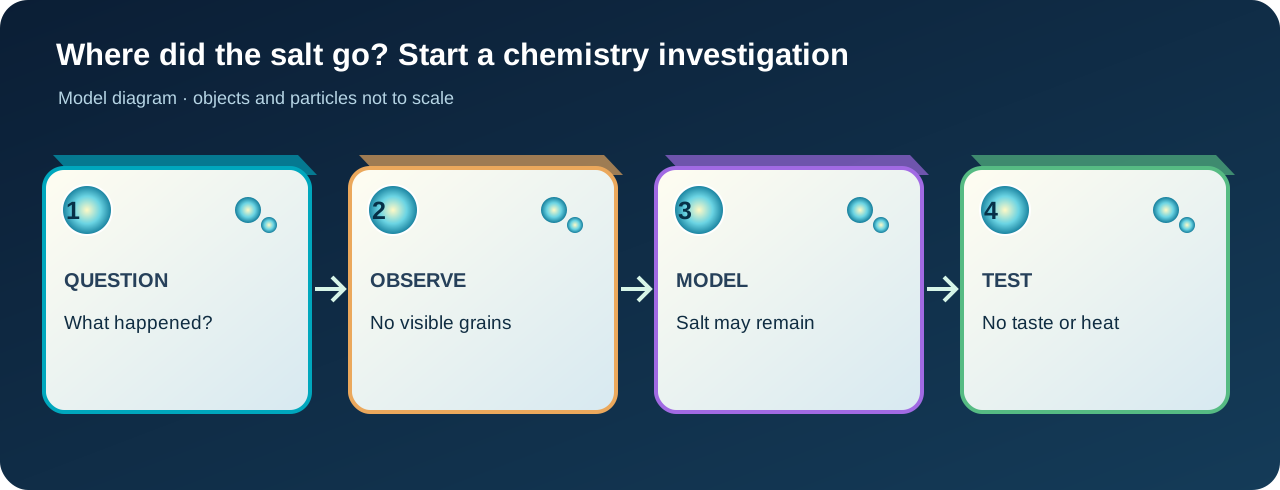
Support map
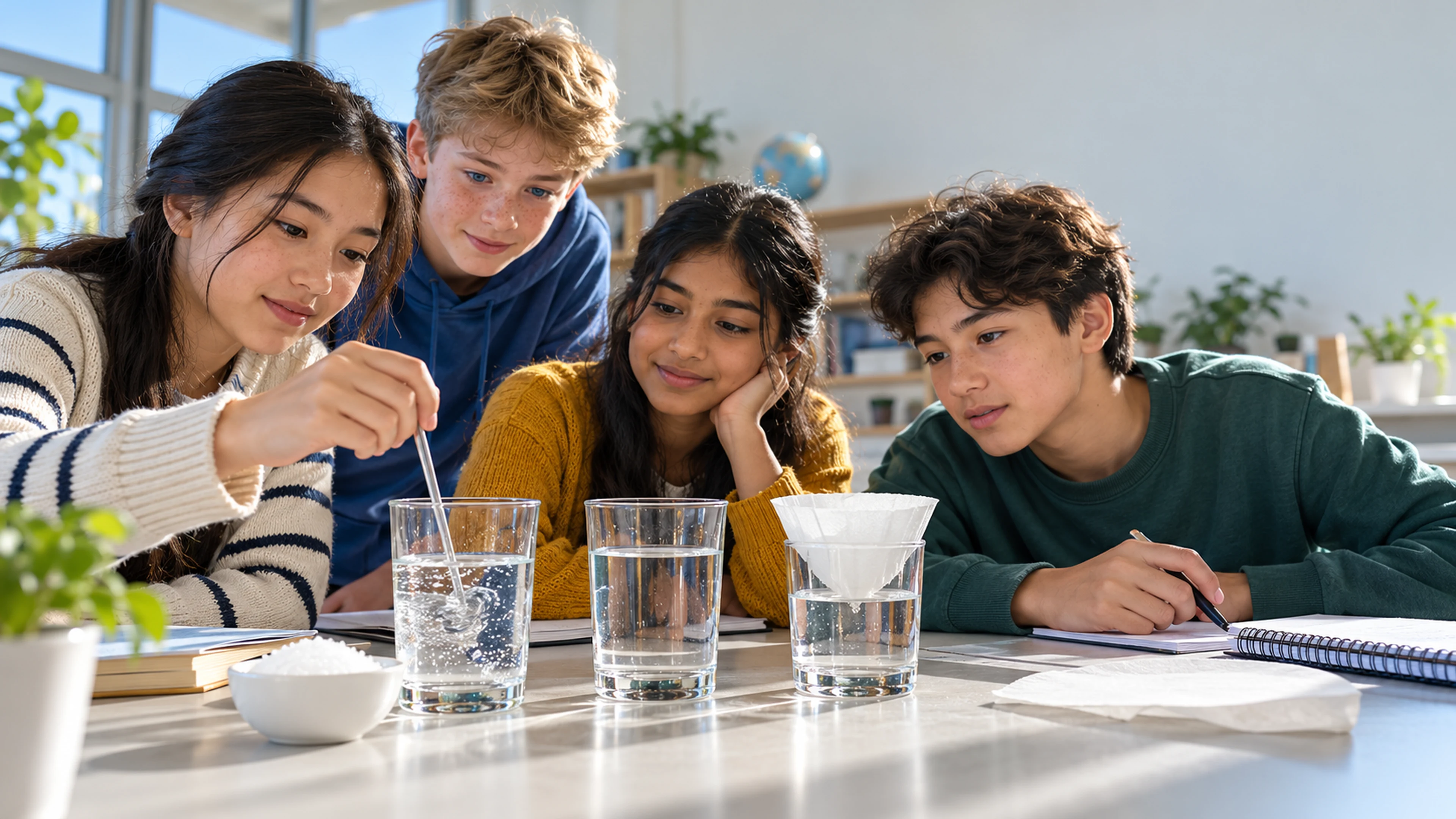
Investigating water and salt: a photorealistic reconstruction of a lesson scene.
Situation and question
You stir salt into a clear glass of water. The grains are no longer visible. Has the salt vanished? A vote cannot settle two plausible explanations; we need to test what each predicts.
New terms, fully explained
Chemistry studies substances, their properties and changes. An observation is what you can see or measure: the grains are no longer visible after stirring. An explanation proposes a cause: the salt may be distributed in the water. A prediction says what a later check should show if an explanation is correct. A control is a comparison case: a second glass with the same water but no salt. Do not call an explanation an observation.
Mass measures how much matter a sample contains; here compare it by weighing and record it in grams (g). Weighing a closed vessel includes both vessel and contents. If it was opened, account for everything added or removed. Make two notebook columns: “I actually observed” and “I currently infer”.
Predict first
Write two explanations: A, the salt ceased to exist; B, it remains in the water but cannot be seen. What test might distinguish them? Set the answer aside while you plan a check. Neither tasting nor smelling is an acceptable test.
Investigate or analyse given data
With an adult, use two clear glasses of room-temperature water, table salt and a spoon. Label them ‘water’ and ‘water + salt’. Compare clarity and visible grains before and after stirring. Do not heat or taste anything. Without materials, use these given observations: both glasses are clear; no grains are visible after stirring.
Worked example
Invisible grains do not show that the salt has vanished. Clarity is an observation; the fate of the salt is still a question. Later we will compare ways of separating mixtures. This is a more honest answer than a confident guess without a test.
A common mistake
Mistake: ‘I cannot see salt, therefore it is absent.’ Visibility depends on the size and distribution of visible grains. Tasting is also a mistake: do not sample even food substances used in a lesson; it is dangerous with unknown materials.
Transfer to a new case
For sugar that is no longer visible in tea, write the observation separately from an explanation. Propose a safe comparison with plain water without tasting. What other evidence would support the conclusion that the sugar remains?
Answer and recall
Check: the observation is that grains are not visible; the explanation is that sugar may be distributed. Weigh vessel, water and sugar separately, then compare their total with the mass of the same vessel holding the solution, losing nothing during transfer. Rebuild the map from memory: question → observation → two explanations → test → cautious claim. Return tomorrow without looking at the map.
Investigator’s table
| Stage | Record | This does not yet prove |
|---|---|---|
| Before | Prediction and matched conditions | That the prediction is right |
| During | Only what was seen or measured | A cause without a test |
| After | A claim with a limit and a new question | Complete purity or safety |
When to revisit
Close the page and, after 10 minutes, reconstruct the map, define the terms in your own words and solve the new case. Repeat without hints after a day and a week. If an error persists, return to the worked example and write down the missing step.
If you have found a mistake or a typo in this article, tell us about it
Comments (0)
Log in to leave a comment →
No comments yet. Be the first.