

Chemistry: investigate the world of substances Lesson 4 of 5
Dissolving without vanishing: a particle model
Connect visible stirring to an invisible model and distinguish dissolving from melting.
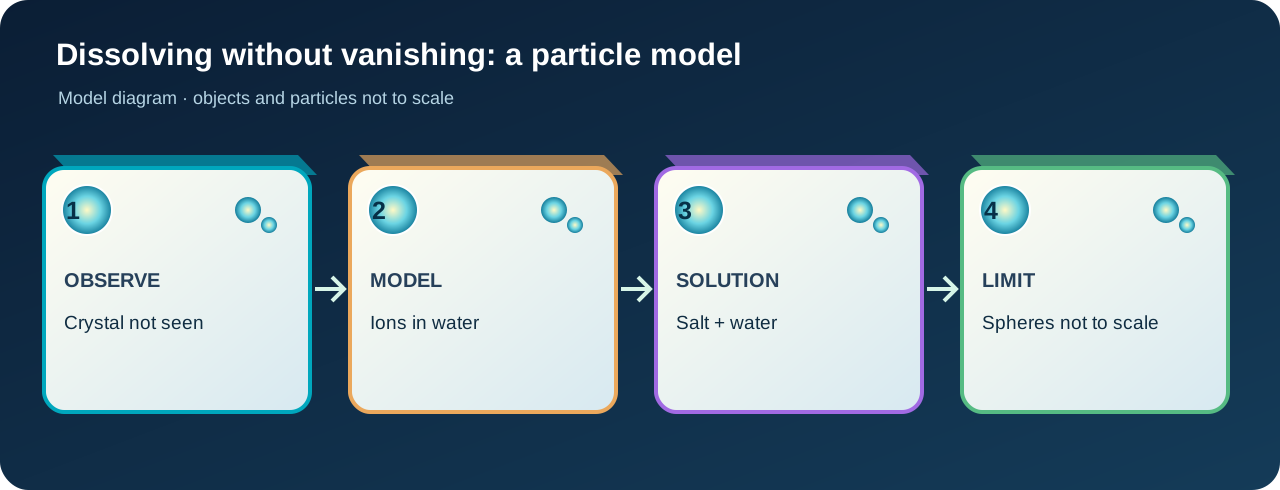
Support map
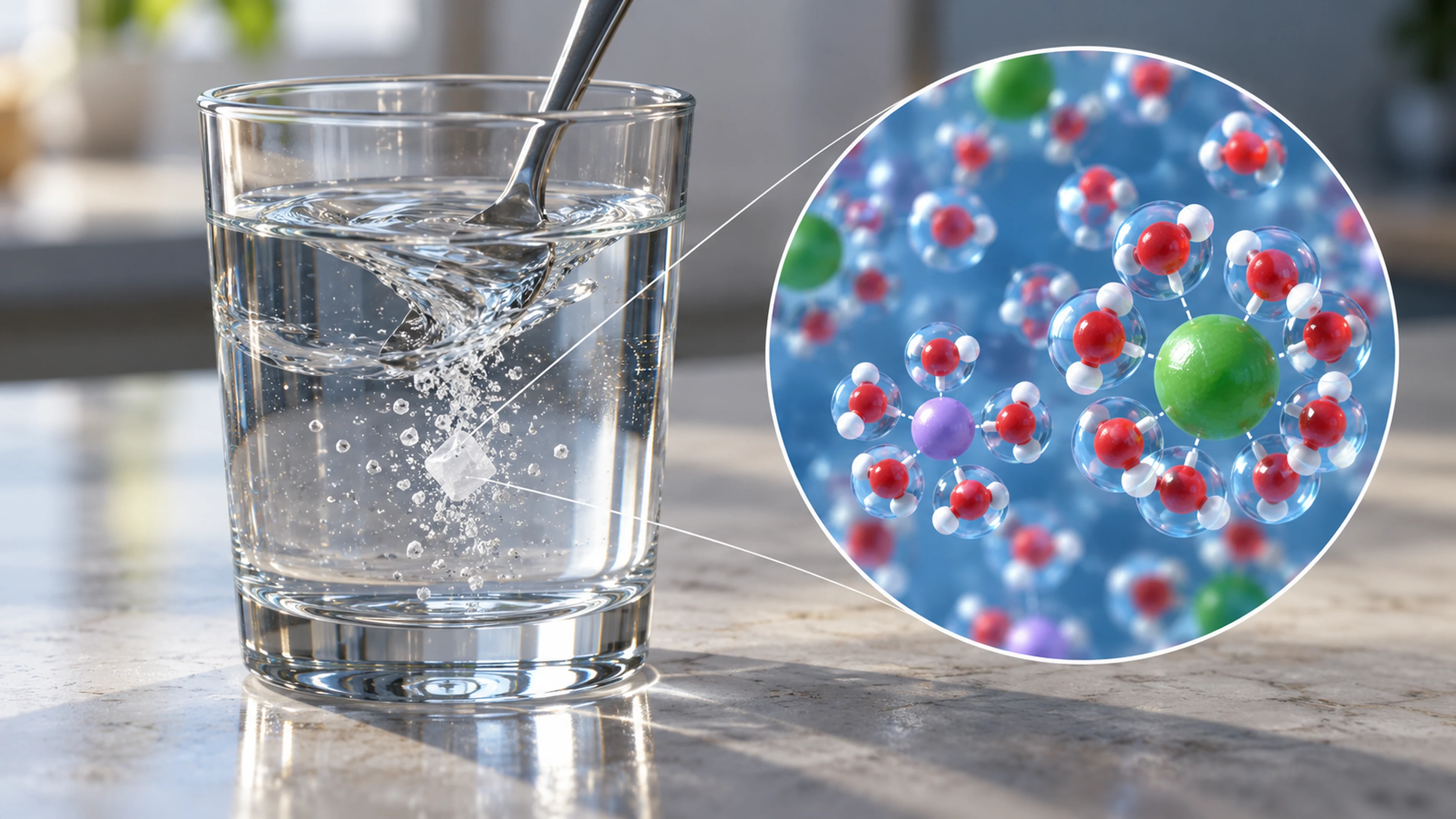
Magnified 3D model of dissolving: particle colours and sizes are symbolic, not a micrograph.
Situation and question
In lesson one salt seemed to ‘disappear’. We now need a model that explains both clear water and the salt’s continued presence.
New terms, fully explained
The solvent is the component in which another substance is distributed; here, water. The solute is the dissolved substance; here, salt. A solution is a homogeneous mixture of solvent and solute. A particle in this chapter is a tiny symbolic unit in a model; we will identify the actual kinds later. A model explains and predicts; it is not a photograph. When table salt dissolves, its crystal separates into ions surrounded by water molecules; for now we draw simplified spheres. Melting is a solid turning liquid when conditions change, not mixing with a solvent.
An atom is a small unit of a chemical element; elements and atomic structure come later. A molecule is a group of bonded atoms; water consists of molecules. An ion is an electrically charged particle; table salt contains positive and negative ions. When salt dissolves, those ions spread through water. Spheres in the image are symbols: actual sizes, distances and movement are not shown.
Predict first
Before the diagram, predict: if one or two small measured spoonfuls of salt are stirred into equal glasses of room-temperature water, does the salt’s mass vanish? Can you keep adding salt without limit to one fixed volume of water? Do not test by taste.
Investigate or analyse given data
Use two clear glasses with the same amount of water. With an adult, put a small measured portion of table salt in one; leave the other as a comparison. Draw visible grains before stirring and symbolic dots afterward. Label what you actually saw and what the model adds. Without materials, use these given observations: a small portion has been stirred in; water remains clear and grains cannot be seen.
Worked example
Worked example: add 5 g of salt to 100 g of water. If none is lost during transfer, the mass of the contents after dissolving is 105 g; count the vessel separately. Here, mass of solution = mass of water + mass of salt added. The mass of the entire closed system stays the same before and after dissolving. Volumes need not add in the same way. In an open vessel, escaping water vapour must also be counted.
A common mistake
Mistake: ‘The salt melted.’ Melting usually describes ice or another solid becoming liquid; salt dissolved in water. Drawing the particles the size of rice grains is another mistake: the diagram is enlarged and shows relationships, not actual size or colour.
Transfer to a new case
Why does a paper filter that holds back sand fail to hold dissolved salt? Explain at the visible and model levels. What observation might challenge your model?
Answer and recall
Check: water and dissolved components pass through an ordinary paper filter; large sand grains remain. In the model, small solution particles pass through pores. Pore and particle sizes are not to scale. From memory draw crystal + water → distribution → homogeneous solution; revisit tomorrow and in a week.
Investigator’s table
| Stage | Record | This does not yet prove |
|---|---|---|
| Before | Prediction and matched conditions | That the prediction is right |
| During | Only what was seen or measured | A cause without a test |
| After | A claim with a limit and a new question | Complete purity or safety |
When to revisit
Close the page and, after 10 minutes, reconstruct the map, define the terms in your own words and solve the new case. Repeat without hints after a day and a week. If an error persists, return to the worked example and write down the missing step.
Tap water, air and salt: which is a mixture?
Recovering salt from a mixture: settling, filtering, evaporation
If you have found a mistake or a typo in this article, tell us about it
Comments (0)
Log in to leave a comment →
No comments yet. Be the first.