

Chemistry: investigate the world of substances Lesson 60 of 67
What does an indicator colour show—and what can it not prove?
Interpret supplied observations and separate classifying a solution from identifying a substance.
Support map
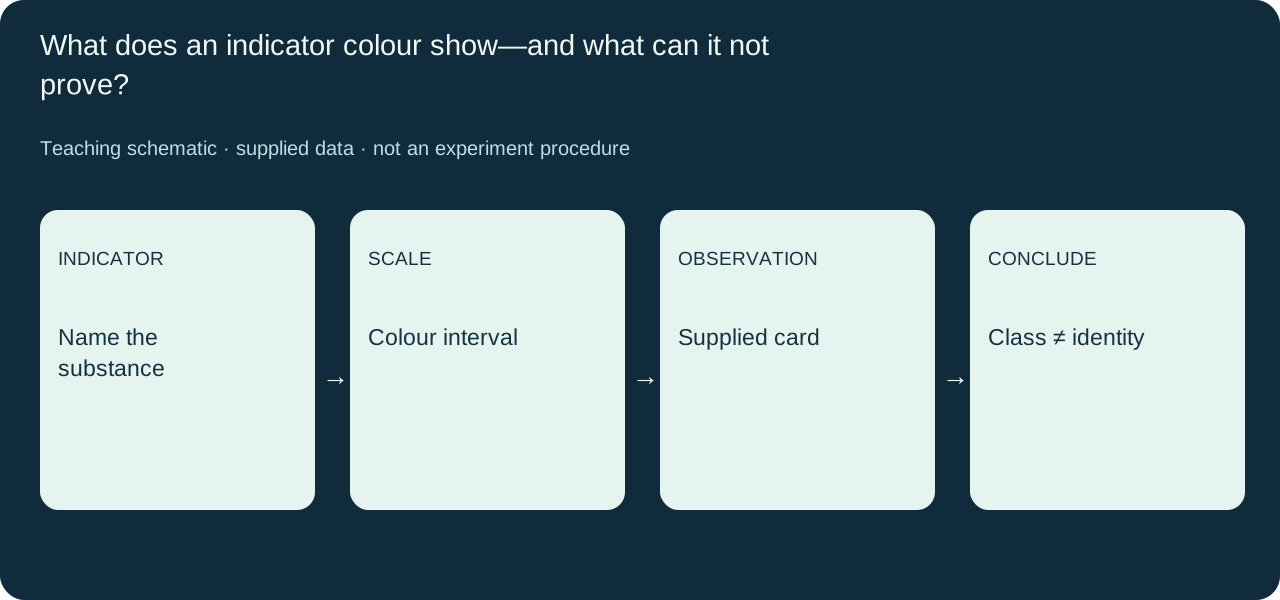
Model diagram
Use paper, a calculator and supplied data only. Do not taste, smell, mix or heat chemicals; do not open household products or unknown containers. Neutral pH does not establish safety. Do not apply teaching neutralisation to skin, eyes, spills or unknown mixtures.
Situation and question
The notebook says: “The indicator is red, so hydrochloric acid has been found.” It gives neither the indicator’s name nor its scale. Is that sufficient? A sample’s own colour and an added indicator’s response are different observations. Use printed observation cards only; do not handle liquids or prepare indicators.
New terms, fully explained
An indicator changes colour over a particular acidity range. A transition interval is a pH range, not one exact value. Our supplied card says litmus is red in acidic solution, purple in neutral solution and blue in basic solution. Interpret these signs together with the indicator name and observation conditions.
Predict first
Predict whether blue litmus identifies NaOH specifically. Could colourless phenolphthalein indicate either an acidic or a near-neutral solution? List alternatives first, then use this reference: it is colourless below roughly pH 8.2, with its pink transition usually around 8.2–10.
Investigate or analyse given data
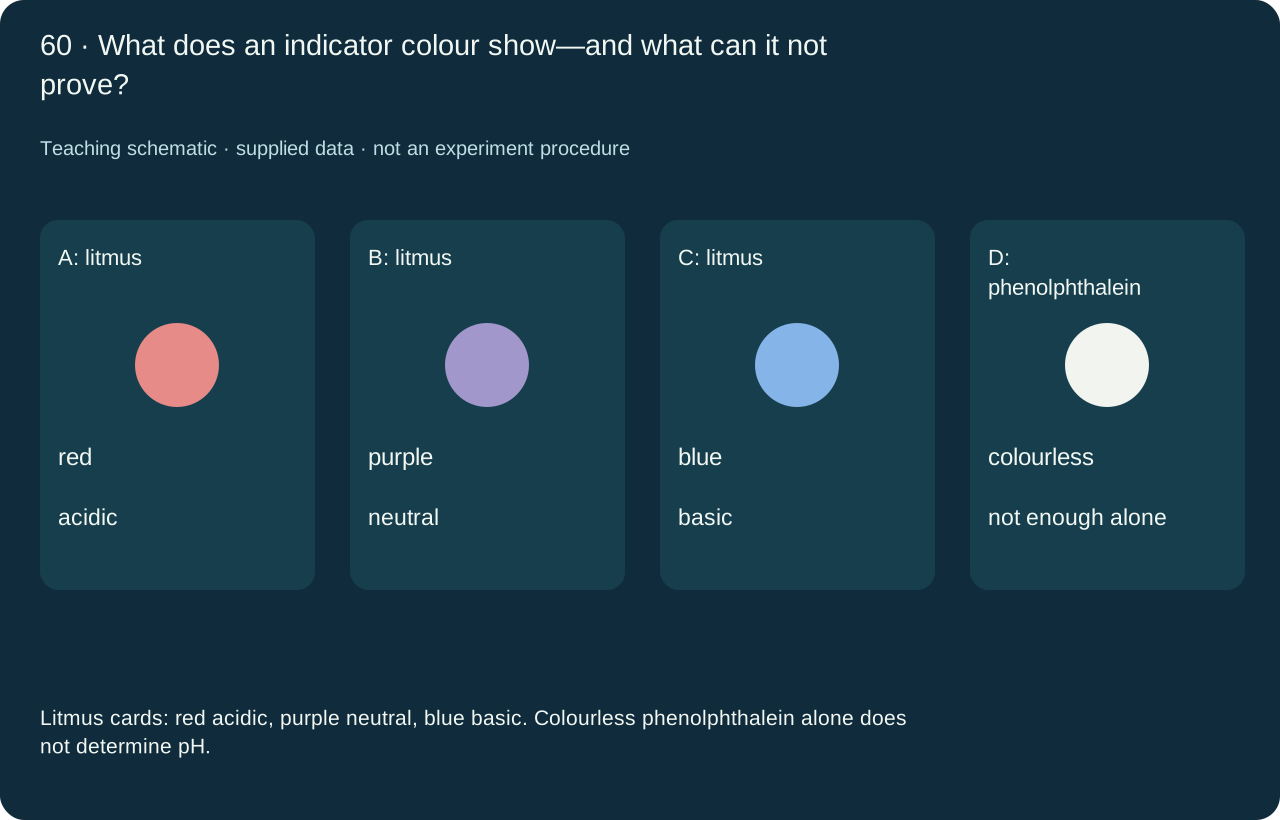
Cards read: A—red litmus; B—purple litmus; C—blue litmus; D—colourless phenolphthalein. Write the justified conclusion for each without assigning an exact pH. A sample’s own colour or cloudiness may interfere; the supplied exercise explicitly excludes those effects.
| Object / step | Given / calculation | Conclusion |
|---|---|---|
| A: litmus | red | acidic |
| B: litmus | purple | neutral |
| C: litmus | blue | basic |
| D: phenolphthalein | colourless | not enough alone |
Worked example
Under the given scale, A is acidic, B neutral and C basic. D alone is insufficient: colourlessness is compatible with a broad range including acidic and neutral conditions. Another observation is needed. None of these results by itself names a particular acid or base.
A common mistake
Mistake: treating any red colour as evidence of acidity without naming the indicator, or reading a colour scale as a precise digital instrument. Different indicators have different transitions. Universal-indicator colour charts vary with the product, so use the supplied chart. Do not identify unknown household liquids using this teaching table.
Transfer to a new case
Transfer case: card E reports pH 7.8 at 25 °C and colourless phenolphthalein, with interference excluded. Must the records contradict each other? Explain how a mildly basic region below phenolphthalein’s transition can allow both. Distinguish the numerical instrument record from a conclusion based on colour alone.
Answer and recall
Check: the results can coexist; colourlessness does not prove neutrality. State the indicator, scale, observation and limit of the conclusion. The original notebook entry does not identify a specific acid. Reconstruct the four cards and suggest an additional observation that would reduce uncertainty.
Exercise
Does colourless phenolphthalein establish pH seven and absence of acid?
Answers
Show the answers
No. The result fits a broad range; a scale and more evidence are needed.
When to revisit
Close the page and, after 10 minutes, reconstruct the map, define the terms in your own words and solve the new case. Repeat without hints after a day and a week. If an error persists, return to the worked example and write down the missing step.
Sources and limits
If you have found a mistake or a typo in this article, tell us about it
Comments (0)
Log in to leave a comment →
No comments yet. Be the first.