

Chemistry: investigate the world of substances Lesson 48 of 49
Why can the collected mass differ from the calculated mass?
Determine product yield, account for purity and check whether a result is plausible.
Support map
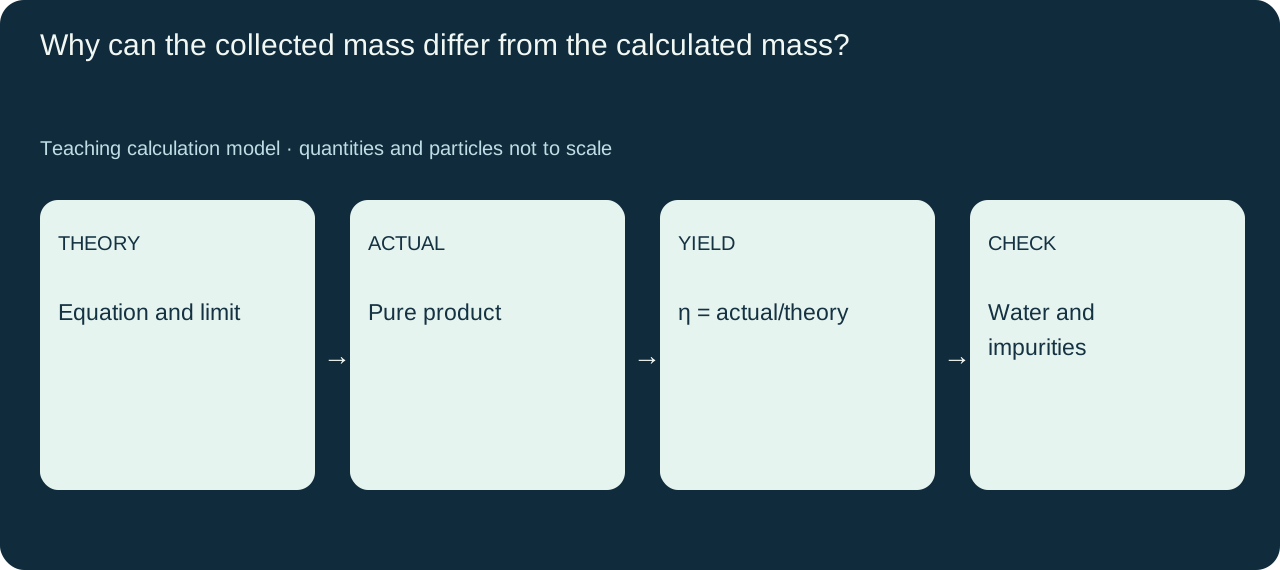
Model diagram
Use only paper, a calculator and supplied data. Do not carry out reactions, generate gases, heat substances or mix household chemicals.
Situation and question
A calculation predicts 5.85 g of NaCl, while a supplied report lists 4.68 g of pure dry NaCl. Where did the other 1.17 g go? Can those two numbers identify one definite cause? Analyse supplied data rather than carrying out a synthesis.
New terms, fully explained
Theoretical yield is the maximum product from the selected reaction and limiting reactant. Actual yield is the quantity of the selected product obtained, measured with its purity accounted for. Percentage yield η = m(actual)/m(theoretical)×100% for the same product. Amounts in moles may also be compared on a consistent basis.
Predict first
Predict the yield when half the theoretical mass is collected. Does 80% yield mean exactly 20% of the starting material did not react? List alternatives such as separation losses, side reactions, incomplete conversion and measurement error.
Investigate or analyse given data
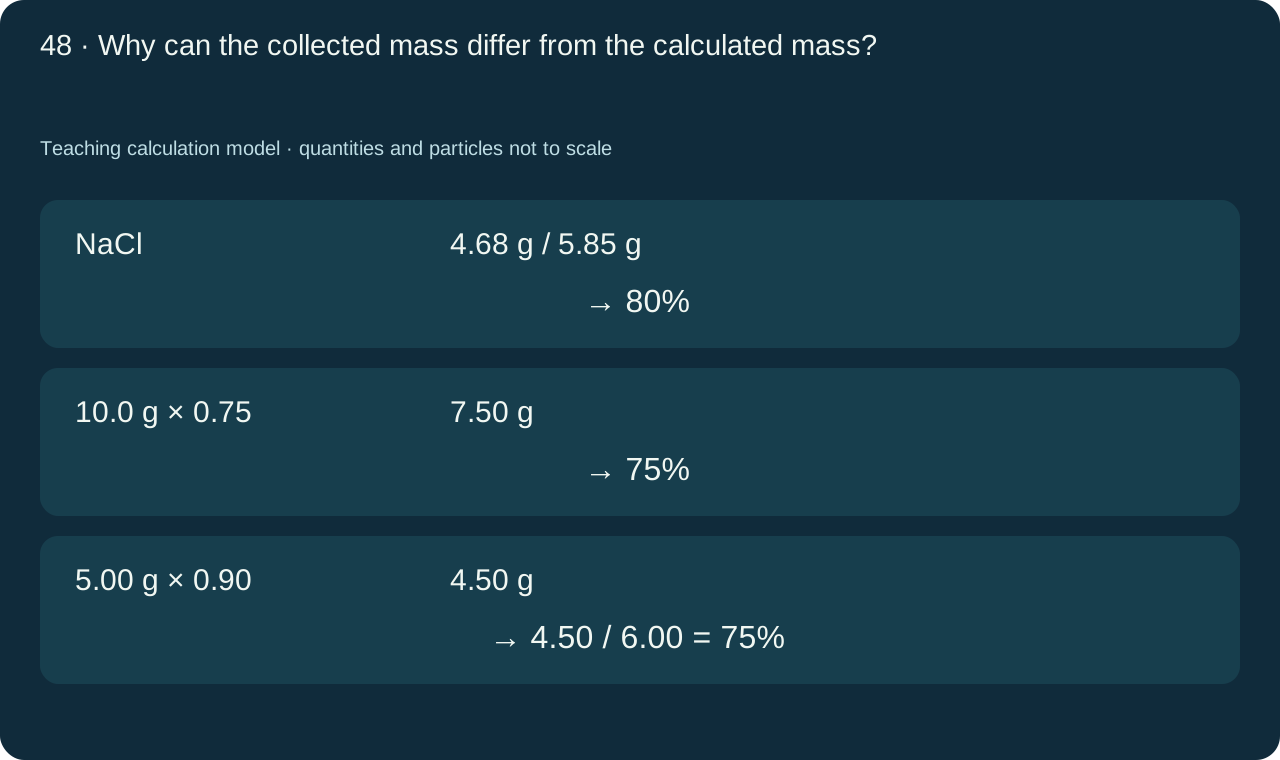
The supplied masses are 5.85 g theoretical and 4.68 g actual for pure dry NaCl. Divide product mass by the theoretical mass of that same product, not by the initial Na₂CO₃ mass. A separate report gives 6.20 g of wet residue; this is not yet a measurement of pure NaCl mass.
| Entity / step | Given / calculation | Result |
|---|---|---|
| NaCl | 4.68 g / 5.85 g | 80% |
| 10.0 g × 0.75 | 7.50 g | 75% |
| 5.00 g × 0.90 | 4.50 g | 4.50 / 6.00 = 75% |
Worked example
η = 4.68/5.85×100% = 80%. The two numbers establish yield but cannot distinguish every cause of loss. The wet residue would give 6.20/5.85×100%≈106%, signalling a need to check water, impurities, calculation and measurement rather than proving production beyond a correct theoretical limit.
A common mistake
Mistake: explaining every shortage as mass disappearing from the world. Material may remain in solution or form other products. Yield is different from purity: 80% yield and 80% NaCl in a mixture answer different questions.
Transfer to a new case
If the theoretical product mass is 10.0 g and yield is 75%, how much pure product was obtained? In another report, a 5.00 g mixture has a target-product mass fraction of 90%, with a theoretical mass of 6.00 g. Find pure-product mass first, then yield.
Answer and recall
Check: 7.50 g in the first case. In the second, m(product)=5.00×0.90=4.50 g and η=4.50/6.00×100%=75%. Label which fraction describes purity and which describes yield. Without purity evidence, do not treat mixture mass as established product mass.
Exercise
Theory is 12 g and pure product 9 g: yield? What about a 10 g mixture with 90% product and the same theory?
Answers
Show the answers
75% in both: first correct the second sample to 10×0.90=9 g of pure product.
When to revisit
Close the page and, after 10 minutes, reconstruct the map, define the terms in your own words and solve the new case. Repeat without hints after a day and a week. If an error persists, return to the worked example and write down the missing step.
Sources and limits
How do we identify the reactant that runs out first?
The salt case: how can we check the entire calculation chain?
If you have found a mistake or a typo in this article, tell us about it
Comments (0)
Log in to leave a comment →
No comments yet. Be the first.