

Chemistry: investigate the world of substances Lesson 49 of 49
The salt case: how can we check the entire calculation chain?
Combine composition, moles, limiting reactants, purity and yield in one report.
Support map
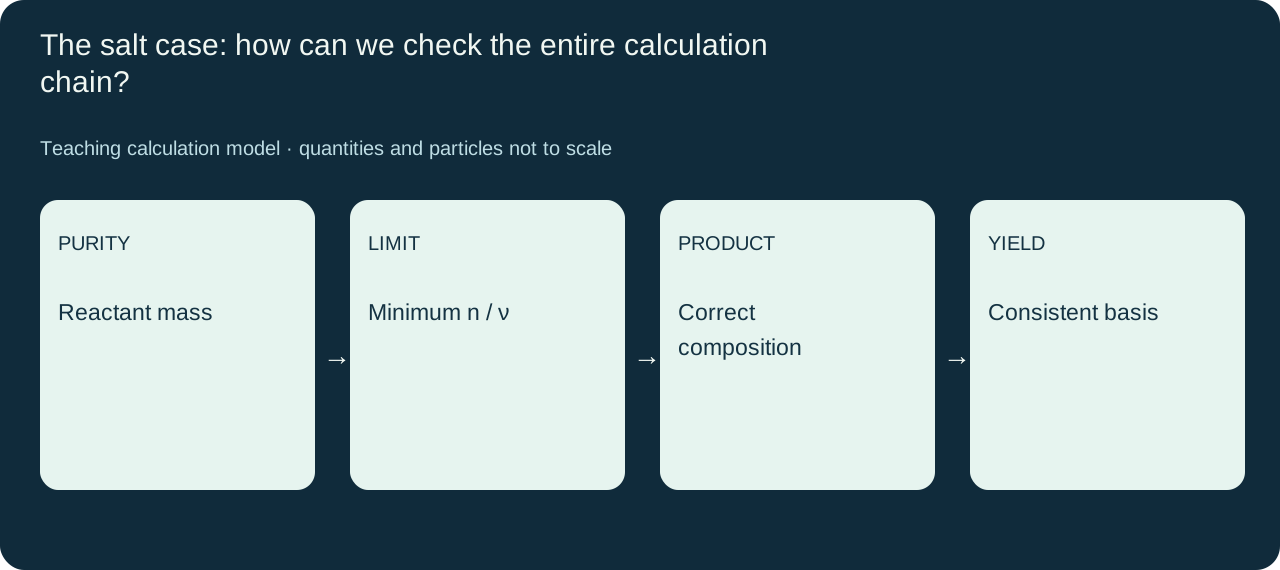
Model diagram
Use only paper, a calculator and supplied data. Do not carry out reactions, generate gases, heat substances or mix household chemicals.
Situation and question
An invented report describes a 13.25 g sample containing 80% Na₂CO₃ by mass; the remainder is inert in this model. It receives 0.150 mol of HCl. The reaction is Na₂CO₃ + 2HCl → 2NaCl + H₂O + CO₂. The dry mixture obtained weighs 8.00 g and contains 87.75% NaCl. Can we calculate salt yield? No actual reaction is required.
New terms, fully explained
Separate three fractions: starting-sample purity, NaCl content of the collected mixture and percentage yield. Calculate reacting amount from the reacting substance’s own mass. Both reactants constrain theoretical product. Correct collected-mixture mass for its composition to find actual target-product mass.
Predict first
May all 13.25 g be treated as Na₂CO₃ and all 8.00 g as NaCl? Is 0.150 mol of HCl enough to convert 0.100 mol of carbonate completely? State the required ratio before calculating any salt mass.
Investigate or analyse given data
Use M(Na₂CO₃)=106 and M(NaCl)=58.5 g/mol. The data specify 0.150 mol of HCl substance, not the mass or volume of its solution. Inertness is a supplied model assumption, not a claim about every unidentified impurity. Composition is given from separate analysis.
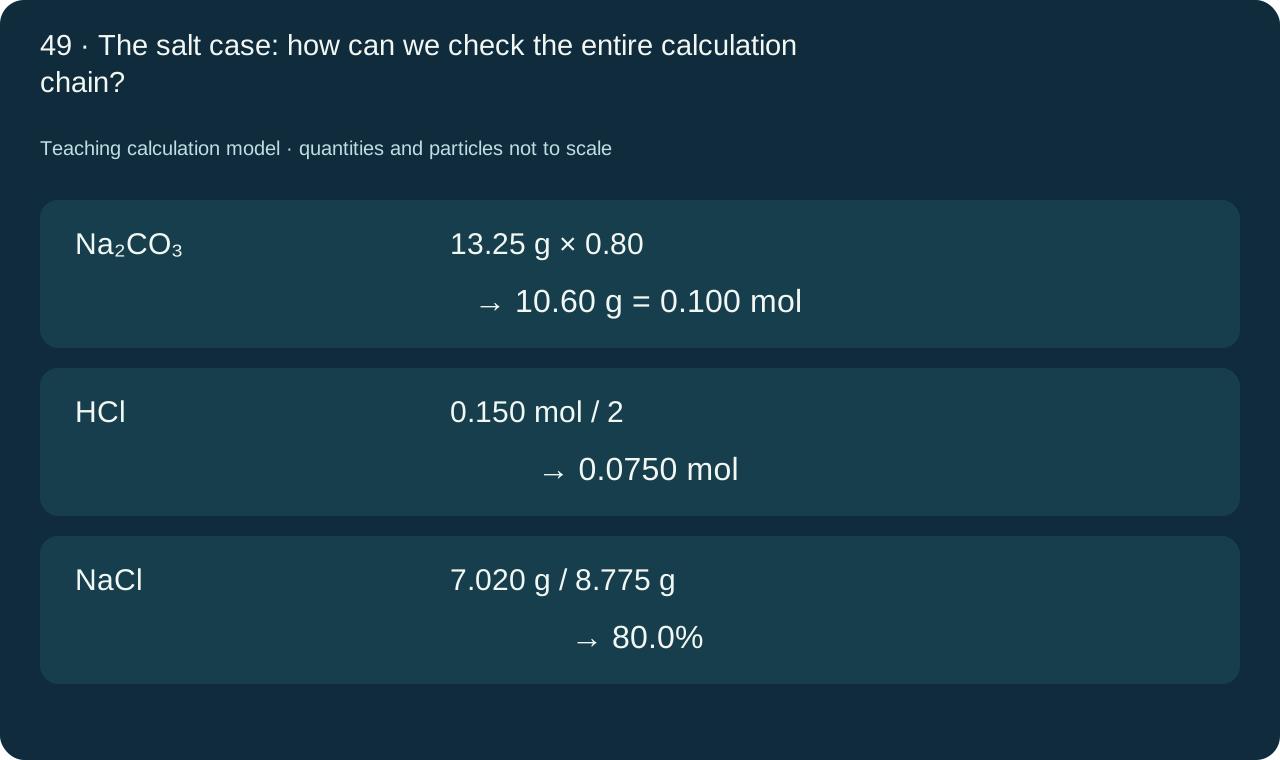
| Entity / step | Given / calculation | Result |
|---|---|---|
| Na₂CO₃ | 13.25 g × 0.80 | 10.60 g = 0.100 mol |
| HCl | 0.150 mol / 2 | 0.0750 mol |
| NaCl | 7.020 g / 8.775 g | 80.0% |
Worked example
Na₂CO₃ mass is 13.25×0.80=10.60 g, or 0.100 mol. Compare 0.100/1 with 0.150/2=0.0750 mol: HCl limits. Theoretical n(NaCl)=2×0.0750=0.150 mol and m=8.775 g. Actual NaCl is 8.00×0.8775=7.020 g. Yield is 7.020/8.775×100%=80.0%.
A common mistake
Mistake: calculating yield as 8.00/8.775 or using all the carbonate as the limit. The ideal model leaves 0.100−0.0750=0.0250 mol, or 2.65 g, of Na₂CO₃ in addition to the original inert impurity. These leftovers are not pure salt mass. Yield alone cannot establish a unique cause of losses.
Transfer to a new case
Transfer: the starting sample is 6.625 g with the same 80% Na₂CO₃, and HCl is now 0.200 mol. The collected mixture is 5.00 g containing 93.6% NaCl. Find the limiting reactant, theoretical and actual NaCl masses and percentage yield. Also calculate the remaining HCl amount.
Answer and recall
Check: Na₂CO₃ is 5.30 g = 0.0500 mol and limits; theoretical NaCl is 0.100 mol = 5.85 g. Actual mass is 5.00×0.936=4.68 g, giving 80% yield. The ideal model leaves 0.100 mol of HCl. Hide the answers and reconstruct each step with units; the next block moves to water and solutions.
Exercise
Why does HCl limit the main case? Is 8.00 g pure salt? What does 80% mean?
Answers
Show the answers
0.150/2 is less than 0.100/1; no, apply the 87.75% fraction; 80% is pure NaCl yield relative to theoretical NaCl.
When to revisit
Close the page and, after 10 minutes, reconstruct the map, define the terms in your own words and solve the new case. Repeat without hints after a day and a week. If an error persists, return to the worked example and write down the missing step.
Sources and limits
If you have found a mistake or a typo in this article, tell us about it
Comments (0)
Log in to leave a comment →
No comments yet. Be the first.