

Chemistry: investigate the world of substances Lesson 5 of 5
Recovering salt from a mixture: settling, filtering, evaporation
Finish the investigation by choosing separation methods from properties and stating their limits.
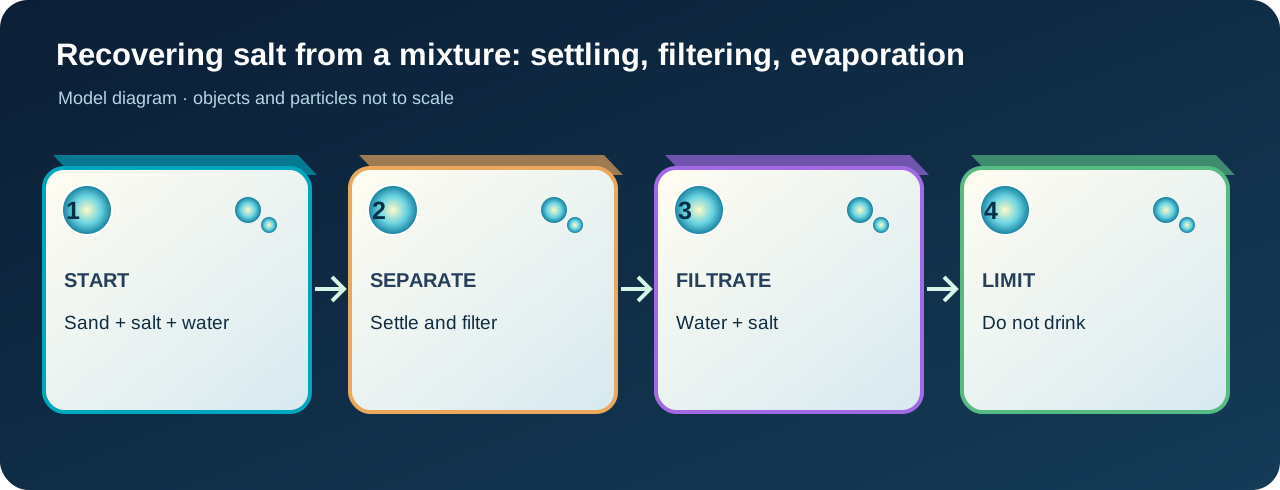
Support map
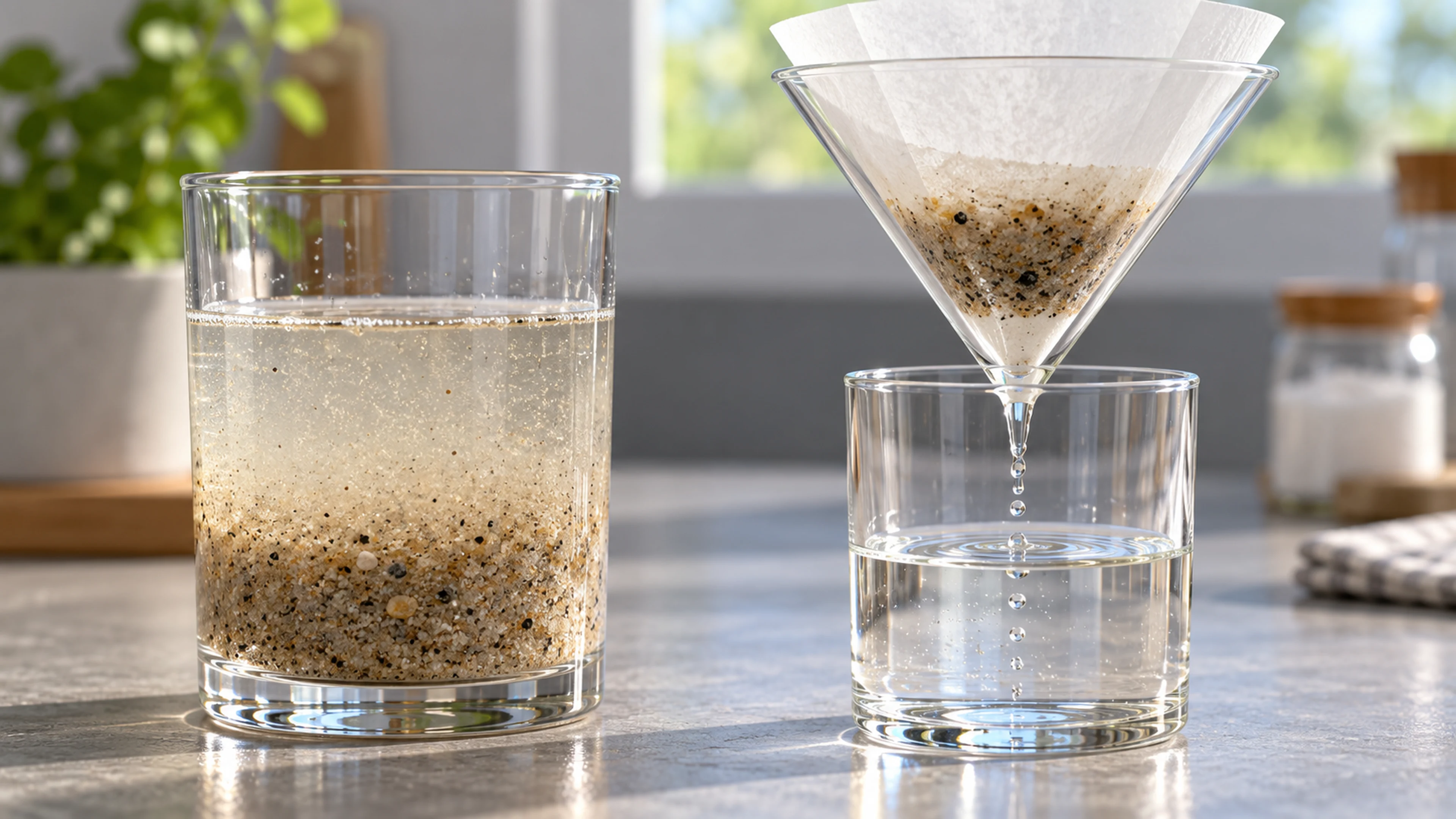
Filtering sand: clear filtrate may still contain dissolved salt.
Situation and question
Imagine a mixture of clean sand, table salt and room-temperature water. The task is to separate sand and obtain clearer salty water, then explain how salt might remain without heating anything at home.
New terms, fully explained
Separating a mixture uses different properties of its components; it does not turn one substance into another. Settling is the collection of larger insoluble particles at the bottom under gravity. Filtration lets liquid pass through a porous barrier while sufficiently large solid pieces stay behind. The liquid that passes is the filtrate. Evaporation is water changing to gas; as water slowly evaporates from salty water, salt can remain. This does not prove the remaining salt is pure: other dissolved substances may remain too.
A pore is a tiny hole in a filter. Paper is porous because liquid can pass between its fibres. Particle and pore size determine what is retained; dissolved salt usually passes through ordinary filter paper. Microorganisms are tiny living things unseen without special equipment; clear filtrate is not thereby safe to drink.
Predict first
Plan a route before reading the answer. Choose A, filter first and then consider evaporation, or B, evaporate the sandy mixture first. Where does the sand end up in each case? Where is dissolved salt after filtration?
Investigate or analyse given data
With an adult’s permission, mix clean dry sand, a little table salt and room-temperature water. Let it settle; carefully pour through a paper filter into another glass. Do not heat anything or taste the filtrate. Record what remains on paper and what passes. Without materials, use these given observations: visible sand grains remain on the paper; a clear liquid passes through.
Worked example
Worked route: sand does not dissolve and is retained by the filter; water with dissolved salt passes into the filtrate. Label the receiving glass ‘water + dissolved salt’, never ‘pure water’. In principle, water in an open vessel can evaporate at room temperature over a long period and leave salt behind. That is an explanation, not an at-home assignment or a guarantee of purity.
A common mistake
Mistake: ‘The filter removed everything.’ It retains particles larger than its effective pores; dissolved substances and microorganisms may pass. This experiment never establishes water as safe to drink. Residue left by evaporation need not be pure salt either.
Transfer to a new case
New mixture: rice, sugar and water. What can a sieve retain, what stays dissolved, and what passes through ordinary filter paper? Explain why a sieve and a filter address different scales.
Answer and recall
Check: a sieve can retain large rice grains; dissolved sugar passes through ordinary paper with the water. Write a method-choice rule: which property differs → which method exploits it → what remains unknown. Rebuild the chain of five lessons from memory, then test a new case after 7 and 30 days without notes.
Investigator’s table
| Stage | Record | This does not yet prove |
|---|---|---|
| Before | Prediction and matched conditions | That the prediction is right |
| During | Only what was seen or measured | A cause without a test |
| After | A claim with a limit and a new question | Complete purity or safety |
When to revisit
Close the page and, after 10 minutes, reconstruct the map, define the terms in your own words and solve the new case. Repeat without hints after a day and a week. If an error persists, return to the worked example and write down the missing step.
If you have found a mistake or a typo in this article, tell us about it
Comments (0)
Log in to leave a comment →
No comments yet. Be the first.