

Chemistry: investigate the world of substances Lesson 61 of 67
Why does one pH unit represent a tenfold difference?
Read the logarithmic scale and state the model’s temperature explicitly.
Support map
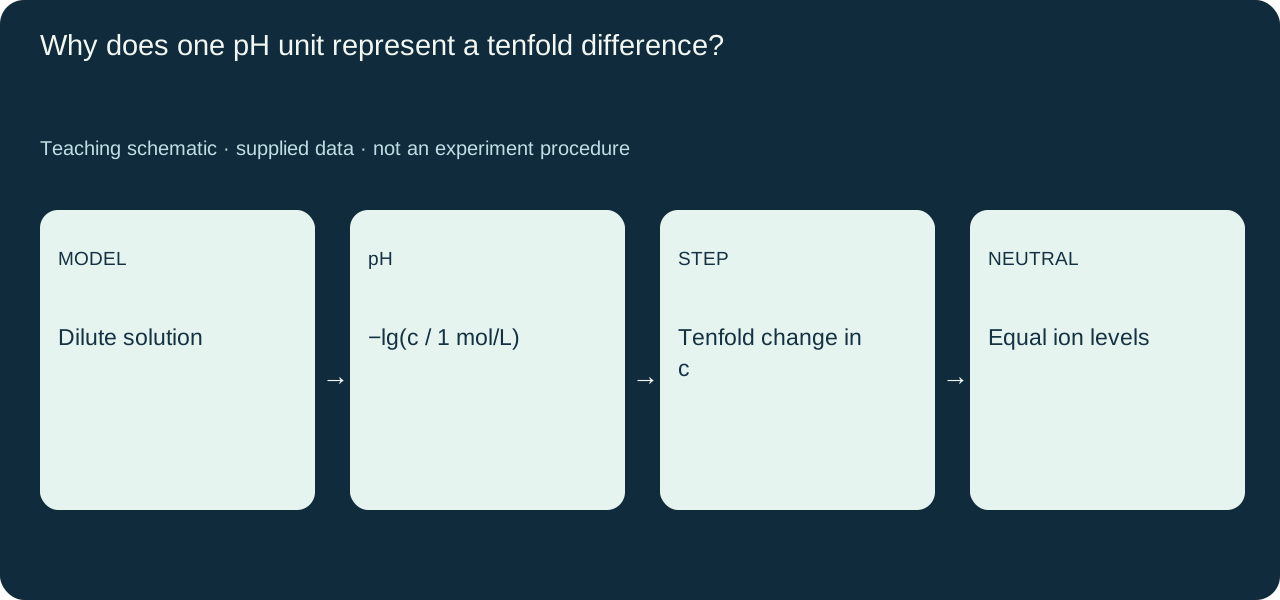
Model diagram
Use paper, a calculator and supplied data only. Do not taste, smell, mix or heat chemicals; do not open household products or unknown containers. Neutral pH does not establish safety. Do not apply teaching neutralisation to skin, eyes, spills or unknown mixtures.
Situation and question
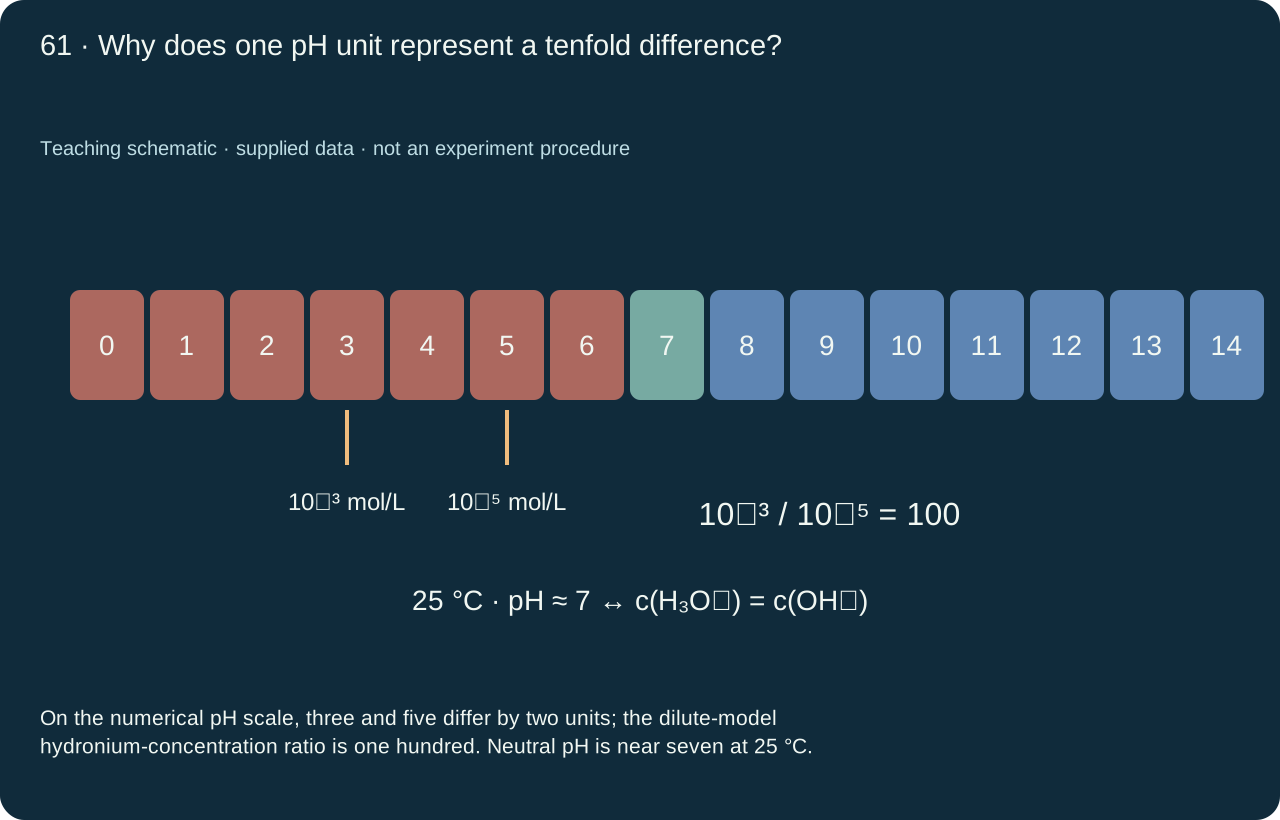
Two solution cards show pH 3 and pH 5. One learner says “twice as much”, another says “one hundred times”. What quantity are they comparing? Do not inspect or measure real solutions: use numerical cards and an aqueous model at 25 °C only.
New terms, fully explained
pH is rigorously related to hydrogen-ion activity. For a sufficiently dilute teaching model, use pH≈−lg(c(H₃O⁺)/(1 mol/L)). The logarithm acts on a dimensionless ratio; pH is dimensionless too. At 25 °C, neutrality means c(H₃O⁺)=c(OH⁻), giving approximately pH 7 in this model.
Predict first
Predict which has more H₃O⁺ per volume: pH 3 or pH 5. The pH numbers differ by two, but how does 10^(−pH) change? Do not infer acid strength from pH alone: composition and concentration both matter. Here compare activity, approximated by concentration.
Investigate or analyse given data
Complete cards at 25 °C for c(H₃O⁺)=10⁻³, 10⁻⁵ and 10⁻⁷ mol/L. Find each pH. In reverse, pH 4 gives 10⁻⁴ mol/L. A one-unit step changes the concentration approximation by a factor of ten, rather than adding a fixed number of ions.
| Object / step | Given / calculation | Conclusion |
|---|---|---|
| 10⁻³ mol/L | −lg(10⁻³) | pH ≈ 3 |
| 10⁻⁵ mol/L | −lg(10⁻⁵) | pH ≈ 5 |
| 10⁻⁷ mol/L; 25 °C | c(H₃O⁺) = c(OH⁻) | pH ≈ 7 |
Worked example
For pH 3 the approximation gives 10⁻³ mol/L; for pH 5 it gives 10⁻⁵. Their ratio is 10⁻³/10⁻⁵=100. The first has one hundred times the hydronium concentration in this model. The neutral point depends on temperature: equal concentrations matter more than memorising one number.
A common mistake
Mistake: treating 0–14 as an absolute limit for every solution, or writing “pH 7 is safe to drink”. Aqueous solutions can lie outside the familiar range; here it is just a convenient scale segment. pH does not determine contaminants, microbes or every hazard. At another temperature, neutral pH may differ from 7.
Transfer to a new case
Transfer case: A has pH 2 and B pH 4 at the same temperature, with the approximation applicable. Find their hydronium-concentration ratio. Card C gives c(H₃O⁺)=10⁻⁹ mol/L at 25 °C. Classify it without claiming to know its complete chemical contents.
Answer and recall
Check: A/B=100, with more hydronium in A; C has approximately pH 9 and is basic at 25 °C. Neither complete composition nor drinking safety follows. Recall the three reference values and explain why the temperature condition belongs in the answer.
Exercise
For pH four and six, what is the hydronium-concentration ratio in this approximation? Is neutrality always pH seven?
Answers
Show the answers
100:1; no. Neutrality means equal hydronium and hydroxide concentrations; neutral pH depends on temperature.
When to revisit
Close the page and, after 10 minutes, reconstruct the map, define the terms in your own words and solve the new case. Repeat without hints after a day and a week. If an error persists, return to the worked example and write down the missing step.
Sources and limits
What does an indicator colour show—and what can it not prove?
If you have found a mistake or a typo in this article, tell us about it
Comments (0)
Log in to leave a comment →
No comments yet. Be the first.