

Chemistry: investigate the world of substances Lesson 31 of 40
The salt case: what do formulas and bonding models prove?
Combine the block into one investigation and distinguish correct calculation from identifying an unknown substance.
Support map
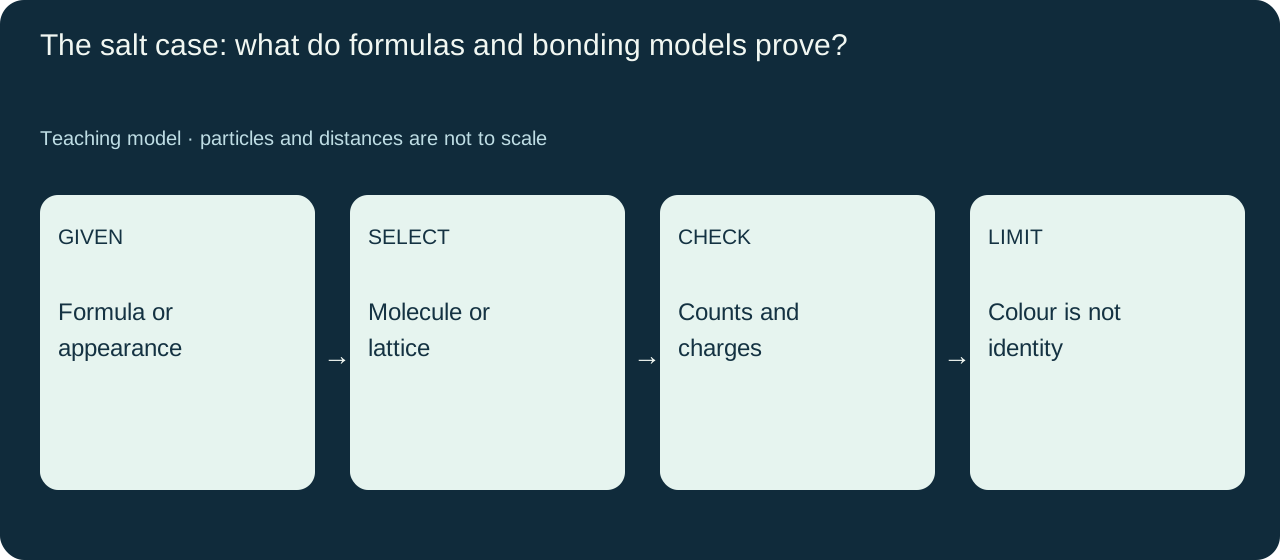
Model diagram
Teaching model · particles and distances are not to scale
Use paper and supplied data only. Do not produce gases, heat substances or use electrical equipment; do not touch, taste or smell unknown substances.
Situation and question
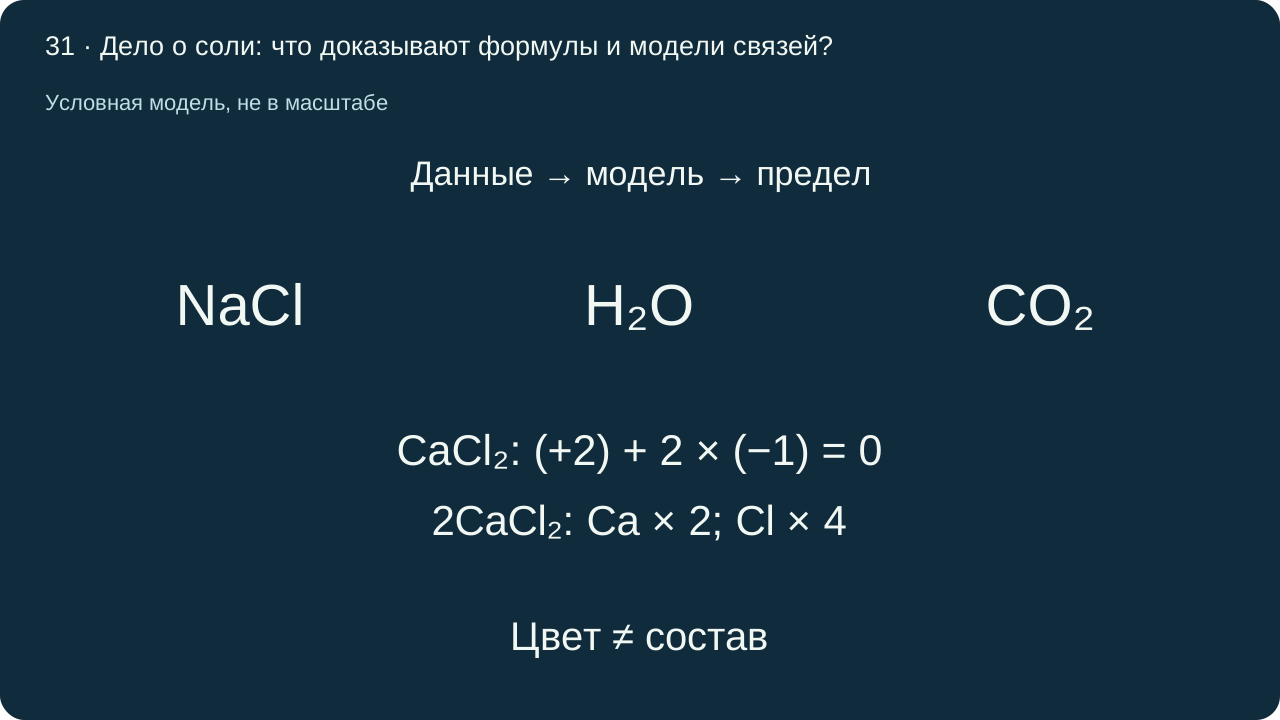
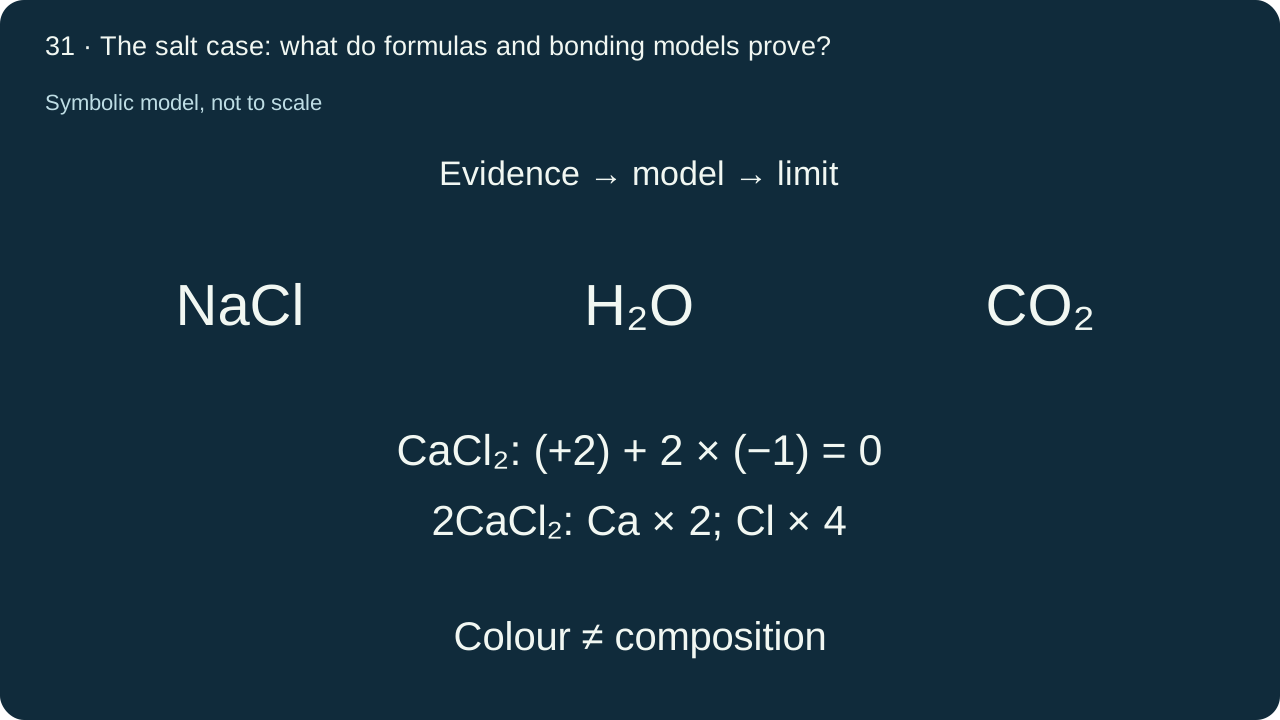
Three labelled cards say A:NaCl, B:H₂O and C:CO₂. A fourth, D, is an unknown white powder. The notebook claims: “D is white, so it is NaCl; CO₂ contains oxygen, so it is polar; H₂O has two H, so its charge is +2.” Identify the different errors without experimenting on the powder.
New terms, fully explained
A model explains selected properties and has limits. Evidence of composition requires suitable sample data; a card’s name is not an analysis of D. Recall molecule versus formula unit, subscript versus coefficient, valency versus charge and bond versus molecular polarity. These distinctions stop correct counting from becoming an unsupported conclusion.
Predict first
Predict which notation calls for a lattice and which for separate molecules. Can white colour establish a formula? Use the specified linear shape for CO₂ rather than its letters alone. Recall water’s bent shape. Give a reason and a condition for each claim.
Investigate or analyse given data
Make four rows A–D with “given evidence”, “model”, “allowed conclusion” and “unknown”. A supplies Na⁺ and Cl⁻ charges; B supplies two single O—H bonds; C supplies two polar C=O bonds in a linear arrangement. D supplies appearance only. Do not touch, taste or smell the unidentified substance.
Worked example
A has a 1:1 ion ratio and zero charge sum; no separate salt molecules are needed. B is a neutral molecule with two H and one O; O’s valency II does not mean an O²⁻ ion. C has cancelling polar bonds and is nonpolar overall. D’s composition and safety cannot be established from white colour.
A common mistake
Mistake: treating one correct observation as a complete investigation. Even a correctly supplied A formula proves nothing about D. Conductivity and melting temperature also depend on conditions. Ionic or covalent structure alone never authorises contact with a substance. Every task in this block can be solved using paper and given data.
Transfer to a new case
Final transfer: use Ca²⁺ and Cl⁻ to build a formula; count atoms in 2CaCl₂; compare H₂O₂ with 2H₂O; state the energy requirement of bond breaking. Pose a question for the next block: how can we record a transformation while preserving the number of each element’s atoms?
Answer and recall
Check: CaCl₂;2 Ca and 4 Cl. H₂O₂ is one molecule containing 2:2 atoms; 2H₂O is two molecules totalling 4 H and 2 O. Breaking a bond requires energy. Assess five skills separately: identifying particles, balancing charge, reading formulas, explaining properties and limiting claims. Retry new cases tomorrow and a week later; the next block begins with evidence and notation for reactions.
Exercise
- What can white colour alone tell us about D?
- What formula combines Ca²⁺ and Cl⁻?
- How many Ca and Cl atoms are in 3CaCl₂?
- Does a polar bond guarantee molecular polarity?
Answers
Show the answers
Appearance only, not composition; CaCl₂;3 Ca and 6 Cl; no, shape matters. Assess each answer separately and correct the reason for any error.
Investigator’s notebook
Record your first answer before reading the explanation. For each error, identify the step: particle model, electron count, charge balance, brackets or limits of inference. Correct the explanation, invent a new example and solve it without hints.
When to revisit
Close the page and, after 10 minutes, reconstruct the map, define the terms in your own words and solve the new case. Repeat without hints after a day and a week. If an error persists, return to the worked example and write down the missing step.
Sources and limits
If you have found a mistake or a typo in this article, tell us about it
Comments (0)
Log in to leave a comment →
No comments yet. Be the first.