

Chemistry: investigate the world of substances Lesson 25 of 40
Why is an ionic crystal not made of NaCl molecules?
Separate ion formation, attraction and the ratio in an extended lattice.
Support map
Model diagram
Teaching model · particles and distances are not to scale
Use paper and supplied data only. Do not produce gases, heat substances or use electrical equipment; do not touch, taste or smell unknown substances.
Situation and question
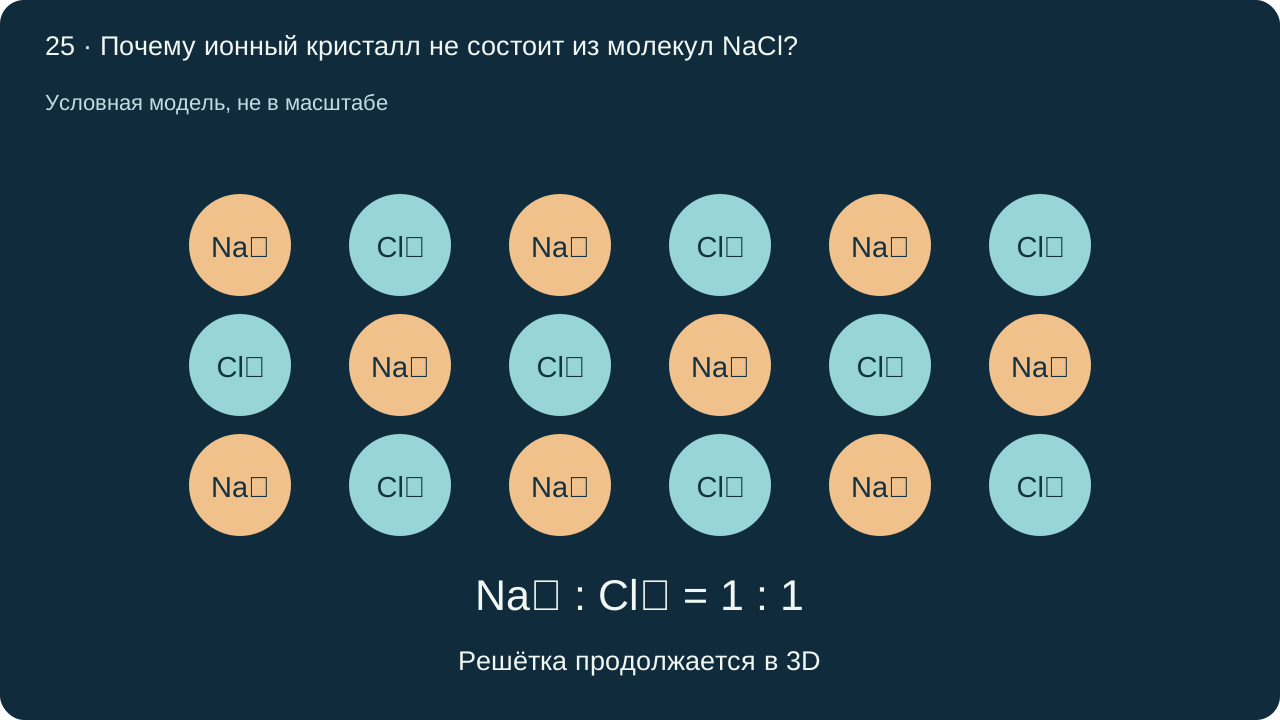
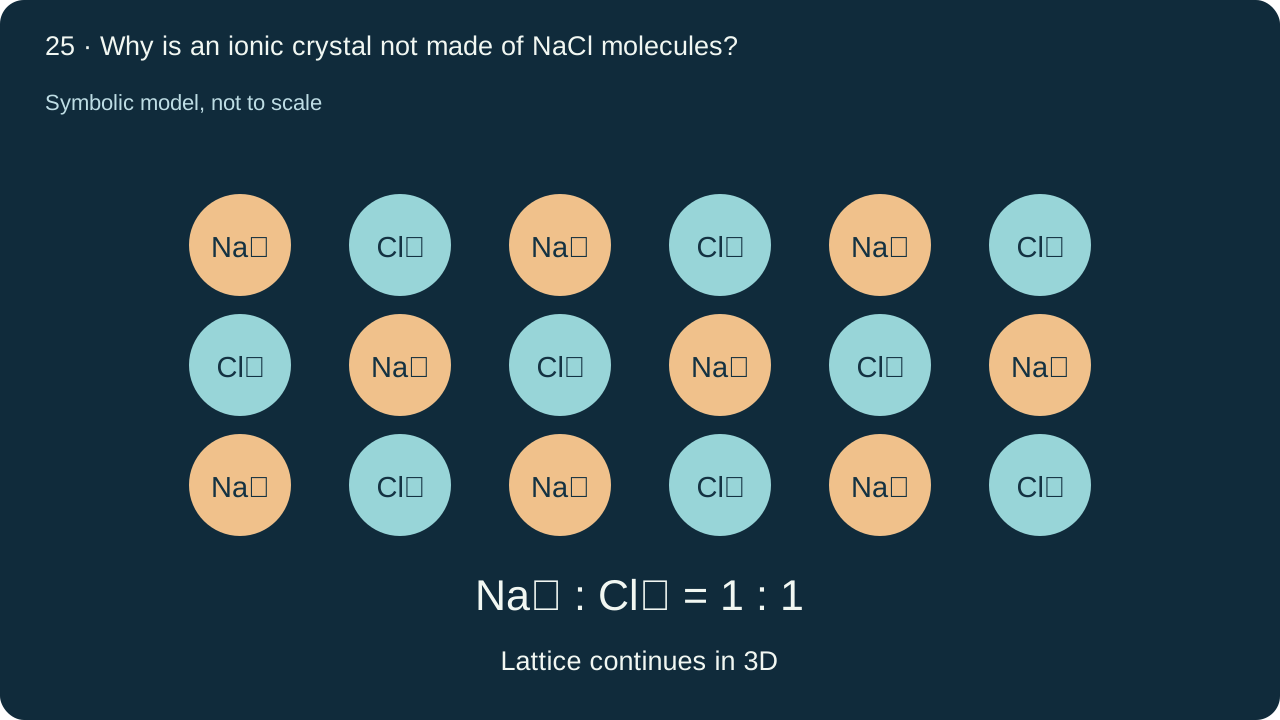
In lesson 22 you balanced Na⁺ and Cl⁻ charges. Does a salt grain therefore contain individual pairs isolated from their neighbours? Imagine a checkerboard pattern continuing beyond the paper. It illustrates repetition, but a real crystal is three-dimensional rather than flat.
New terms, fully explained
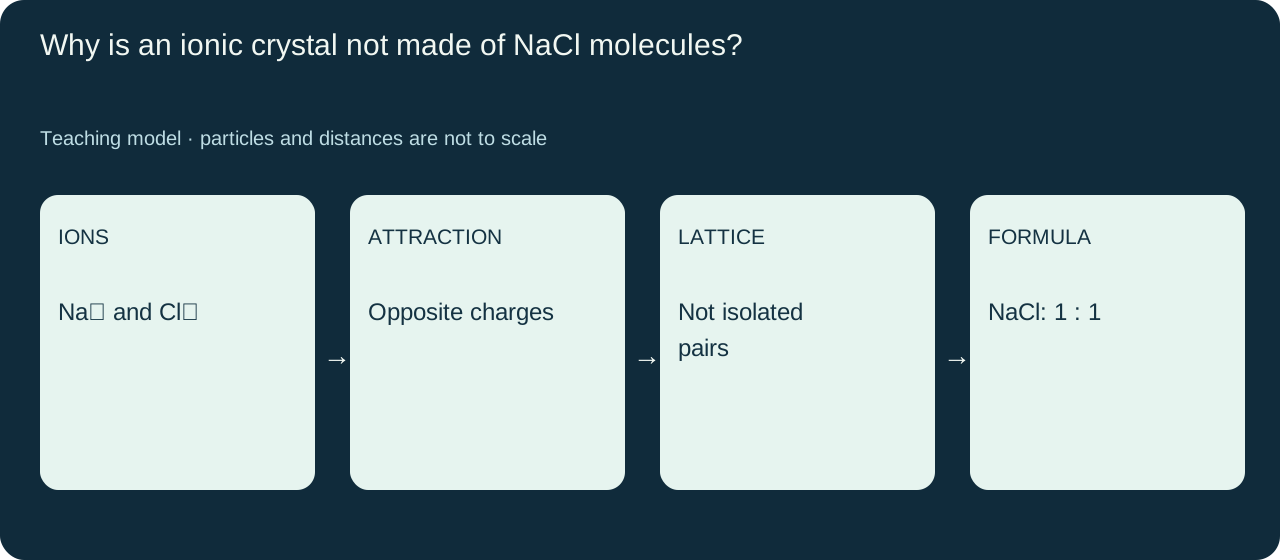
A cation has positive charge and an anion has negative charge. Ionic bonding involves electrostatic attraction between oppositely charged ions. An ionic lattice is their repeating arrangement in a crystal. A formula unit gives the simplest whole-number ratio of ions: 1:1 for NaCl. It does not denote a separate molecule within the crystal.
Predict first
Predict whether the proton count of Na changes when Na⁺ forms. How many electrons does Cl⁻ have if Z=17? Must each Na⁺ interact with only one Cl⁻? Do not confuse the charge bookkeeping used for a formula with all interactions in space.
Investigate or analyse given data
Use Na:11p,11e and Cl:17p,17e to write a paper model of one electron transferring. Then draw alternating + and − signs in three rows. Do not react sodium with chlorine or produce gases. The flat drawing shows a fragment, not the full coordination environment.
Worked example
After transfer, Na⁺ has 11p and 10e; Cl⁻ has 17p and 18e. The total remains 28 electrons and 28 protons. Charges +1 and −1 sum to zero in a 1:1 ratio. Attraction operates throughout the crystal. Electron transfer is useful bookkeeping, but this step alone does not explain the entire energy balance of salt formation.
A common mistake
Mistake: drawing separate NaCl molecules or claiming salt retains chlorine’s hazardous properties. Ions and elemental substances have different properties. That does not make an unidentified white powder safe: appearance cannot establish composition. Do not treat model colours as real colours or alter ion sizes to do the counting.
Transfer to a new case
A new condition specifies Mg²⁺ and O²⁻ in a neutral compound. Find the simplest ratio. Explain why Mg₂O₂ can be reduced to MgO when expressing an ion ratio, while the molecular formula H₂O₂ cannot arbitrarily be shortened to HO.
Answer and recall
Check: 1:1, MgO; the total charge is +2−2=0. An ionic formula gives the simplest ratio; molecular H₂O₂ gives the actual atom count in one molecule. Reconstruct ion formation, attraction, lattice and formula unit from memory. Limit: these drawings have not identified an unknown sample.
Exercise
- How many electrons are in Na⁺ if Z=11?
- Is NaCl a separate molecule in its crystal?
- What is the simplest neutral ratio of Mg²⁺ to O²⁻?
Answers
Show the answers
10; no;1:1. Proton counts remain unchanged. A formula unit gives a lattice ratio.
Investigator’s notebook
Record your first answer before reading the explanation. For each error, identify the step: particle model, electron count, charge balance, brackets or limits of inference. Correct the explanation, invent a new example and solve it without hints.
When to revisit
Close the page and, after 10 minutes, reconstruct the map, define the terms in your own words and solve the new case. Repeat without hints after a day and a week. If an error persists, return to the worked example and write down the missing step.
Sources and limits
If you have found a mistake or a typo in this article, tell us about it
Comments (0)
Log in to leave a comment →
No comments yet. Be the first.