

Chemistry: investigate the world of substances Lesson 10 of 13
Why can two carbon atoms have different masses?
See how isotopes differ in neutron count while sharing an atomic number.
Support map
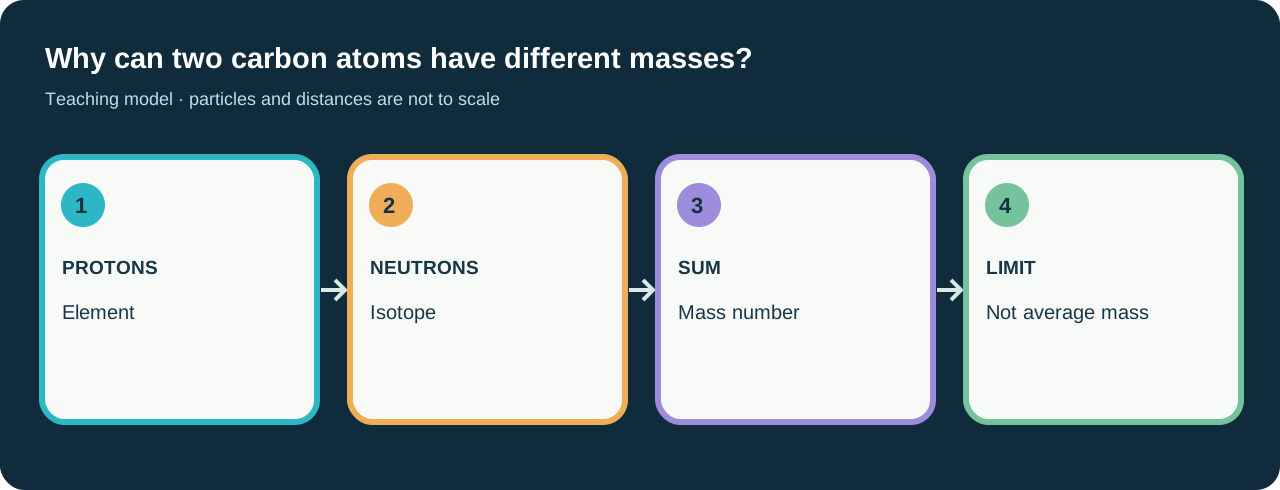
Teaching model · particles and distances are not to scale
Situation and question
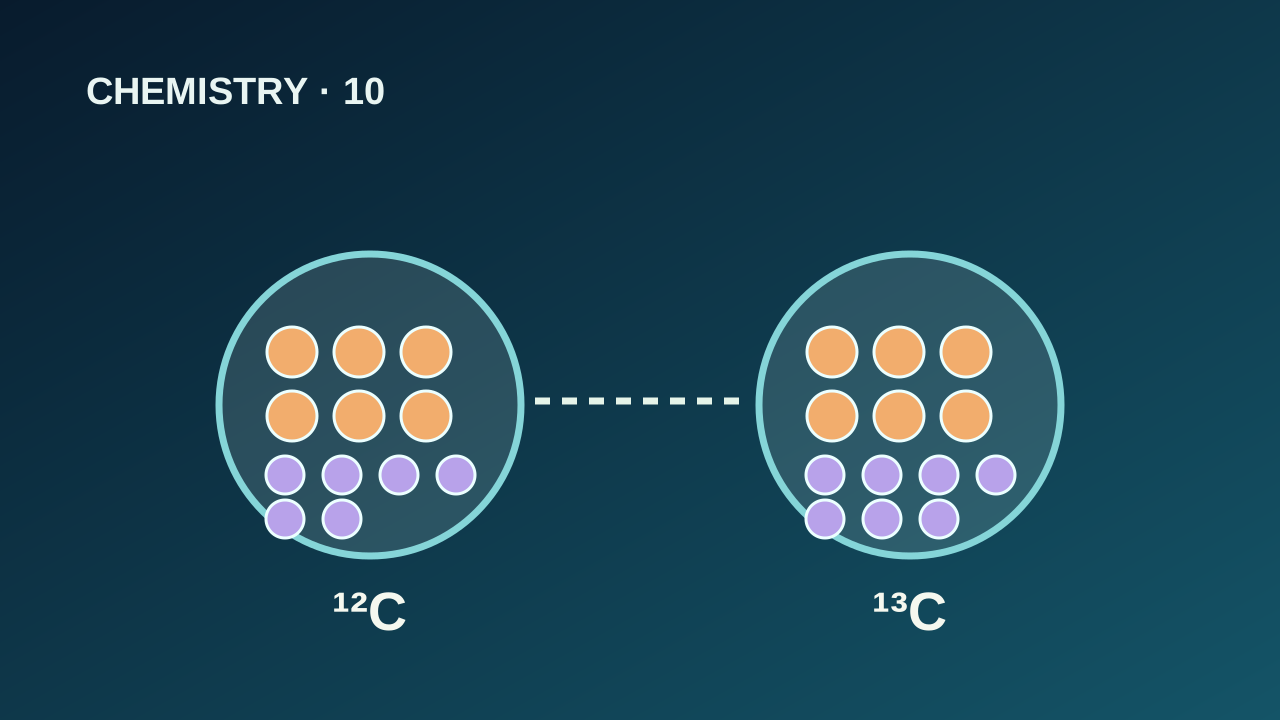
Two cards both say C. One lists six protons and six neutrons; the other six protons and seven neutrons. Does the same symbol mean the same mass?
New terms, fully explained
Isotopes are atoms of one element with the same proton count but different neutron counts. Mass number is the sum of protons and neutrons in an individual atom; do not confuse it with average atomic mass in a table. Carbon with six protons and six neutrons has mass number 12; with seven neutrons, 13. Electrons are not part of this sum. Some isotopes have unstable nuclei; radioactivity cannot be inferred from the letter C alone.
Predict first
Predict the mass number for an atom with eight protons and ten neutrons. Another has eight protons and eight neutrons: a new element or a different isotope?
Investigate or analyse given data
Sort paper records: P, 6p and 6n; Q, 6p and 7n; R, 8p and 8n; S, 8p and 10n. Give the atomic and mass numbers of each. This is a data exercise, not an isotope experiment; seek or handle no samples.
Worked example
P and Q are carbon with mass numbers 12 and 13. R and S are oxygen with mass numbers 16 and 18. P and Q share six protons and therefore an element; Q and R differ in proton count and element.
A common mistake
Mistake: treating the average atomic mass in a periodic table as every atom’s mass number. An average depends on isotope proportions in a specified sample and may not be an integer. Neutron count alone does not determine the symbol.
Transfer to a new case
Imagine two neutral atoms each with one proton: one has no neutron, the other has one. Give their element and mass numbers. Can these counts tell how common each is in nature?
Answer and recall
Check: both are hydrogen isotopes with mass numbers one and two. Abundance requires measurements of samples. Rebuild from memory: ‘protons → element; protons + neutrons → mass number’, then solve a fresh card.
Knowledge check
- Mass numbers for 6p+6n and 6p+7n?
- Does the element change?
Answers: 12 and 13; no, both are carbon.
When to revisit
Close the page and, after 10 minutes, reconstruct the map, define the terms in your own words and solve the new case. Repeat without hints after a day and a week. If an error persists, return to the worked example and write down the missing step.
If you have found a mistake or a typo in this article, tell us about it
Comments (0)
Log in to leave a comment →
No comments yet. Be the first.