

Chemistry: investigate the world of substances Lesson 11 of 13
Is every substance made of molecules?
Compare water and table salt without inventing separate NaCl molecules in an ionic crystal.
Support map
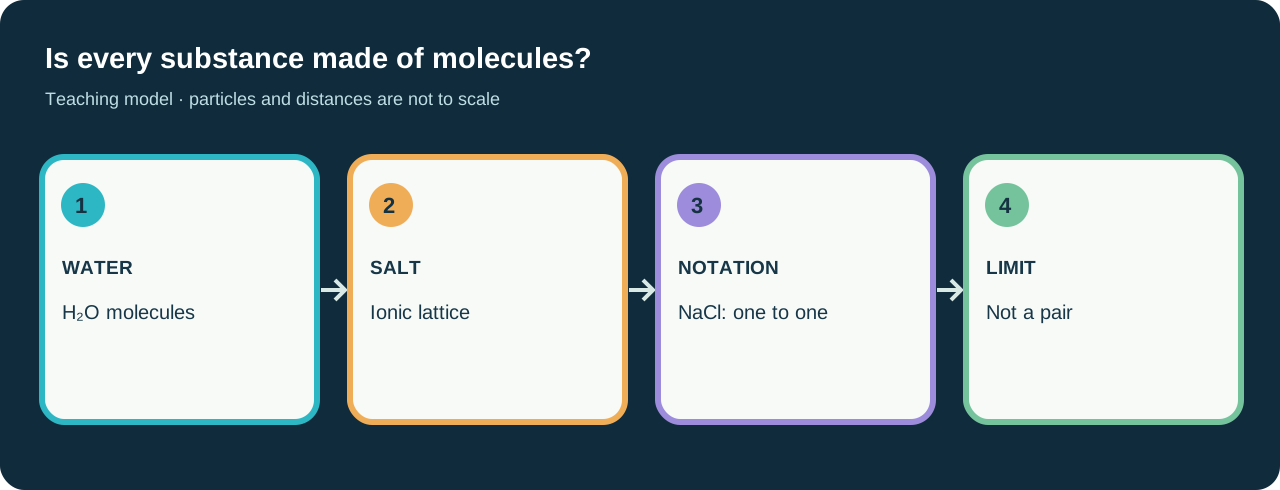
Teaching model · particles and distances are not to scale
Situation and question
Water is written H₂O and salt NaCl. Do both formulas mean the same kind of separate ‘atom packets’?
New terms, fully explained
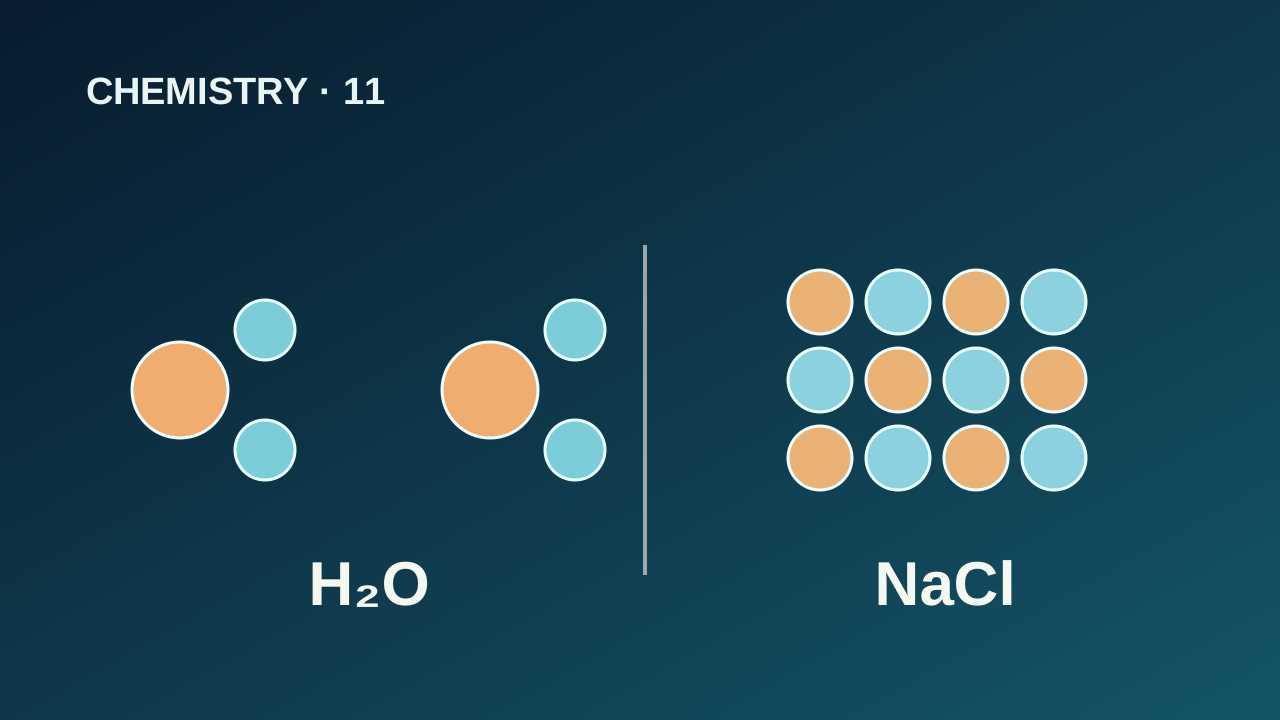
A molecule is an electrically neutral group of bonded atoms that can be considered a distinct particle; water molecules contain two hydrogen atoms and one oxygen atom. An ion carries charge. Solid sodium chloride is an ordered lattice of positive sodium ions, Na⁺, and negative chloride ions, Cl⁻. NaCl gives their 1:1 ratio as a formula unit of the crystal; it is not a separate salt molecule. Dissolved salt is represented by ions dispersed in water.
Predict first
Predict whether a single Na⁺ can be a neutral molecule. What do the subscript ₂ in H₂O and the missing subscripts in NaCl signify?
Investigate or analyse given data
Use paper circles to build separate groups of two H and one O; then make a repeating pattern alternating Na⁺ and Cl⁻. Do not label a single square in the pattern a ‘real molecule’. These are symbolic, unscaled models, not explanations of every bonding force.
Worked example
Three H₂O groups stand for three water molecules, six H and three O atoms in all. Three NaCl formula units correspond to three Na⁺ and three Cl⁻ in the lattice. Dissolving the crystal distributes ions in water; NaCl does not turn into H₂O.
A common mistake
Mistake: calling every substance molecular and drawing isolated NaCl pairs inside its crystal. Other substances have atomic or metallic structures; we will return to them later. Ball models do not reproduce electron-cloud shapes.
Transfer to a new case
Sugar and salt can both disappear from view in water. Does transparency prove they produce the same kind of dissolved particles? What composition evidence would help?
Answer and recall
Check: transparency does not identify particles; evidence about the substances and a measurement method is needed. From memory label ‘H₂O: distinct molecule’ and ‘NaCl: ion ratio in a crystal’.
Knowledge check
- Is there a separate NaCl molecule in an ordinary crystal?
- What does H₂O mean?
Answers: No, NaCl is an ion ratio; a water molecule has two H and one O.
When to revisit
Close the page and, after 10 minutes, reconstruct the map, define the terms in your own words and solve the new case. Repeat without hints after a day and a week. If an error persists, return to the worked example and write down the missing step.
If you have found a mistake or a typo in this article, tell us about it
Comments (0)
Log in to leave a comment →
No comments yet. Be the first.