

Chemistry: investigate the world of substances Lesson 13 of 13
The salt case: what can the particle model now explain?
Bring the block into one investigation and test which claims the evidence really supports.
Support map
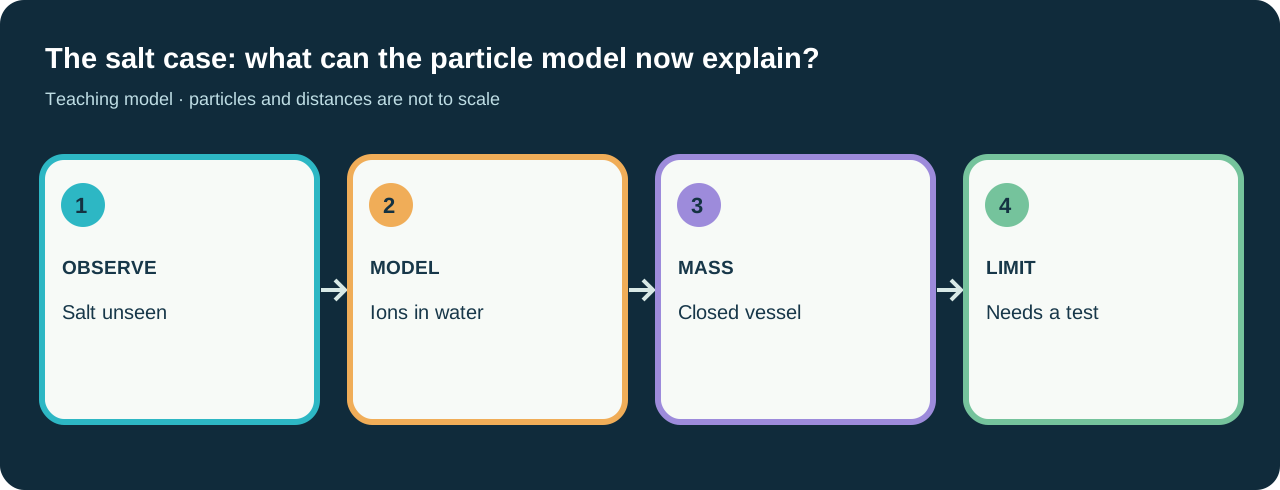
Teaching model · particles and distances are not to scale
Situation and question
Return to our first question: salt crystals are no longer visible after dissolving. Which claims can we now justify, and what remains untested?
New terms, fully explained
Keep three levels of description separate: observation (grains disappear from view), model (Na⁺ and Cl⁻ ions spread among water molecules), and chemical notation (H₂O and NaCl). A model is not a photograph. Conservation of matter in dissolving means atoms do not appear from nowhere or vanish; in an actual investigation, mass is checked by weighing a closed vessel. An open vessel can exchange matter with its surroundings.
Predict first
Predict the scale reading before and after five grams of salt fully dissolve in 100 grams of water inside a closed vessel, if the empty vessel weighs 50 grams. What exactly is weighed?
Investigate or analyse given data
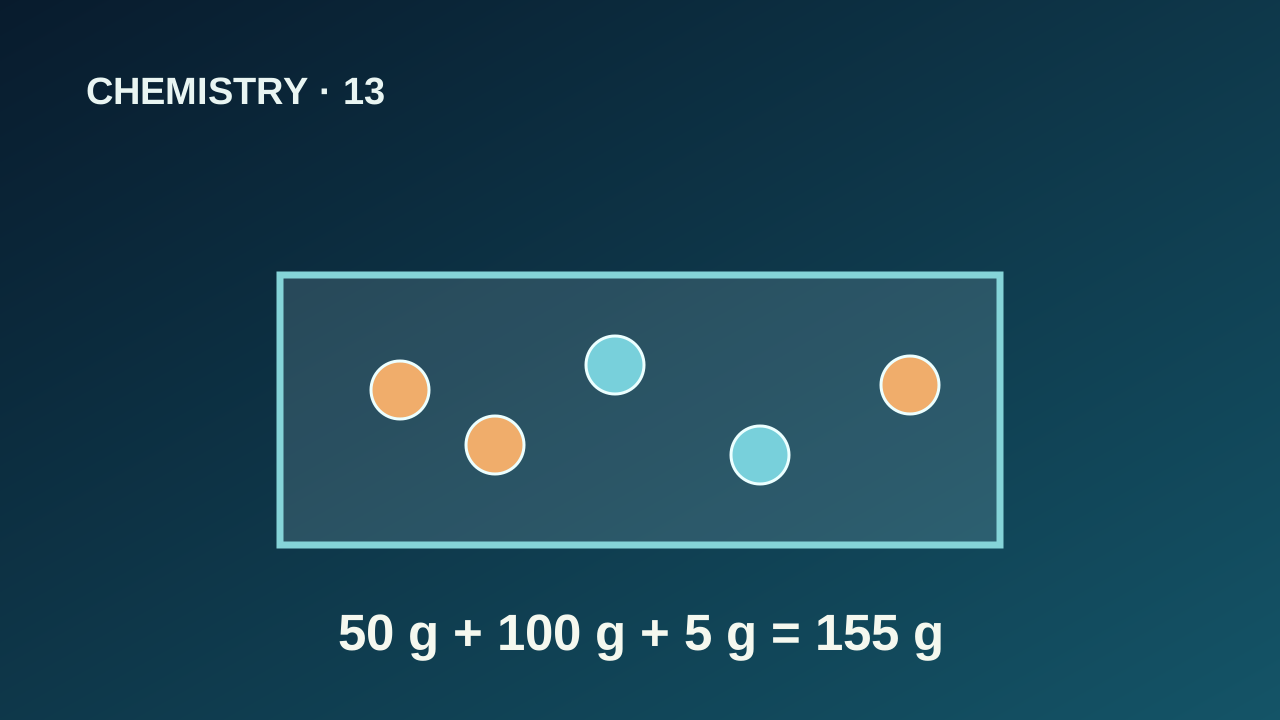
Data: empty vessel, 50 g; water, 100 g; salt, 5 g. The vessel stays closed, with no spill or addition. Make a table for ‘before’, ‘after’, ‘observation’ and ‘model’. This is a calculation; no tasting or hands-on experiment is required.
Worked example
Before, the total is 155 g; after, 155 g is expected because the scale includes vessel and all contents. Clarity alone does not prove that reading. In the model, ions formerly in a crystal spread out, while water molecules remain water. Ordinary paper filtration will not separate dissolved ions from water.
A common mistake
Mistake: ’the crystal vanished, so mass fell’ or ‘separate NaCl molecules float in the solution’. Do not infer an unknown solution’s composition from a calculated mass alone. Measurement precision and a closed vessel are conditions of the test.
Transfer to a new case
New case: 80 g of water and 10 g of sugar in a closed vessel weighing 40 g. Give the expected total, distinguish observation from model, and explain why sugar particles cannot simply be replaced with Na⁺ and Cl⁻ ions.
Answer and recall
Check: expect 130 g. Sugar and salt particles have different compositions; transparency does not identify them. From memory rebuild lessons 6–13: state → motion → element → charge → isotope → molecule/ion → formula → model test. Repeat the case after a week.
Knowledge check
- Closed-system mass of 50+100+5 g?
- Does clarity establish composition?
Answers: 155 g; no.
When to revisit
Close the page and, after 10 minutes, reconstruct the map, define the terms in your own words and solve the new case. Repeat without hints after a day and a week. If an error persists, return to the worked example and write down the missing step.
If you have found a mistake or a typo in this article, tell us about it
Comments (0)
Log in to leave a comment →
No comments yet. Be the first.