

Chemistry: investigate the world of substances Lesson 7 of 13
How does colour spread without stirring?
Use diffusion data to separate visible mixing from invisible particle motion.
Support map
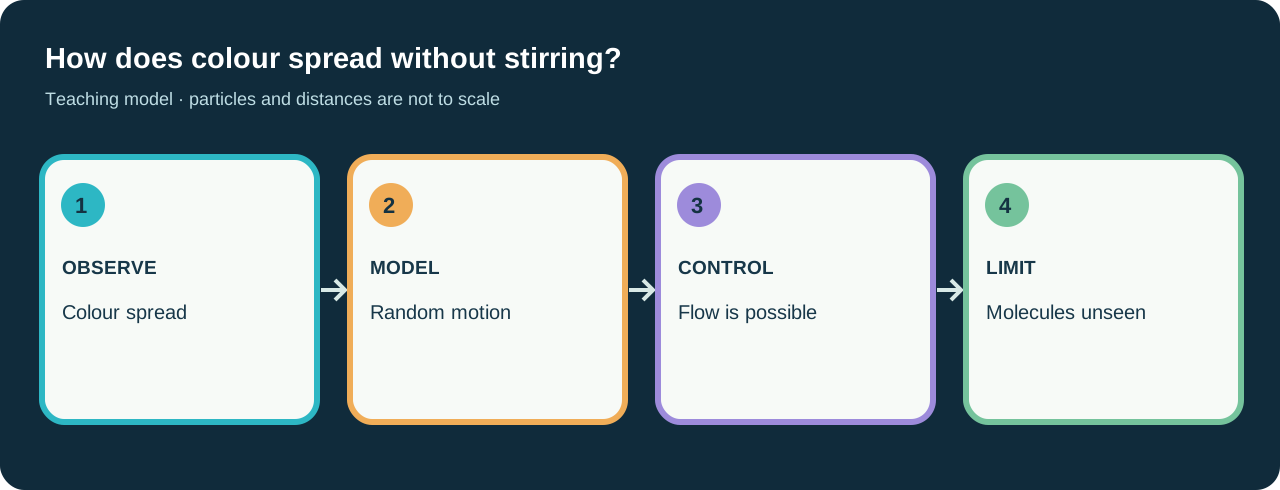
Teaching model · particles and distances are not to scale
Situation and question
In a video, a drop of food colouring gradually colours still water. The colour changes even without a spoon. Does water somehow ‘stir itself’?
New terms, fully explained
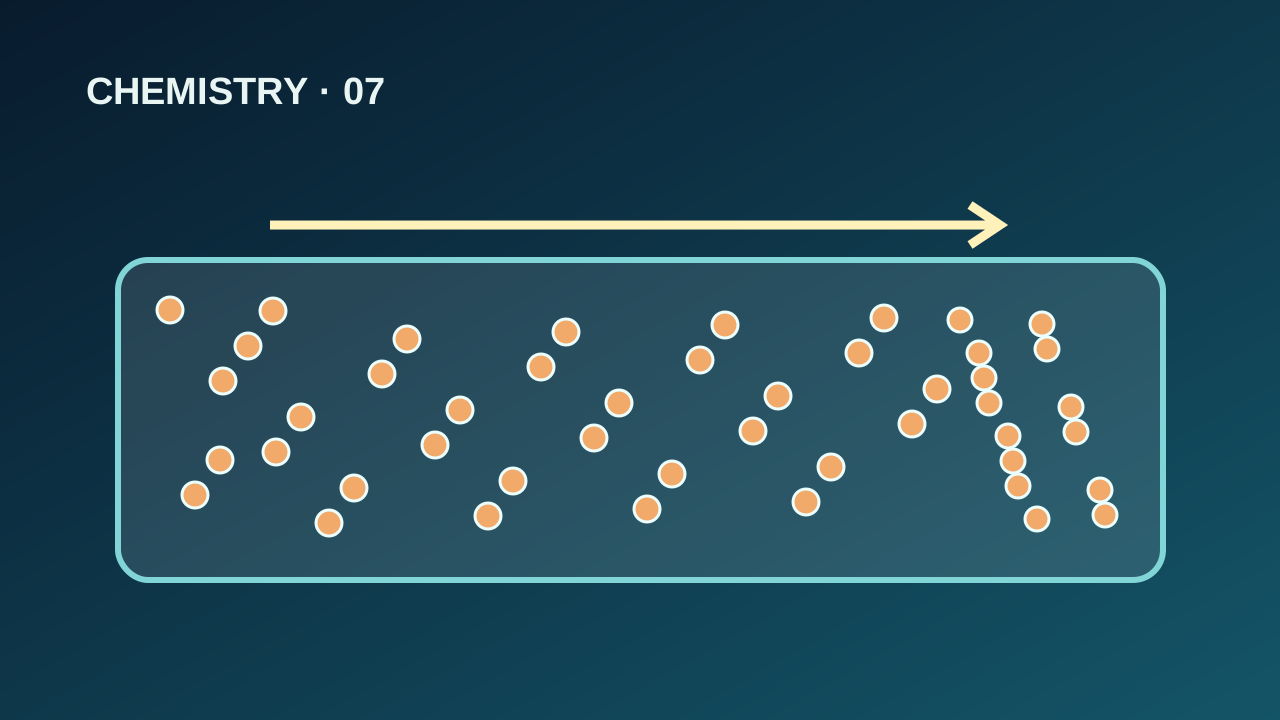
Diffusion is spreading caused by random particle motion; in liquids it is usually slower than transport by bulk flow. Concentration describes how much of a selected substance is in a given volume of mixture. On average, particles spread from higher to lower concentration, although individual particles move in every direction. A visible colour boundary is not a boundary between individual molecules.
Predict first
Predict whether colour will be stronger near the drop or at the opposite wall one minute later. How could flow created while pouring change the answer?
Investigate or analyse given data
Analyse these model data only: just after addition, the bright region fills 1/10 of the glass; after ten minutes, 6/10; after an hour, colour is nearly uniform. This is not an instruction to use dye. No individual molecules were measured, and the water may not have been perfectly still.
Worked example
Observation: the visible coloured region expanded. Explanation: dye particles spread as they move, and possible water currents speed up the process. To isolate diffusion, compare matched containers, temperature and drop placement while controlling liquid flow.
A common mistake
Mistake: every particle heads deliberately from a ‘crowded’ region to an ’empty’ one. Motion is random; net spreading is statistical. Colour does not prove that a solution is safe or perfectly uniform at molecular scale.
Transfer to a new case
Two gases mix over time in a closed vessel. How is this like dye in water, and how may their rates differ? Do not smell unknown substances or open vessels for this activity.
Answer and recall
Check: particle motion explains both, and spreading is generally faster in gases. Make two notebook columns, ‘seen’ and ‘model’. State which extra data could distinguish diffusion from mixing by flow.
Knowledge check
- What is visible in the dye case?
- Does every particle move one way?
Answers: The coloured region expands; no, individual motion is random.
When to revisit
Close the page and, after 10 minutes, reconstruct the map, define the terms in your own words and solve the new case. Repeat without hints after a day and a week. If an error persists, return to the worked example and write down the missing step.
If you have found a mistake or a typo in this article, tell us about it
Comments (0)
Log in to leave a comment →
No comments yet. Be the first.