

Chemistry: investigate the world of substances Lesson 2 of 5
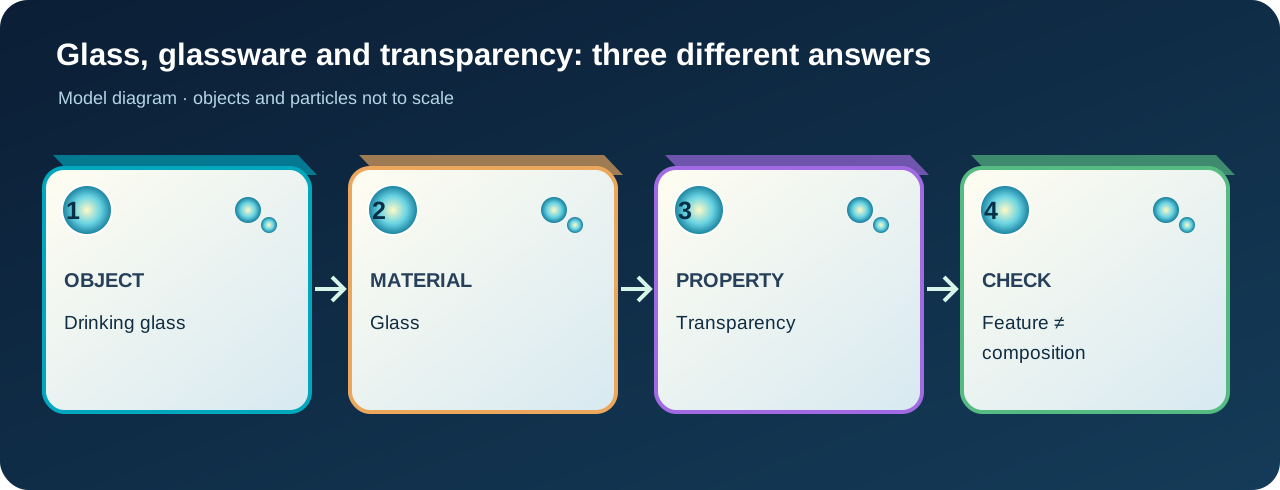
Glass, glassware and transparency: three different answers
Distinguish an object, its material and a property so a thing is not confused with a feature.
Support map
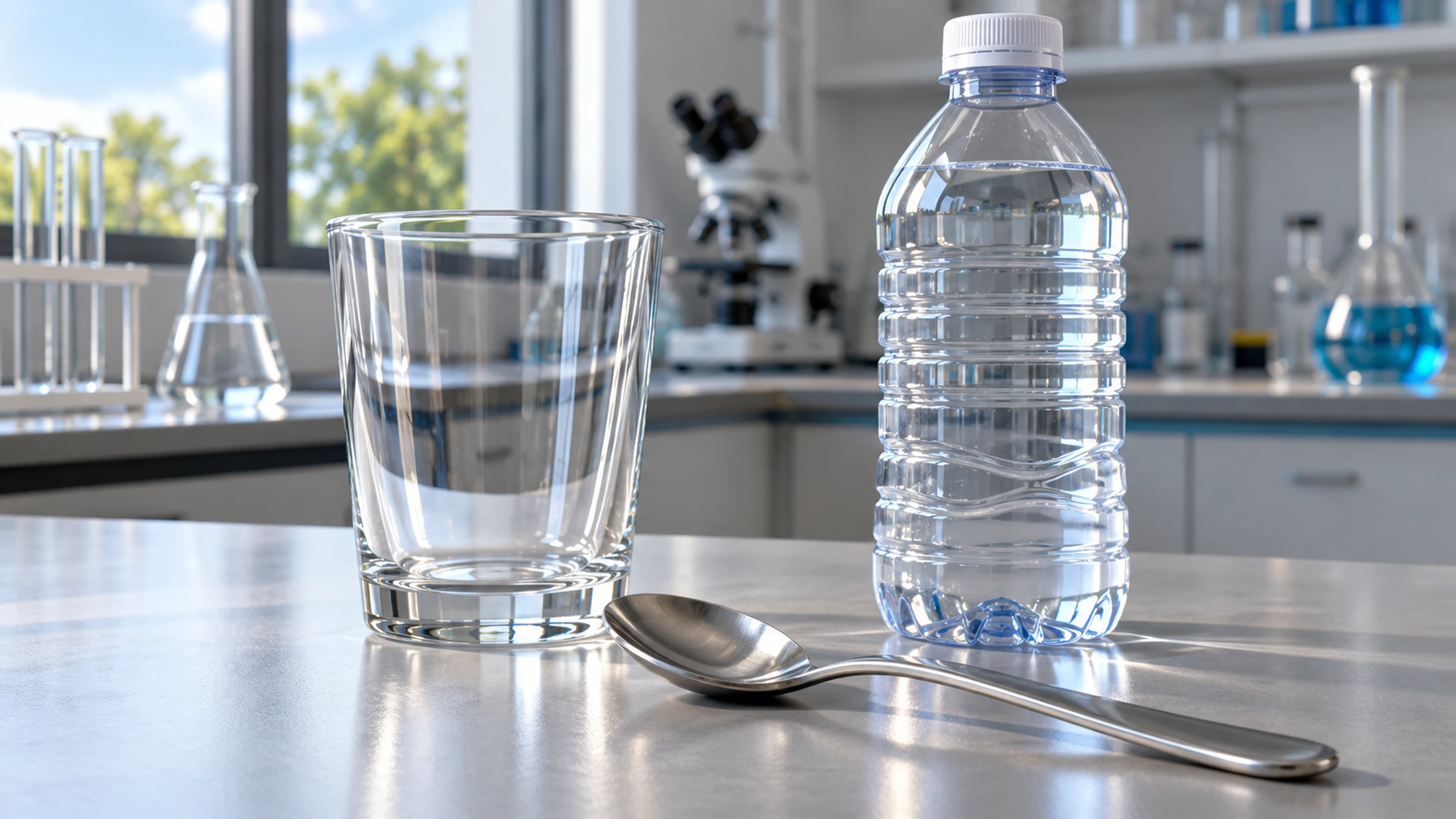
A glass, metal spoon and plastic bottle: compare object, material and property.
Situation and question
Ask ‘What is this drinking glass made of?’ and hear ‘glass’. Ask ‘What is it like?’ and hear ’transparent’. One scene has produced three kinds of words.
New terms, fully explained
An object is an individual thing with shape and purpose: a glass, spoon or paper filter. A material is what an object is made from: glass, metal or paper. A substance is a kind of matter with a defined composition and properties; later we will distinguish individual substances from mixtures. Ordinary glass is usually a material containing several substances, not one pure substance. A property is a feature testable under stated conditions: transparency, colour or solubility. ‘Transparent’ is a property; ‘glass’ is a material.
Matter is anything that occupies space and has mass. Composition tells which substances are present and how much of each. Solubility describes whether a substance can distribute in a chosen solvent under stated conditions; different substances behave differently. One property alone cannot identify a material.
Predict first
Before reading the example, classify these: steel spoon; steel; shine; water in a glass. Why is ‘water’ not the name of an object?
Investigate or analyse given data
Make a card for one safe object: its name, material, two observable properties and how to check them by sight or by touching a dry outside surface. You may write that glass is fragile, but do not break it. Never test a liquid by taste or smell.
Worked example
The spoon is an object, steel is its material, and its surface shining in the light is an observation. ‘Shine’ names a visible property. A plastic spoon remains a spoon while the material changes, and it may still shine. That is why the three layers matter.
A common mistake
Mistake: treating glass as one pure substance with a single formula. Ordinary glass has several components. Another mistake is saying ‘shiny, so it must be metal’; other materials can shine too.
Transfer to a new case
For a clear plastic bottle, name the object, material and property. Why cannot transparency alone prove that it is glass? What further safe check would help?
Answer and recall
Check: bottle is the object, plastic the material and transparency the property. Glass and some plastics are transparent; one feature cannot distinguish them. Draw ‘object → material → property’ from memory and explain a new example. Try again on an unfamiliar object in a week.
Investigator’s table
| Stage | Record | This does not yet prove |
|---|---|---|
| Before | Prediction and matched conditions | That the prediction is right |
| During | Only what was seen or measured | A cause without a test |
| After | A claim with a limit and a new question | Complete purity or safety |
When to revisit
Close the page and, after 10 minutes, reconstruct the map, define the terms in your own words and solve the new case. Repeat without hints after a day and a week. If an error persists, return to the worked example and write down the missing step.
If you have found a mistake or a typo in this article, tell us about it
Comments (0)
Log in to leave a comment →
No comments yet. Be the first.