

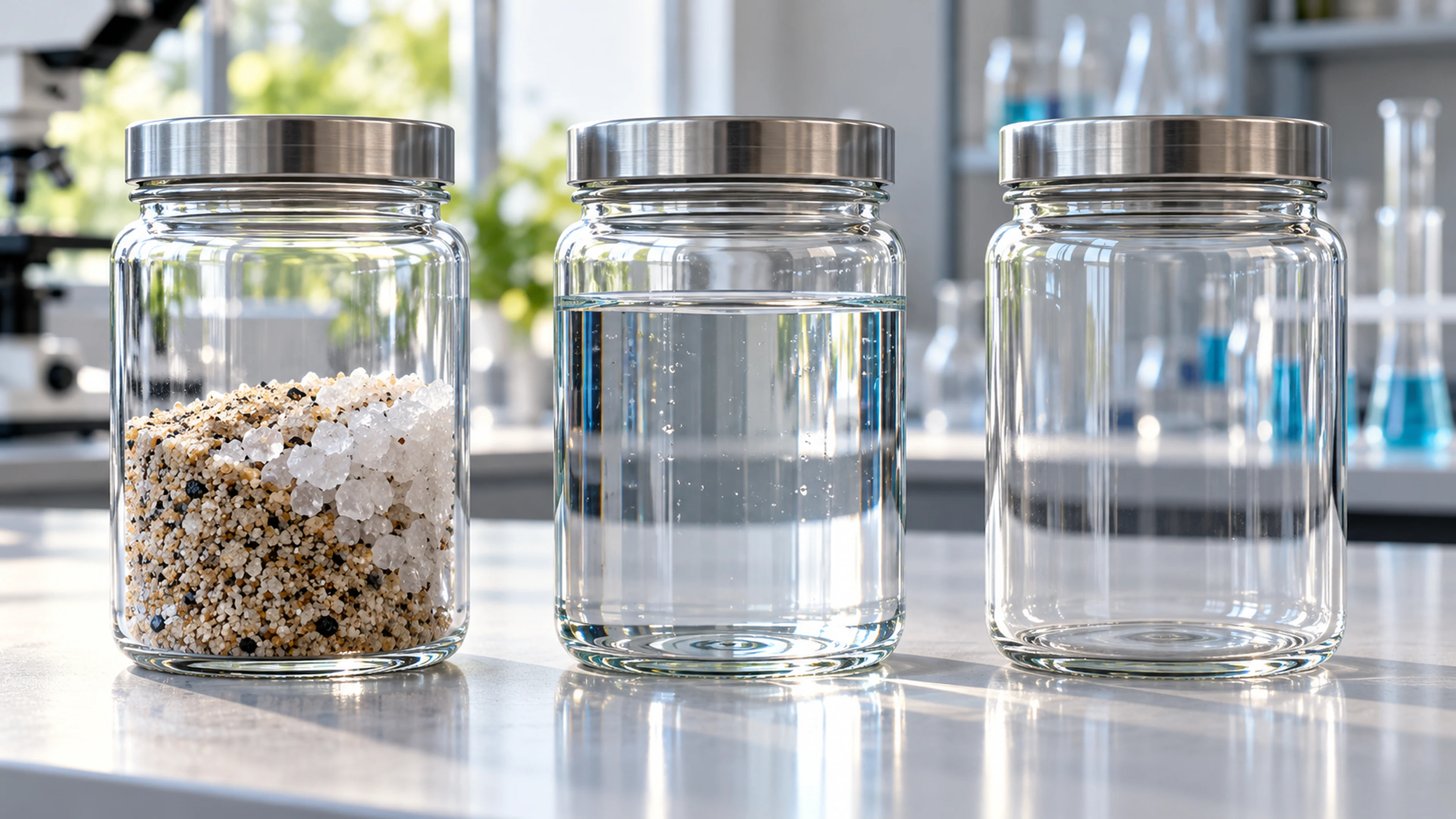
Chemistry: investigate the world of substances Lesson 3 of 5
Tap water, air and salt: which is a mixture?
Discover why a clear, uniform-looking material may contain several substances.
Support map
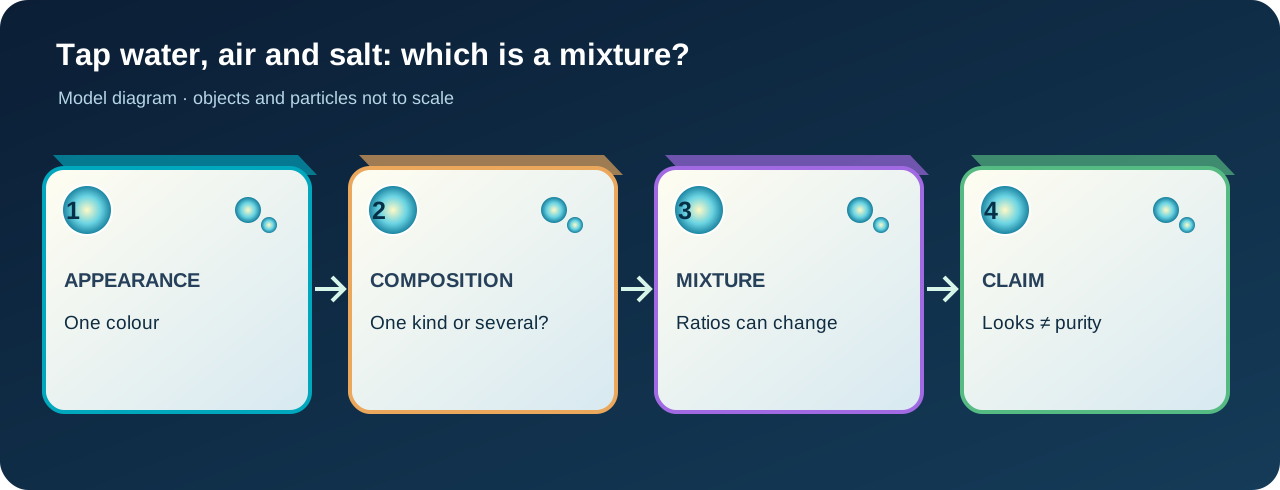
Mixture and clear-water samples: appearance does not establish composition.
Situation and question
The air above a table appears uniform. Tap water is clear. Yet both can contain several components. Appearance alone does not reveal a complete composition.
New terms, fully explained
In our school model, a pure substance contains one chemical kind of particle and has a characteristic composition; a real sample with impurities is no longer strictly pure. A mixture is a physical combination of two or more substances whose proportions may vary. A component is one constituent. A homogeneous mixture looks the same in sufficiently large portions; a heterogeneous mixture has visibly different parts or phases. Here a ‘phase’ is a region of uniform observable state and composition. Looking uniform does not prove purity.
H₂O is shorthand for water; we will explain the formula in full after introducing atoms. Distilled water is water obtained by evaporating water and turning its vapour back into liquid; this reduces many impurities, but a label alone does not prove any sample is absolutely pure. A phase is a region of roughly uniform state and composition.
Predict first
Before the hint, classify a sealed sample of distilled water, room air, dry sand and tap water. Where is appearance insufficient for a final judgement? Why is one colour of sand not proof of one pure substance?
Investigate or analyse given data
List possible components without tasting or smelling. Air is mainly nitrogen and oxygen, with argon, water vapour and other gases. Tap water contains water and dissolved substances, in varying amounts. Sand may contain minerals of different composition. Mark which statements rely on known information and which need analysis of the particular sample.
Worked example
Salt and sand in a bowl form an obviously heterogeneous mixture: different grains are visible. When table salt dissolves completely in water, the result is a homogeneous solution. Salt remains a component even though we cannot see it. ‘No visible boundary’ does not mean ‘one substance’.
A common mistake
Mistake: ‘Clear tap water is pure H₂O.’ Clarity does not rule out dissolved salts. Another mistake is confusing ‘safe to drink’ in everyday speech with ‘chemically pure’; these answer different questions.
Transfer to a new case
An unlabelled closed bottle contains a colourless liquid. Can you identify it as pure water? Plan a safe way to gather information without opening, heating or tasting it. What conclusions remain impossible?
Answer and recall
Check: no; appearance cannot establish composition. You may investigate its origin and label, but without reliable evidence cannot call it water or safe. From memory draw ‘composition → one kind or several → visible or invisible parts’ and explain why one visual feature is not enough.
Investigator’s table
| Stage | Record | This does not yet prove |
|---|---|---|
| Before | Prediction and matched conditions | That the prediction is right |
| During | Only what was seen or measured | A cause without a test |
| After | A claim with a limit and a new question | Complete purity or safety |
When to revisit
Close the page and, after 10 minutes, reconstruct the map, define the terms in your own words and solve the new case. Repeat without hints after a day and a week. If an error persists, return to the worked example and write down the missing step.
If you have found a mistake or a typo in this article, tell us about it
Comments (0)
Log in to leave a comment →
No comments yet. Be the first.