

Chemistry: investigate the world of substances Lesson 6 of 13
Why does water flow while ice keeps its shape?
Connect the three states of matter to particle motion without mistaking a model for a photograph.
Support map
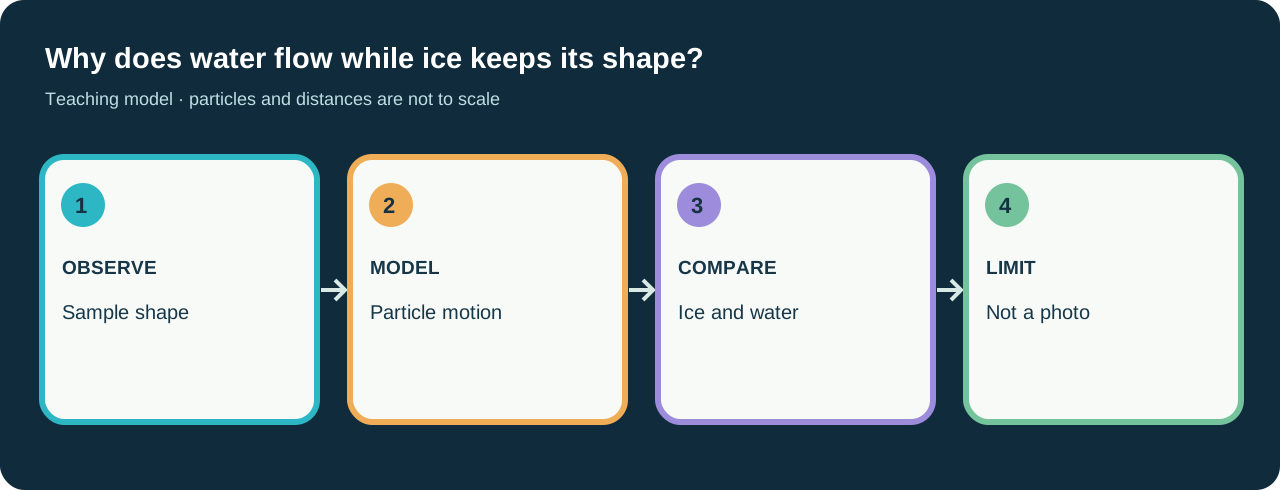
Teaching model · particles and distances are not to scale
Situation and question
Compare water in a closed glass with an ice cube on a plate. Their shapes differ, yet both samples consist mainly of H₂O. Did the molecules themselves change, or did their arrangement change?
New terms, fully explained
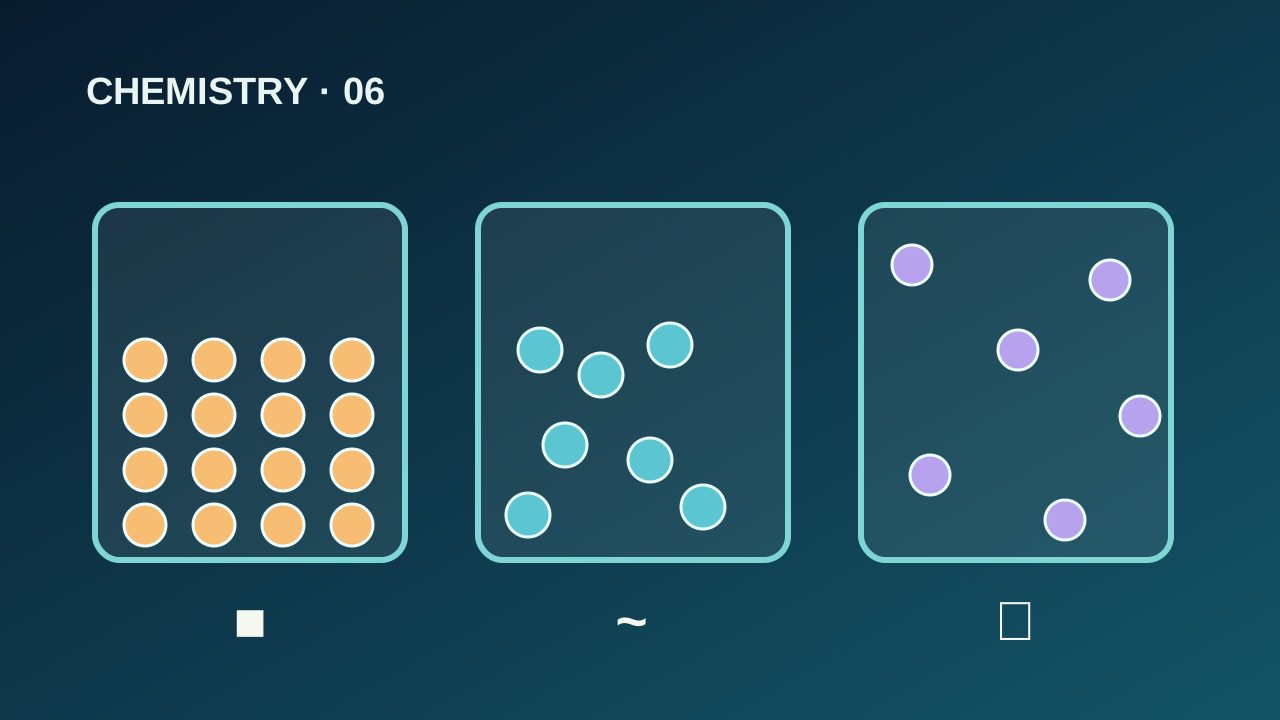
Particle is a useful general word for an atom, molecule or ion. A particle model describes an unseen level and is tested through observable consequences. In a solid, particles generally vibrate around stable positions; in a liquid they stay near one another but can change neighbours; in a gas their separations are much larger. This is not a literal picture of water.
Predict first
Predict whether liquid water keeps the shape of a rectangular container when poured into a round one. What about ice? Record your explanation before observing.
Investigate or analyse given data
Pour only room-temperature water between two safe containers. Do not heat or taste anything. Observe ice without holding it for long. Without materials, use these observations: water takes its container’s shape; ice retains its shape until it melts; air occupies the available space.
Worked example
Water in a glass and on a plate remains water. In the model, its molecules move relative to their neighbours. Melting ice does not split H₂O molecules into hydrogen and oxygen atoms; their motion and arrangement change. A gas should not be drawn as a tightly packed layer at the bottom of an otherwise empty vessel.
A common mistake
Mistake: particles in a solid do not move at all, or a gas contains no particles. A simplified diagram does not show real paths, sizes or forces. State alone cannot reveal the substance’s composition.
Transfer to a new case
A sealed bag of air changes shape under gentle pressure. How is this different from pouring water? Name the observation separately from the model-based explanation.
Answer and recall
Check: gas compresses more easily than liquid, so the bag’s volume can change more readily. Draw three equal frames for solid, liquid and gas; arrange symbolic particles and label the drawings ’not to scale’. Tomorrow explain without the drawing what remains the same when ice melts.
Knowledge check
- Why does ice keep its shape?
- What survives melting?
Answers: Particles vibrate near stable positions; H₂O molecules remain.
When to revisit
Close the page and, after 10 minutes, reconstruct the map, define the terms in your own words and solve the new case. Repeat without hints after a day and a week. If an error persists, return to the worked example and write down the missing step.
Recovering salt from a mixture: settling, filtering, evaporation
If you have found a mistake or a typo in this article, tell us about it
Comments (0)
Log in to leave a comment →
No comments yet. Be the first.