

Chemistry: investigate the world of substances Lesson 9 of 13
What is inside an atom?
Use paper cards to reason about the nucleus, electrons and electric charge.
Support map
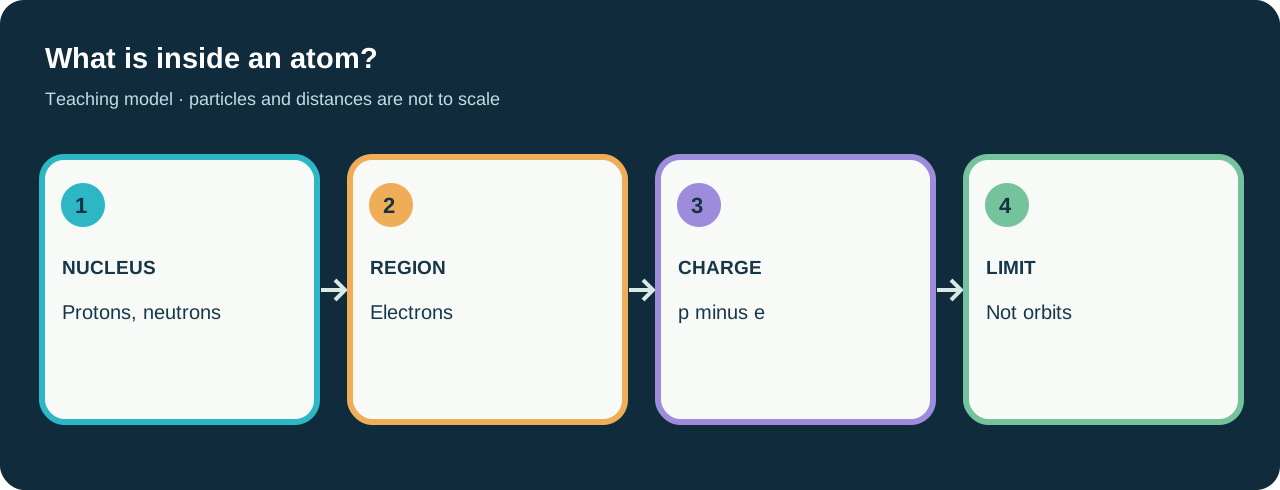
Teaching model · particles and distances are not to scale
Situation and question
How can an atom as a whole be neutral when it contains positively charged particles? We must account for negative charge too.
New terms, fully explained
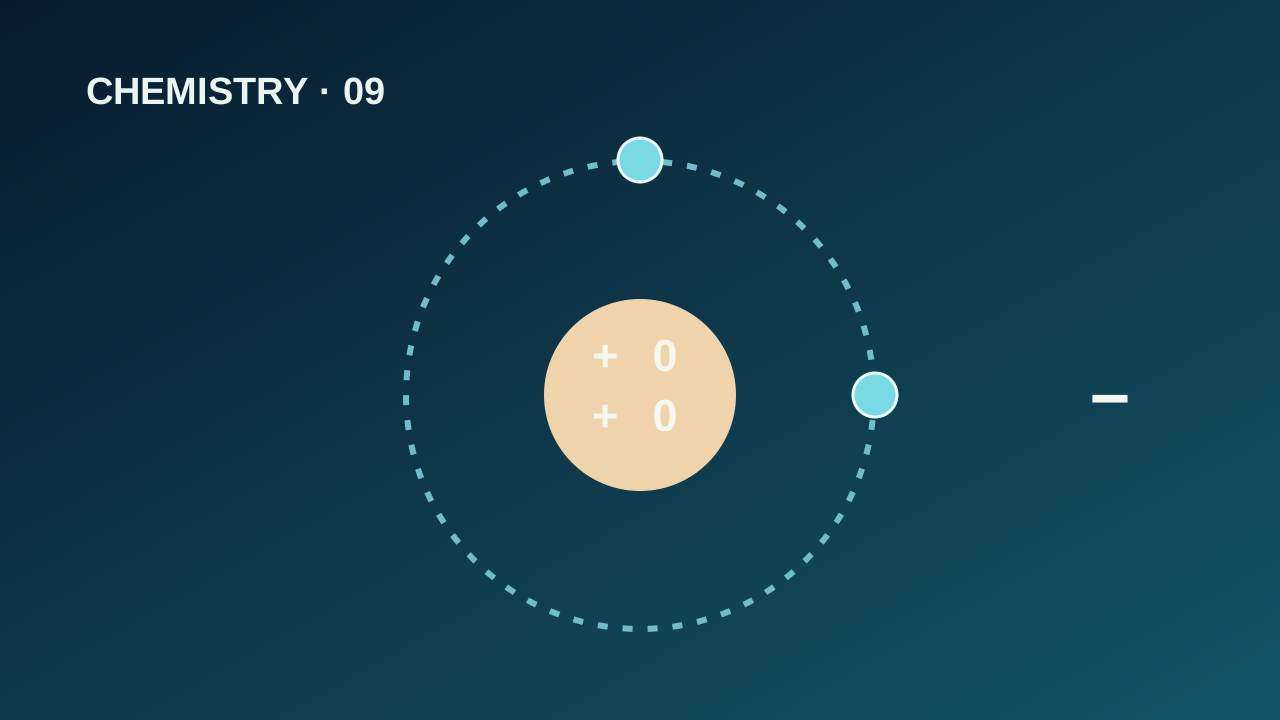
The nucleus is the tiny central region containing protons and neutrons; it holds almost all of an atom’s mass. A neutron has no electric charge. An electron has negative charge and occupies a region around the nucleus. A neutral atom has equal numbers of electrons and protons. An ion forms when an atom or group of atoms loses or gains electrons. Drawn circles are a classroom aid, not planetary electron paths.
Predict first
Predict the charge of a particle with three protons and two electrons. What if it has four electrons? Do neutrons affect the sign?
Investigate or analyse given data
Use paper cards labelled ‘+’, ‘0’ and ‘−’; connect no electrical equipment. Case A has three protons, four neutrons and three electrons. Case B has the same nucleus and two electrons. Case C has the same nucleus and four electrons. Add charges only, treating their unit magnitudes as equal.
Worked example
A is neutral: +3 and −3 sum to zero. B has charge +1 and C has charge −1. All three are the same element, atomic number three, because proton count stays fixed. Cards count charge correctly but do not locate electrons precisely.
A common mistake
Mistake: including neutrons in a charge sum or claiming loss of an electron creates a new element. The nucleus in classroom diagrams is vastly oversized compared with the atom; separations and electron clouds are simplified.
Transfer to a new case
A particle has eight protons, eight neutrons and ten electrons. What element and formal charge does it have? Do these numbers prove it exists as a free ion in a glass of water?
Answer and recall
Check: it is oxygen with formal charge −2. The count alone cannot establish its stability or environment. Close the page and explain why protons define the element while the proton–electron difference defines charge.
Knowledge check
- How many electrons in a neutral atom with three protons?
- Charge with two electrons?
Answers: Three; +1.
When to revisit
Close the page and, after 10 minutes, reconstruct the map, define the terms in your own words and solve the new case. Repeat without hints after a day and a week. If an error persists, return to the worked example and write down the missing step.
If you have found a mistake or a typo in this article, tell us about it
Comments (0)
Log in to leave a comment →
No comments yet. Be the first.