

Chemistry: investigate the world of substances Lesson 37 of 40
Why can a balance reading change when atoms are conserved?
Define the system boundary and account for material entering, leaving and measurement uncertainty.
Support map
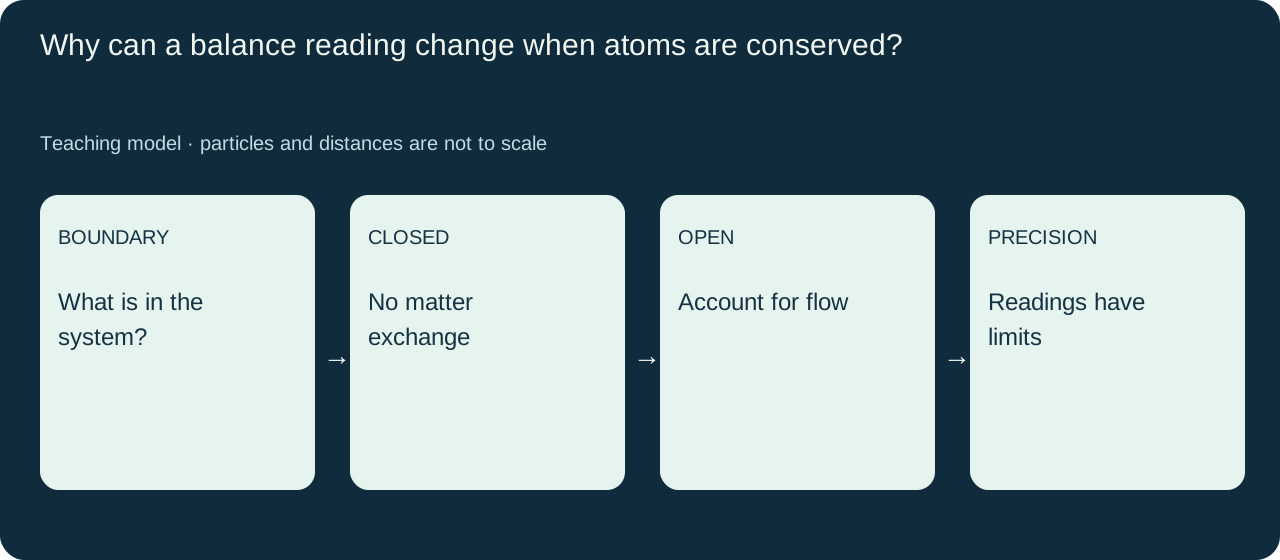
Model diagram
Use paper and supplied data only. Do not produce gases, heat substances or use electrical equipment; do not touch, taste or smell unknown substances.
Situation and question
One teaching report gives a whole apparatus mass of 100.00 g before and after. Another open apparatus changes from 100.00 to 97.00 g. A learner calls the second result a violation of conservation. First draw the weighing boundary. Never seal a gas-producing reaction: a closed system here is only a problem condition.
New terms, fully explained
A system is the part of the world selected for analysis; its surroundings are everything else. A closed system exchanges no matter with the surroundings but may exchange energy. In ordinary chemical exercises, the mass of all accounted material is conserved within measurement accuracy. An open-system balance must include material crossing its boundary.
Predict first
Predict whether an invisible gas has mass. Does a metal gaining mass during oxidation mean atoms appeared from nothing? Distinguish the metal piece from metal plus all the original air. Select the object before calculating.
Investigate or analyse given data
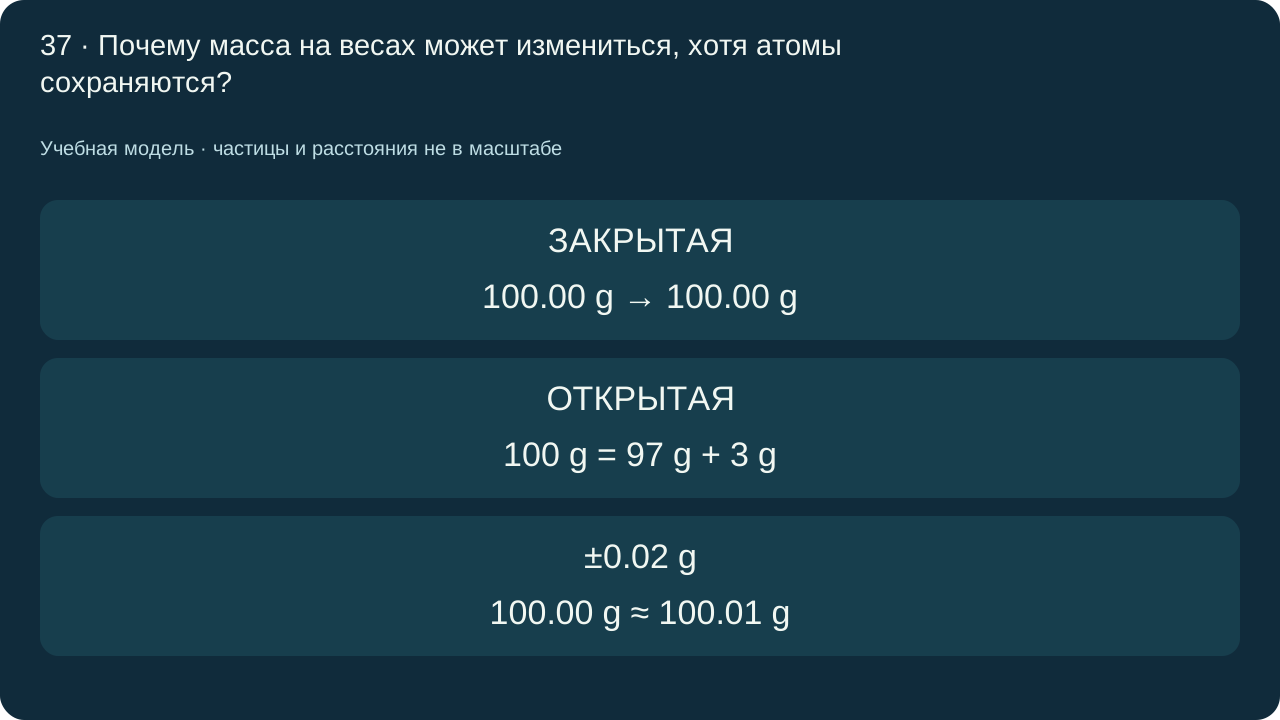
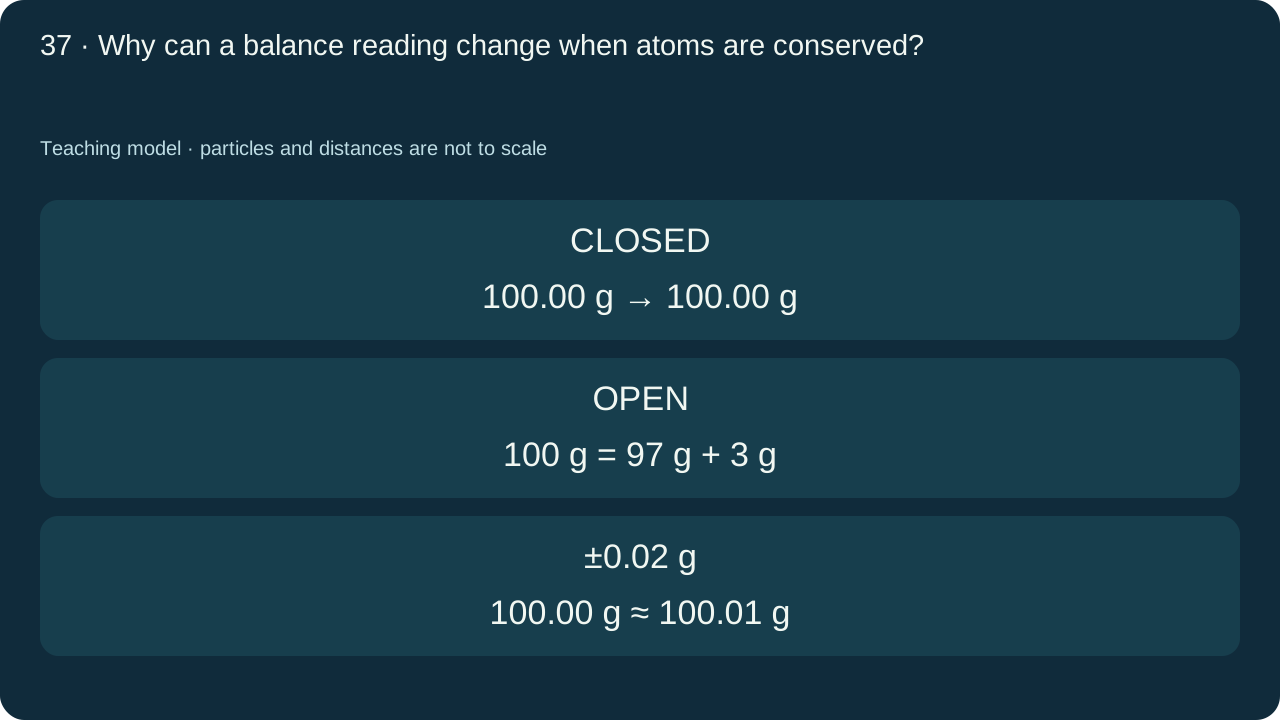
Given balances are: closed system 100.00 → 100.00 g; open system 100.00 → 97.00 g with 3.00 g of escaped gas separately accounted for; metal 10.00 → 12.00 g after 2.00 g oxygen joins it. Calculate each balance. These supplied numbers are not instructions to heat metal or collect gas.
100 = 97 + 3; 10 + 2 = 12
| Data / element | Before / left | After / right |
|---|---|---|
| g | 100.00 | 100.00 |
| g | 100 | 97 + 3 |
| g | 10 + 2 | 12 |
Worked example
For the open case, 97.00+3.00=100.00 g: mass has crossed the weighing boundary rather than vanished. For metal, 10.00+2.00=12.00 g: oxygen supplies the added mass. The closed-system comparison includes the entire apparatus and contents rather than one selected product.
A common mistake
Mistake: calling gas weightless or interpreting every difference as chemical destruction of mass. Measurements have uncertainty: 100.00 and 100.01 g, each with uncertainty ±0.02 g, do not establish a significant change. Leaks, evaporation, transferred droplets or accounting errors can also cause differences.
Transfer to a new case
An open system starts at 64.00 g and ends at 61.50 g with no incoming material. How much left if other losses are absent? Can that difference identify the gas formula? Separately consider 1.20 g oxygen entering an 8.80 g sample.
Answer and recall
Check: 2.50 g left, but its gas formula is not established; the second sample becomes 10.00 g without other flows. Recall “initial mass + incoming = final mass + outgoing”. Apply the boundary before assessing uncertainty. Atom balance and good mass accounting do not replace identification of unknown products.
Exercise
- Open system: 100 → 97 g, only gas leaves. Its mass?
- Metal: 10 → 12 g, only O₂ enters. How much enters?
- Do 100.00 and 100.01 g, each ±0.02 g, prove a loss?
Answers
Show the answers
3 g; 2 g; no, the difference is smaller than the stated uncertainty. Include incoming and outgoing matter in the balance.
Investigator’s notebook
For each error, identify its cause: wrong composition, changed subscript, missing atom, neglected system boundary, or confusion between heat and temperature. Correct your explanation and check another example without hints.
When to revisit
Close the page and, after 10 minutes, reconstruct the map, define the terms in your own words and solve the new case. Repeat without hints after a day and a week. If an error persists, return to the worked example and write down the missing step.
Sources and limits
How do we balance bracketed formulas without losing atoms?
Why do some reactions warm their surroundings while others cool them?
If you have found a mistake or a typo in this article, tell us about it
Comments (0)
Log in to leave a comment →
No comments yet. Be the first.